

particle size distribution of small particles is indispensable, as even a few larger
particles will contribute more than proportionally to the scattering power. When d is
the optically active particle size, it is important to note that this is the size of the
nanoparticle clusters (if present). As clusters of particles cause a dramatic increase
in the light scattering, Eq. (9.2) does not allow for the presence of any clusters of
particles in applications requiring transparent dispersions.
Equation (9.1) indicates that a certain index of refraction may be adjusted either by
a smaller fraction c of nanoparticles with a higher index of refraction or by a larger
fraction of particles with a lower index of refraction. Equations (9.1) and (9.2) give no
clue as to which of these two possibilities is better, but one possible answer may be
obtained by considering the concentration. For statistical reasons, it is unavoidable
that – even under the assumption of perfect blending – clusters consisting of two or
more particles will occur.
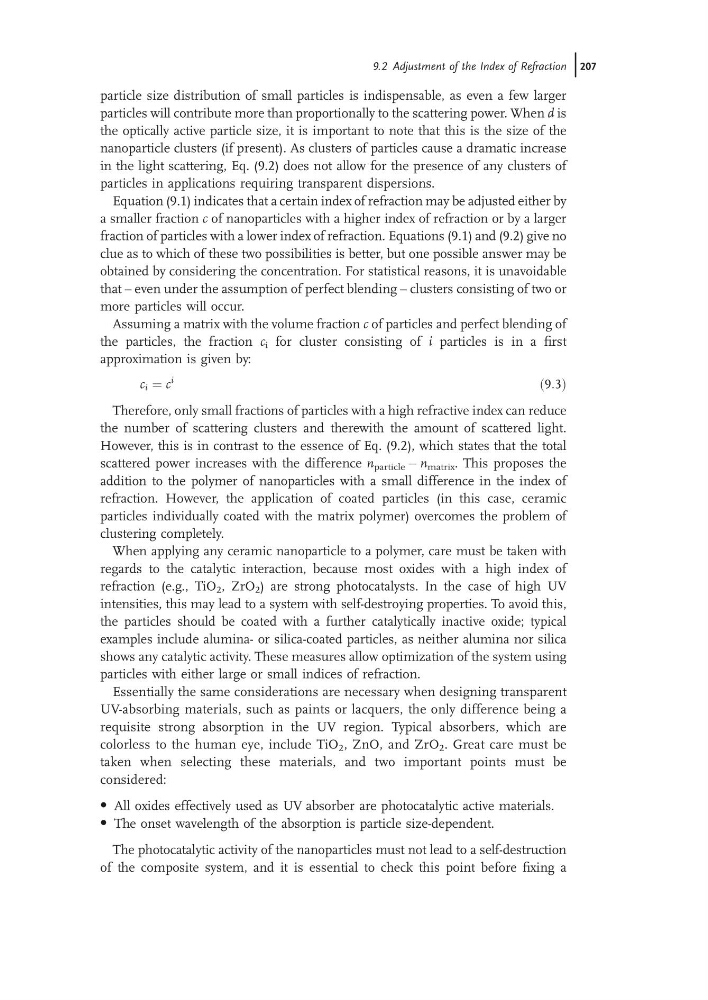
Assuming a matrix with the volume fraction c of particles and perfect blending of
the particles, the fraction c i for cluster consisting of i particles is in a first
approximation is given by:
c i ¼ c
i
ð9:3Þ
Therefore, only small fractions of particles with a high refractive index can reduce
the number of scattering clusters and therewith the amount of scattered light.
However, this is in contrast to the essence of Eq. (9.2), which states that the total
scattered power increases with the difference n particle À n matrix . This proposes the
addition to the polymer of nanoparticles with a small difference in the index of
refraction. However, the application of coated particles (in this case, ceramic
particles individually coated with the matrix polymer) overcomes the problem of
clustering completely.
When applying any ceramic nanoparticle to a polymer, care must be taken with
regards to the catalytic interaction, because most oxides with a high index of
refraction (e.g., TiO 2 , ZrO 2 ) are strong photocatalysts. In the case of high UV
intensities, this may lead to a system with self-destroying properties. To avoid this,
the particles should be coated with a further catalytically inactive oxide; typical
examples include alumina- or silica-coated particles, as neither alumina nor silica
shows any catalytic activity. These measures allow optimization of the system using
particles with either large or small indices of refraction.
Essentially the same considerations are necessary when designing transparent
UV-absorbing materials, such as paints or lacquers, the only difference being a
requisite strong absorption in the UV region. Typical absorbers, which are
colorless to the human eye, include TiO 2 , ZnO, and ZrO 2 . Great care must be
taken when selecting these materials, and two important points must be
considered:
All oxides effectively used as UV absorber are photocatalytic active materials.
The onset wavelength of the absorption is particle size-dependent.
The photocatalytic activity of the nanoparticles must not lead to a self-destruction
of the composite system, and it is essential to check this point before fixing a
9.2 Adjustment of the Index of Refraction j207
particles will contribute more than proportionally to the scattering power. When d is
the optically active particle size, it is important to note that this is the size of the
nanoparticle clusters (if present). As clusters of particles cause a dramatic increase
in the light scattering, Eq. (9.2) does not allow for the presence of any clusters of
particles in applications requiring transparent dispersions.
Equation (9.1) indicates that a certain index of refraction may be adjusted either by
a smaller fraction c of nanoparticles with a higher index of refraction or by a larger
fraction of particles with a lower index of refraction. Equations (9.1) and (9.2) give no
clue as to which of these two possibilities is better, but one possible answer may be
obtained by considering the concentration. For statistical reasons, it is unavoidable
that – even under the assumption of perfect blending – clusters consisting of two or
more particles will occur.
Assuming a matrix with the volume fraction c of particles and perfect blending of
the particles, the fraction c i for cluster consisting of i particles is in a first
approximation is given by:
c i ¼ c
i
ð9:3Þ
Therefore, only small fractions of particles with a high refractive index can reduce
the number of scattering clusters and therewith the amount of scattered light.
However, this is in contrast to the essence of Eq. (9.2), which states that the total
scattered power increases with the difference n particle À n matrix . This proposes the
addition to the polymer of nanoparticles with a small difference in the index of
refraction. However, the application of coated particles (in this case, ceramic
particles individually coated with the matrix polymer) overcomes the problem of
clustering completely.
When applying any ceramic nanoparticle to a polymer, care must be taken with
regards to the catalytic interaction, because most oxides with a high index of
refraction (e.g., TiO 2 , ZrO 2 ) are strong photocatalysts. In the case of high UV
intensities, this may lead to a system with self-destroying properties. To avoid this,
the particles should be coated with a further catalytically inactive oxide; typical
examples include alumina- or silica-coated particles, as neither alumina nor silica
shows any catalytic activity. These measures allow optimization of the system using
particles with either large or small indices of refraction.
Essentially the same considerations are necessary when designing transparent
UV-absorbing materials, such as paints or lacquers, the only difference being a
requisite strong absorption in the UV region. Typical absorbers, which are
colorless to the human eye, include TiO 2 , ZnO, and ZrO 2 . Great care must be
taken when selecting these materials, and two important points must be
considered:
All oxides effectively used as UV absorber are photocatalytic active materials.
The onset wavelength of the absorption is particle size-dependent.
The photocatalytic activity of the nanoparticles must not lead to a self-destruction
of the composite system, and it is essential to check this point before fixing a
9.2 Adjustment of the Index of Refraction j207