

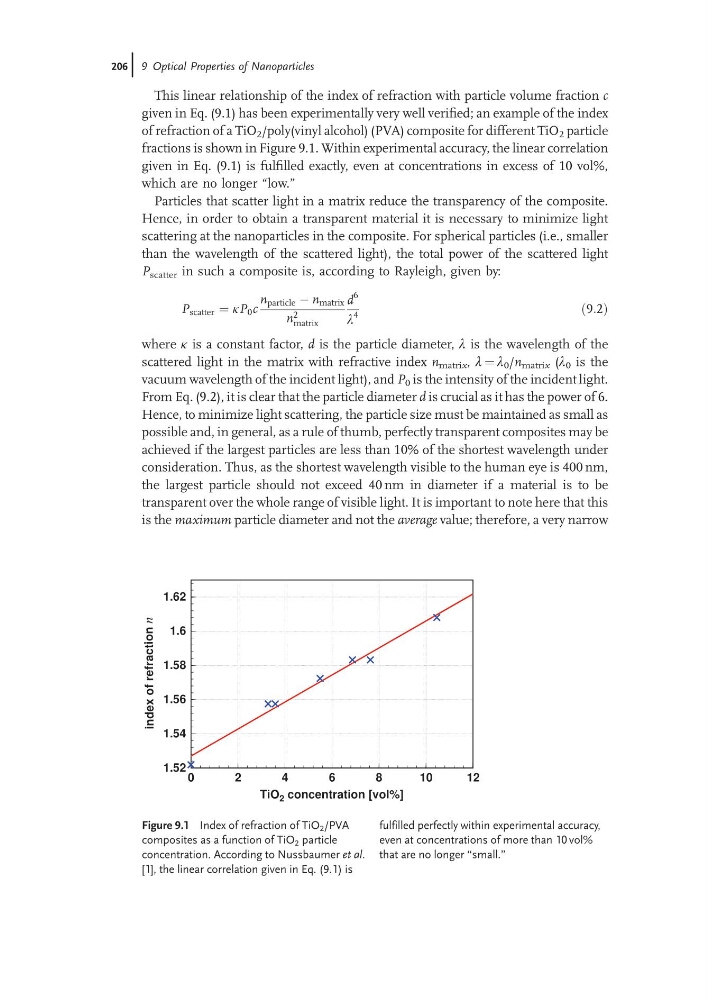
This linear relationship of the index of refraction with particle volume fraction c
given in Eq. (9.1) has been experimentally very well verified; an example of the index
of refraction of a TiO 2 /poly(vinyl alcohol) (PVA) composite for different TiO 2 particle
fractions is shown in Figure 9.1. Within experimental accuracy, the linear correlation
given in Eq. (9.1) is fulfilled exactly, even at concentrations in excess of 10 vol%,
which are no longer “low.”
Particles that scatter light in a matrix reduce the transparency of the composite.
Hence, in order to obtain a transparent material it is necessary to minimize light
scattering at the nanoparticles in the composite. For spherical particles (i.e., smaller
than the wavelength of the scattered light), the total power of the scattered light
P scatter in such a composite is, according to Rayleigh, given by:
P scatter ¼ kP 0 c
n particle À n matrix
n 2
matrix
d
6
l
4
ð9:2Þ
where k is a constant factor, d is the particle diameter, l is the wavelength of the
scattered light in the matrix with refractive index n matrix , l ¼ l 0 /n matrix (l 0 is the
vacuum wavelength of the incident light), and P 0 is the intensity of the incident light.
From Eq. (9.2), it is clear that the particle diameter d is crucial as it has the power of 6.
Hence, to minimize light scattering, the particle size must be maintained as small as
possible and, in general, as a rule of thumb, perfectly transparent composites may be
achieved if the largest particles are less than 10% of the shortest wavelength under
consideration. Thus, as the shortest wavelength visible to the human eye is 400 nm,
the largest particle should not exceed 40 nm in diameter if a material is to be
transparent over the whole range of visible light. It is important to note here that this
is the maximum particle diameter and not the average value; therefore, a very narrow
0
2
4
6
8
10
12
TiO 2 concentration [vol%]
1.52
1.54
1.56
1.58
1.6
1.62
index
of
refraction
n
Figure 9.1 Index of refraction of TiO 2 /PVA
composites as a function of TiO 2 particle
concentration. According to Nussbaumer et al.
[1], the linear correlation given in Eq. (9.1) is
fulfilled perfectly within experimental accuracy,
even at concentrations of more than 10 vol%
that are no longer “small.”
206j 9 Optical Properties of Nanoparticles
given in Eq. (9.1) has been experimentally very well verified; an example of the index
of refraction of a TiO 2 /poly(vinyl alcohol) (PVA) composite for different TiO 2 particle
fractions is shown in Figure 9.1. Within experimental accuracy, the linear correlation
given in Eq. (9.1) is fulfilled exactly, even at concentrations in excess of 10 vol%,
which are no longer “low.”
Particles that scatter light in a matrix reduce the transparency of the composite.
Hence, in order to obtain a transparent material it is necessary to minimize light
scattering at the nanoparticles in the composite. For spherical particles (i.e., smaller
than the wavelength of the scattered light), the total power of the scattered light
P scatter in such a composite is, according to Rayleigh, given by:
P scatter ¼ kP 0 c
n particle À n matrix
n 2
matrix
d
6
l
4
ð9:2Þ
where k is a constant factor, d is the particle diameter, l is the wavelength of the
scattered light in the matrix with refractive index n matrix , l ¼ l 0 /n matrix (l 0 is the
vacuum wavelength of the incident light), and P 0 is the intensity of the incident light.
From Eq. (9.2), it is clear that the particle diameter d is crucial as it has the power of 6.
Hence, to minimize light scattering, the particle size must be maintained as small as
possible and, in general, as a rule of thumb, perfectly transparent composites may be
achieved if the largest particles are less than 10% of the shortest wavelength under
consideration. Thus, as the shortest wavelength visible to the human eye is 400 nm,
the largest particle should not exceed 40 nm in diameter if a material is to be
transparent over the whole range of visible light. It is important to note here that this
is the maximum particle diameter and not the average value; therefore, a very narrow
0
2
4
6
8
10
12
TiO 2 concentration [vol%]
1.52
1.54
1.56
1.58
1.6
1.62
index
of
refraction
n
Figure 9.1 Index of refraction of TiO 2 /PVA
composites as a function of TiO 2 particle
concentration. According to Nussbaumer et al.
[1], the linear correlation given in Eq. (9.1) is
fulfilled perfectly within experimental accuracy,
even at concentrations of more than 10 vol%
that are no longer “small.”
206j 9 Optical Properties of Nanoparticles