

FeSiBNbCu or FeZrB the constant of anisotropy is well below 10
3 J m
À3 and, in this
case, the estimated correlation volume is of macroscopic size. As the exchangecoupled particles act as one particle, the susceptibility as estimated according to
Eq. (8.10) leads to extreme high values, because the magnetic moment of each
particle becomes quadratic in the calculation of the susceptibility. However, in the
case of metallic particles, to avoid eddy current losses in the case of high-frequency
applications, it is an important prerequisite for successful application that each of
the particles is coated with a thin insulating layer. For technical applications, this
layer is produced either by oxidizing the surface of the particles or by coating with
silica. This design leads to soft magnetic materials with unmatched high susceptibilities for electronic applications.
Composite materials based on this design are already available commercially, with
typical examples being (Ni,Fe)/SiO 2 , Co/SiO 2 , Fe,Co/SiO 2 , NiFe 2 O 4 /SiO 2 , or (Ni,
Zn)Fe 2 O 4 /SiO 2 (http://www.inframat.com/magnetic.htm). Currently, research in
this area is generally related to processes for synthesis.
Nonetheless, recent developments have been heading in the direction of
increasing the frequency of application. Zhao et al. [24] have reported the details
of such a material that demonstrates typical room temperature magnetization
curves and where the magnetically active material was FeNi coated with silica (see
Figure 8.38). Here, the thickness of the coating is used as a parameter and it is
important to realize that in these magnetization curves hysteresis is not visible.
The size distribution of the particles was quite broad and ranged from 10 to
150 nm. As expected, with increasing thickness of the coating, the saturation
magnetization was seen to decrease, while the weight fraction of the magnetic
active fraction decreased (Figure 8.38). Nonetheless, the saturation magnetization
was remarkably high.
Perhaps the most important characteristic of this type of material is the highfrequency behavior. The major part of the susceptibility m
0 and the quality factor of
0
1000
2000
3000
4000
specific loss power [Wg -1 ]
Fe 3 O 4 15 nm
MnFe 2 O 3 15 nm
CoFe 2 O 3 12 nm
CoFe 2 O 3 / MnFe 2 O 3
Zn 0.4 Co 0.6 Fe 2 O 3 / Zn 0.4 Mn 0.6 Fe 2 O 3
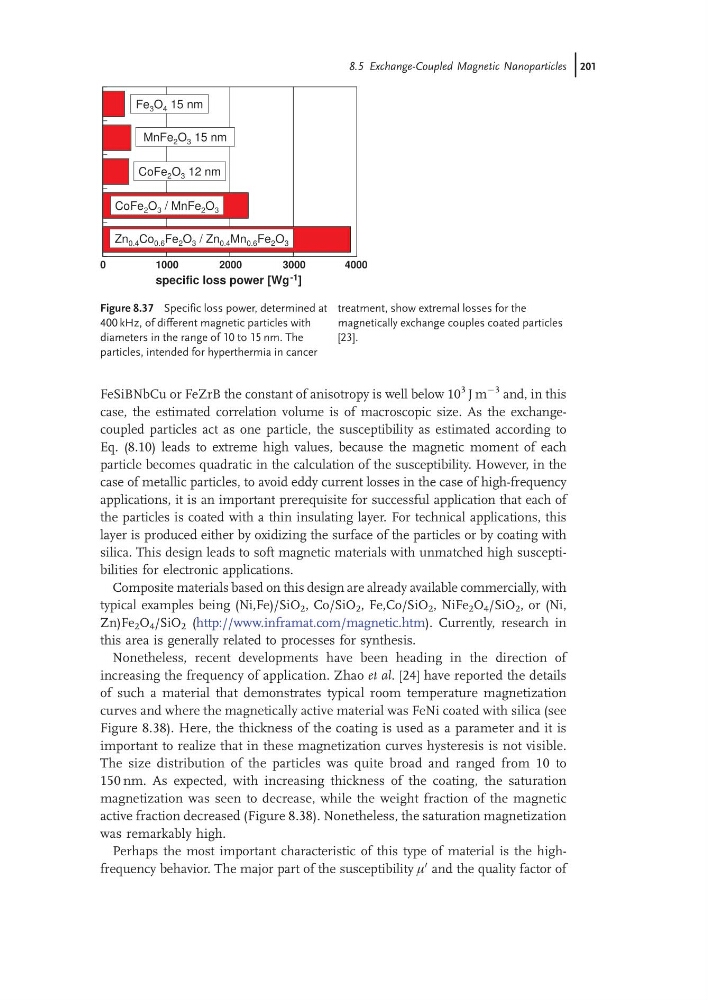
Figure 8.37 Specific loss power, determined at
400 kHz, of different magnetic particles with
diameters in the range of 10 to 15 nm. The
particles, intended for hyperthermia in cancer
treatment, show extremal losses for the
magnetically exchange couples coated particles
[23].
8.5 Exchange-Coupled Magnetic Nanoparticles j201
3 J m
À3 and, in this
case, the estimated correlation volume is of macroscopic size. As the exchangecoupled particles act as one particle, the susceptibility as estimated according to
Eq. (8.10) leads to extreme high values, because the magnetic moment of each
particle becomes quadratic in the calculation of the susceptibility. However, in the
case of metallic particles, to avoid eddy current losses in the case of high-frequency
applications, it is an important prerequisite for successful application that each of
the particles is coated with a thin insulating layer. For technical applications, this
layer is produced either by oxidizing the surface of the particles or by coating with
silica. This design leads to soft magnetic materials with unmatched high susceptibilities for electronic applications.
Composite materials based on this design are already available commercially, with
typical examples being (Ni,Fe)/SiO 2 , Co/SiO 2 , Fe,Co/SiO 2 , NiFe 2 O 4 /SiO 2 , or (Ni,
Zn)Fe 2 O 4 /SiO 2 (http://www.inframat.com/magnetic.htm). Currently, research in
this area is generally related to processes for synthesis.
Nonetheless, recent developments have been heading in the direction of
increasing the frequency of application. Zhao et al. [24] have reported the details
of such a material that demonstrates typical room temperature magnetization
curves and where the magnetically active material was FeNi coated with silica (see
Figure 8.38). Here, the thickness of the coating is used as a parameter and it is
important to realize that in these magnetization curves hysteresis is not visible.
The size distribution of the particles was quite broad and ranged from 10 to
150 nm. As expected, with increasing thickness of the coating, the saturation
magnetization was seen to decrease, while the weight fraction of the magnetic
active fraction decreased (Figure 8.38). Nonetheless, the saturation magnetization
was remarkably high.
Perhaps the most important characteristic of this type of material is the highfrequency behavior. The major part of the susceptibility m
0 and the quality factor of
0
1000
2000
3000
4000
specific loss power [Wg -1 ]
Fe 3 O 4 15 nm
MnFe 2 O 3 15 nm
CoFe 2 O 3 12 nm
CoFe 2 O 3 / MnFe 2 O 3
Zn 0.4 Co 0.6 Fe 2 O 3 / Zn 0.4 Mn 0.6 Fe 2 O 3
Figure 8.37 Specific loss power, determined at
400 kHz, of different magnetic particles with
diameters in the range of 10 to 15 nm. The
particles, intended for hyperthermia in cancer
treatment, show extremal losses for the
magnetically exchange couples coated particles
[23].
8.5 Exchange-Coupled Magnetic Nanoparticles j201