

where the darker region represents the Fe 58 Pt 42 particles and the lighter ring the
Fe 3 O 4 coating.
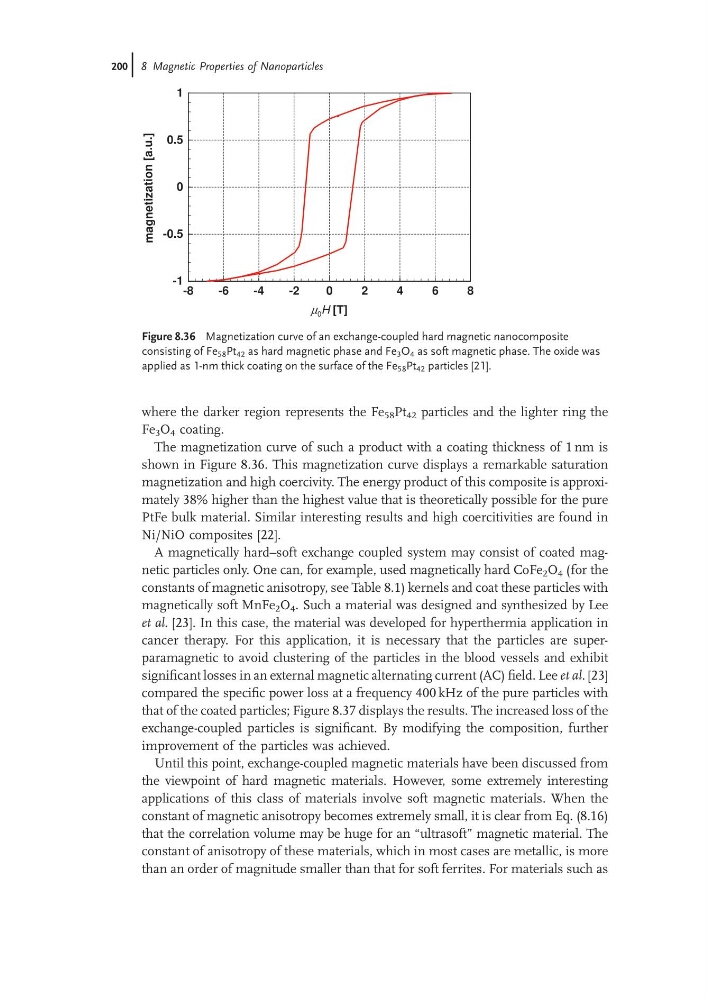
The magnetization curve of such a product with a coating thickness of 1 nm is
shown in Figure 8.36. This magnetization curve displays a remarkable saturation
magnetization and high coercivity. The energy product of this composite is approximately 38% higher than the highest value that is theoretically possible for the pure
PtFe bulk material. Similar interesting results and high coercitivities are found in
Ni/NiO composites [22].
A magnetically hard–soft exchange coupled system may consist of coated magnetic particles only. One can, for example, used magnetically hard CoFe 2 O 4 (for the
constants of magnetic anisotropy, see Table 8.1) kernels and coat these particles with
magnetically soft MnFe 2 O 4 . Such a material was designed and synthesized by Lee
et al. [23]. In this case, the material was developed for hyperthermia application in
cancer therapy. For this application, it is necessary that the particles are superparamagnetic to avoid clustering of the particles in the blood vessels and exhibit
significant losses in an external magnetic alternating current (AC) field. Lee et al. [23]
compared the specific power loss at a frequency 400 kHz of the pure particles with
that of the coated particles; Figure 8.37 displays the results. The increased loss of the
exchange-coupled particles is significant. By modifying the composition, further
improvement of the particles was achieved.
Until this point, exchange-coupled magnetic materials have been discussed from
the viewpoint of hard magnetic materials. However, some extremely interesting
applications of this class of materials involve soft magnetic materials. When the
constant of magnetic anisotropy becomes extremely small, it is clear from Eq. (8.16)
that the correlation volume may be huge for an “ultrasoft” magnetic material. The
constant of anisotropy of these materials, which in most cases are metallic, is more
than an order of magnitude smaller than that for soft ferrites. For materials such as
-8
-6
-4
-2
0
2
4
6
8
-1
-0.5
0
0.5
1
magnetization
[a.u.]
μ 0 H [T]
Figure 8.36 Magnetization curve of an exchange-coupled hard magnetic nanocomposite
consisting of Fe 58 Pt 42 as hard magnetic phase and Fe 3 O 4 as soft magnetic phase. The oxide was
applied as 1-nm thick coating on the surface of the Fe 58 Pt 42 particles [21].
200j 8 Magnetic Properties of Nanoparticles
Fe 3 O 4 coating.
The magnetization curve of such a product with a coating thickness of 1 nm is
shown in Figure 8.36. This magnetization curve displays a remarkable saturation
magnetization and high coercivity. The energy product of this composite is approximately 38% higher than the highest value that is theoretically possible for the pure
PtFe bulk material. Similar interesting results and high coercitivities are found in
Ni/NiO composites [22].
A magnetically hard–soft exchange coupled system may consist of coated magnetic particles only. One can, for example, used magnetically hard CoFe 2 O 4 (for the
constants of magnetic anisotropy, see Table 8.1) kernels and coat these particles with
magnetically soft MnFe 2 O 4 . Such a material was designed and synthesized by Lee
et al. [23]. In this case, the material was developed for hyperthermia application in
cancer therapy. For this application, it is necessary that the particles are superparamagnetic to avoid clustering of the particles in the blood vessels and exhibit
significant losses in an external magnetic alternating current (AC) field. Lee et al. [23]
compared the specific power loss at a frequency 400 kHz of the pure particles with
that of the coated particles; Figure 8.37 displays the results. The increased loss of the
exchange-coupled particles is significant. By modifying the composition, further
improvement of the particles was achieved.
Until this point, exchange-coupled magnetic materials have been discussed from
the viewpoint of hard magnetic materials. However, some extremely interesting
applications of this class of materials involve soft magnetic materials. When the
constant of magnetic anisotropy becomes extremely small, it is clear from Eq. (8.16)
that the correlation volume may be huge for an “ultrasoft” magnetic material. The
constant of anisotropy of these materials, which in most cases are metallic, is more
than an order of magnitude smaller than that for soft ferrites. For materials such as
-8
-6
-4
-2
0
2
4
6
8
-1
-0.5
0
0.5
1
magnetization
[a.u.]
μ 0 H [T]
Figure 8.36 Magnetization curve of an exchange-coupled hard magnetic nanocomposite
consisting of Fe 58 Pt 42 as hard magnetic phase and Fe 3 O 4 as soft magnetic phase. The oxide was
applied as 1-nm thick coating on the surface of the Fe 58 Pt 42 particles [21].
200j 8 Magnetic Properties of Nanoparticles