

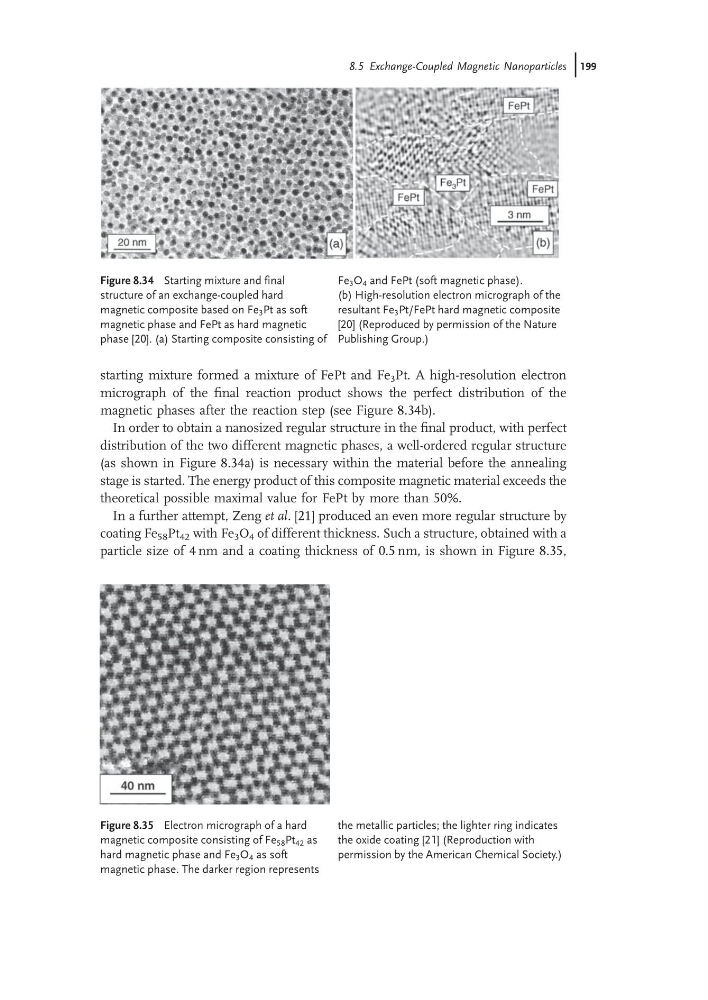
starting mixture formed a mixture of FePt and Fe 3 Pt. A high-resolution electron
micrograph of the final reaction product shows the perfect distribution of the
magnetic phases after the reaction step (see Figure 8.34b).
In order to obtain a nanosized regular structure in the final product, with perfect
distribution of the two different magnetic phases, a well-ordered regular structure
(as shown in Figure 8.34a) is necessary within the material before the annealing
stage is started. The energy product of this composite magnetic material exceeds the
theoretical possible maximal value for FePt by more than 50%.
In a further attempt, Zeng et al. [21] produced an even more regular structure by
coating Fe 58 Pt 42 with Fe 3 O 4 of different thickness. Such a structure, obtained with a
particle size of 4 nm and a coating thickness of 0.5 nm, is shown in Figure 8.35,
Figure 8.34 Starting mixture and final
structure of an exchange-coupled hard
magnetic composite based on Fe 3 Pt as soft
magnetic phase and FePt as hard magnetic
phase [20]. (a) Starting composite consisting of
Fe 3 O 4 and FePt (soft magnetic phase).
(b) High-resolution electron micrograph of the
resultant Fe 3 Pt/FePt hard magnetic composite
[20] (Reproduced by permission of the Nature
Publishing Group.)
Figure 8.35 Electron micrograph of a hard
magnetic composite consisting of Fe 58 Pt 42 as
hard magnetic phase and Fe 3 O 4 as soft
magnetic phase. The darker region represents
the metallic particles; the lighter ring indicates
the oxide coating [21] (Reproduction with
permission by the American Chemical Society.)
8.5 Exchange-Coupled Magnetic Nanoparticles j199
micrograph of the final reaction product shows the perfect distribution of the
magnetic phases after the reaction step (see Figure 8.34b).
In order to obtain a nanosized regular structure in the final product, with perfect
distribution of the two different magnetic phases, a well-ordered regular structure
(as shown in Figure 8.34a) is necessary within the material before the annealing
stage is started. The energy product of this composite magnetic material exceeds the
theoretical possible maximal value for FePt by more than 50%.
In a further attempt, Zeng et al. [21] produced an even more regular structure by
coating Fe 58 Pt 42 with Fe 3 O 4 of different thickness. Such a structure, obtained with a
particle size of 4 nm and a coating thickness of 0.5 nm, is shown in Figure 8.35,
Figure 8.34 Starting mixture and final
structure of an exchange-coupled hard
magnetic composite based on Fe 3 Pt as soft
magnetic phase and FePt as hard magnetic
phase [20]. (a) Starting composite consisting of
Fe 3 O 4 and FePt (soft magnetic phase).
(b) High-resolution electron micrograph of the
resultant Fe 3 Pt/FePt hard magnetic composite
[20] (Reproduced by permission of the Nature
Publishing Group.)
Figure 8.35 Electron micrograph of a hard
magnetic composite consisting of Fe 58 Pt 42 as
hard magnetic phase and Fe 3 O 4 as soft
magnetic phase. The darker region represents
the metallic particles; the lighter ring indicates
the oxide coating [21] (Reproduction with
permission by the American Chemical Society.)
8.5 Exchange-Coupled Magnetic Nanoparticles j199