

It can be seen in Figure 8.32 that the combination of hard and soft magnetic
materials produces a new hard magnetic material with a significantly higher
remanence, but the coercivity is essentially unchanged. This design allows the
production of permanent magnets with higher energy products (energy product ¼
coercivity  remanence) than are possible using conventional designs. It must also
be noted that, in general, hard magnetic materials are significantly more expensive
than soft magnetic materials and therefore exchange-coupled hard magnetic materials are not only more effective, but also more economic – a rare combination!
Generally, it is possible to use either a hard or a soft magnetic material with the
appropriate inclusion of the other type of magnetic material. However, certain
experimentally well-supported theoretical reasons exist as to why the application of
hard magnetic islands in a soft magnetic matrix leads to the best possible results.
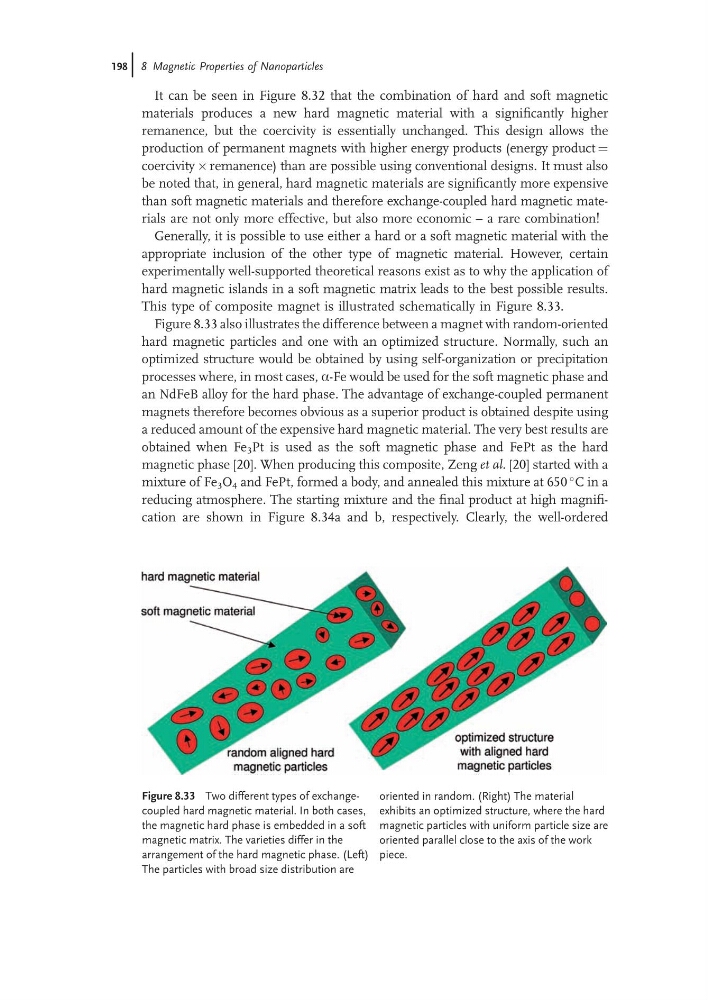
This type of composite magnet is illustrated schematically in Figure 8.33.
Figure 8.33 also illustrates the difference between a magnet with random-oriented
hard magnetic particles and one with an optimized structure. Normally, such an
optimized structure would be obtained by using self-organization or precipitation
processes where, in most cases, a-Fe would be used for the soft magnetic phase and
an NdFeB alloy for the hard phase. The advantage of exchange-coupled permanent
magnets therefore becomes obvious as a superior product is obtained despite using
a reduced amount of the expensive hard magnetic material. The very best results are
obtained when Fe 3 Pt is used as the soft magnetic phase and FePt as the hard
magnetic phase [20]. When producing this composite, Zeng et al. [20] started with a
mixture of Fe 3 O 4 and FePt, formed a body, and annealed this mixture at 650
C in a
reducing atmosphere. The starting mixture and the final product at high magnification are shown in Figure 8.34a and b, respectively. Clearly, the well-ordered
Figure 8.33 Two different types of exchangecoupled hard magnetic material. In both cases,
the magnetic hard phase is embedded in a soft
magnetic matrix. The varieties differ in the
arrangement of the hard magnetic phase. (Left)
The particles with broad size distribution are
oriented in random. (Right) The material
exhibits an optimized structure, where the hard
magnetic particles with uniform particle size are
oriented parallel close to the axis of the work
piece.
198j 8 Magnetic Properties of Nanoparticles
materials produces a new hard magnetic material with a significantly higher
remanence, but the coercivity is essentially unchanged. This design allows the
production of permanent magnets with higher energy products (energy product ¼
coercivity  remanence) than are possible using conventional designs. It must also
be noted that, in general, hard magnetic materials are significantly more expensive
than soft magnetic materials and therefore exchange-coupled hard magnetic materials are not only more effective, but also more economic – a rare combination!
Generally, it is possible to use either a hard or a soft magnetic material with the
appropriate inclusion of the other type of magnetic material. However, certain
experimentally well-supported theoretical reasons exist as to why the application of
hard magnetic islands in a soft magnetic matrix leads to the best possible results.
This type of composite magnet is illustrated schematically in Figure 8.33.
Figure 8.33 also illustrates the difference between a magnet with random-oriented
hard magnetic particles and one with an optimized structure. Normally, such an
optimized structure would be obtained by using self-organization or precipitation
processes where, in most cases, a-Fe would be used for the soft magnetic phase and
an NdFeB alloy for the hard phase. The advantage of exchange-coupled permanent
magnets therefore becomes obvious as a superior product is obtained despite using
a reduced amount of the expensive hard magnetic material. The very best results are
obtained when Fe 3 Pt is used as the soft magnetic phase and FePt as the hard
magnetic phase [20]. When producing this composite, Zeng et al. [20] started with a
mixture of Fe 3 O 4 and FePt, formed a body, and annealed this mixture at 650
C in a
reducing atmosphere. The starting mixture and the final product at high magnification are shown in Figure 8.34a and b, respectively. Clearly, the well-ordered
Figure 8.33 Two different types of exchangecoupled hard magnetic material. In both cases,
the magnetic hard phase is embedded in a soft
magnetic matrix. The varieties differ in the
arrangement of the hard magnetic phase. (Left)
The particles with broad size distribution are
oriented in random. (Right) The material
exhibits an optimized structure, where the hard
magnetic particles with uniform particle size are
oriented parallel close to the axis of the work
piece.
198j 8 Magnetic Properties of Nanoparticles