

moments [19]. It has been shown by Herzer that the size of the correlation volume is
given by:
V corr ¼
A
K
6 1
v 3 or N corr ¼
V corr
v
¼
A
K
6 1
v 4
ð8:16Þ
where V corr is the correlation volume, N corr is the number of particles within the
correlation volume, K is the constant of magnetic anisotropy, and v is the volume of
each particle, assuming that all particles are of equal size. A, which is the exchange
constant of nanoparticles, characterizes the process of exchange and is usually in the
range of 10
À12 J m
À1 . Equation (8.16) states that the correlation volume increases
with decreasing size of the particles and decreasing constant of anisotropy. In other
words, the exchange volume of hard magnetic materials is smaller than that of soft
magnetic materials. However, the correlation volume or equivalent number of
exchanging particles N corr is limited as the smallest size of the magnetic particles is
also limited. Assuming magnetic particles with a diameter of 5 nm, in most cases
the diameter of the correlation volume would be in the range of 100 nm.
The hard magnetic material proposed by Kneller consists of two different types of
magnetic particle: (i) a hard magnetic phase and (ii) a soft magnetic phase with a
constant of anisotropy that is at least two orders of magnitude smaller than that for the
hard magnetic phase. Provided that the particles are sufficiently small, the effective
constant of anisotropy of such a system is close to that of the hard magnetic phase, even
when both magnetic phases have equal volume fractions. The advantage of such an
exchange-coupled hard magnetic material is clear: normally, hard magnetic materials
have high coercivity and low saturation magnetization and remanence, whereas soft
magnetic materials are characterized by a very small coercivity and a high saturation
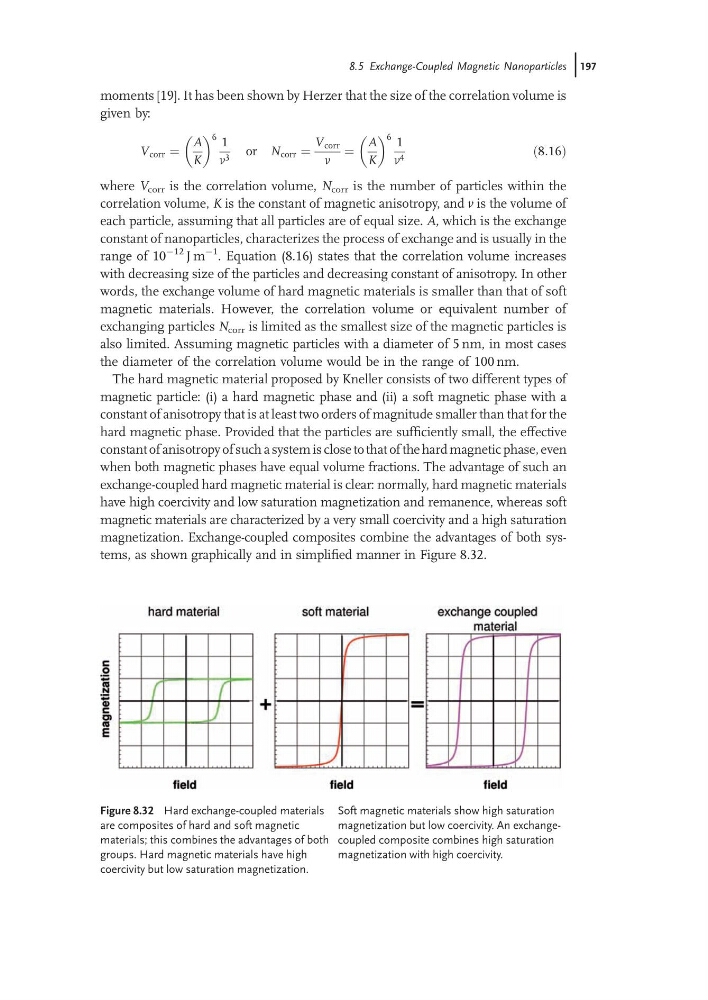
magnetization. Exchange-coupled composites combine the advantages of both systems, as shown graphically and in simplified manner in Figure 8.32.
Figure 8.32 Hard exchange-coupled materials
are composites of hard and soft magnetic
materials; this combines the advantages of both
groups. Hard magnetic materials have high
coercivity but low saturation magnetization.
Soft magnetic materials show high saturation
magnetization but low coercivity. An exchangecoupled composite combines high saturation
magnetization with high coercivity.
8.5 Exchange-Coupled Magnetic Nanoparticles j197
given by:
V corr ¼
A
K
6 1
v 3 or N corr ¼
V corr
v
¼
A
K
6 1
v 4
ð8:16Þ
where V corr is the correlation volume, N corr is the number of particles within the
correlation volume, K is the constant of magnetic anisotropy, and v is the volume of
each particle, assuming that all particles are of equal size. A, which is the exchange
constant of nanoparticles, characterizes the process of exchange and is usually in the
range of 10
À12 J m
À1 . Equation (8.16) states that the correlation volume increases
with decreasing size of the particles and decreasing constant of anisotropy. In other
words, the exchange volume of hard magnetic materials is smaller than that of soft
magnetic materials. However, the correlation volume or equivalent number of
exchanging particles N corr is limited as the smallest size of the magnetic particles is
also limited. Assuming magnetic particles with a diameter of 5 nm, in most cases
the diameter of the correlation volume would be in the range of 100 nm.
The hard magnetic material proposed by Kneller consists of two different types of
magnetic particle: (i) a hard magnetic phase and (ii) a soft magnetic phase with a
constant of anisotropy that is at least two orders of magnitude smaller than that for the
hard magnetic phase. Provided that the particles are sufficiently small, the effective
constant of anisotropy of such a system is close to that of the hard magnetic phase, even
when both magnetic phases have equal volume fractions. The advantage of such an
exchange-coupled hard magnetic material is clear: normally, hard magnetic materials
have high coercivity and low saturation magnetization and remanence, whereas soft
magnetic materials are characterized by a very small coercivity and a high saturation
magnetization. Exchange-coupled composites combine the advantages of both systems, as shown graphically and in simplified manner in Figure 8.32.
Figure 8.32 Hard exchange-coupled materials
are composites of hard and soft magnetic
materials; this combines the advantages of both
groups. Hard magnetic materials have high
coercivity but low saturation magnetization.
Soft magnetic materials show high saturation
magnetization but low coercivity. An exchangecoupled composite combines high saturation
magnetization with high coercivity.
8.5 Exchange-Coupled Magnetic Nanoparticles j197