

suspensions of superparamagnetic particles in a liquid. In order to avoid the
particles coagulating magnetically, they are coated with a second distance-holder
phase. Ferrofluids are discussed in greater detail in Section 6.3.
8.5
Exchange-Coupled Magnetic Nanoparticles
Based on the details of nanoparticle interaction described in previous chapters, it
might be concluded that this phenomenon is persistently disadvantageous.
However, it has been shown by Kneller that a wise combination of different
magnetic nanoparticles can provide significant improvements in the properties of
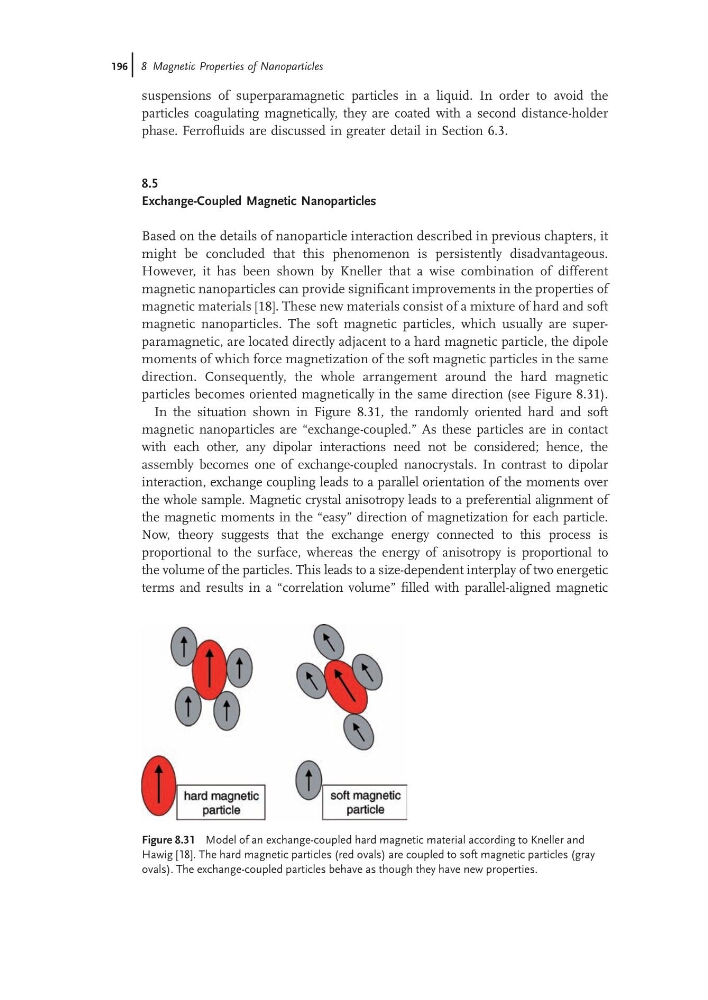
magnetic materials [18]. These new materials consist of a mixture of hard and soft
magnetic nanoparticles. The soft magnetic particles, which usually are superparamagnetic, are located directly adjacent to a hard magnetic particle, the dipole
moments of which force magnetization of the soft magnetic particles in the same
direction. Consequently, the whole arrangement around the hard magnetic
particles becomes oriented magnetically in the same direction (see Figure 8.31).
In the situation shown in Figure 8.31, the randomly oriented hard and soft
magnetic nanoparticles are “exchange-coupled.” As these particles are in contact
with each other, any dipolar interactions need not be considered; hence, the
assembly becomes one of exchange-coupled nanocrystals. In contrast to dipolar
interaction, exchange coupling leads to a parallel orientation of the moments over
the whole sample. Magnetic crystal anisotropy leads to a preferential alignment of
the magnetic moments in the “easy” direction of magnetization for each particle.
Now, theory suggests that the exchange energy connected to this process is
proportional to the surface, whereas the energy of anisotropy is proportional to
the volume of the particles. This leads to a size-dependent interplay of two energetic
terms and results in a “correlation volume” filled with parallel-aligned magnetic
Figure 8.31 Model of an exchange-coupled hard magnetic material according to Kneller and
Hawig [18]. The hard magnetic particles (red ovals) are coupled to soft magnetic particles (gray
ovals). The exchange-coupled particles behave as though they have new properties.
196j 8 Magnetic Properties of Nanoparticles
particles coagulating magnetically, they are coated with a second distance-holder
phase. Ferrofluids are discussed in greater detail in Section 6.3.
8.5
Exchange-Coupled Magnetic Nanoparticles
Based on the details of nanoparticle interaction described in previous chapters, it
might be concluded that this phenomenon is persistently disadvantageous.
However, it has been shown by Kneller that a wise combination of different
magnetic nanoparticles can provide significant improvements in the properties of
magnetic materials [18]. These new materials consist of a mixture of hard and soft
magnetic nanoparticles. The soft magnetic particles, which usually are superparamagnetic, are located directly adjacent to a hard magnetic particle, the dipole
moments of which force magnetization of the soft magnetic particles in the same
direction. Consequently, the whole arrangement around the hard magnetic
particles becomes oriented magnetically in the same direction (see Figure 8.31).
In the situation shown in Figure 8.31, the randomly oriented hard and soft
magnetic nanoparticles are “exchange-coupled.” As these particles are in contact
with each other, any dipolar interactions need not be considered; hence, the
assembly becomes one of exchange-coupled nanocrystals. In contrast to dipolar
interaction, exchange coupling leads to a parallel orientation of the moments over
the whole sample. Magnetic crystal anisotropy leads to a preferential alignment of
the magnetic moments in the “easy” direction of magnetization for each particle.
Now, theory suggests that the exchange energy connected to this process is
proportional to the surface, whereas the energy of anisotropy is proportional to
the volume of the particles. This leads to a size-dependent interplay of two energetic
terms and results in a “correlation volume” filled with parallel-aligned magnetic
Figure 8.31 Model of an exchange-coupled hard magnetic material according to Kneller and
Hawig [18]. The hard magnetic particles (red ovals) are coupled to soft magnetic particles (gray
ovals). The exchange-coupled particles behave as though they have new properties.
196j 8 Magnetic Properties of Nanoparticles