

this type of material compared to competing conventional (Co,Ni)Fe 2 O 4 ferrites are
shown graphically in Figures 8.39 and 8.40.
The data in Figure 8.39 show that, although the susceptibility of the new exchangecoupled material is less than that of a commercial cobalt/nickel ferrite, in contrast to
the ferrite the maximum frequency of application goes beyond 10
7 Hz, in this case at
least up to 10
8 Hz. (The frequency of application for this ferrite is limited by Bloch
wall resonance, as indicated in Figure 8.39, by an increase of susceptibility. During
-1
-0.5
0
0.5
1
-150
-100
-50
0
50
100
150
magnetic
moment
[Am
2 kg
-1 ]
no coating
3 nm SiO 2
6 nm SiO 2
9 nm SiO 2
μ 0 H [T]
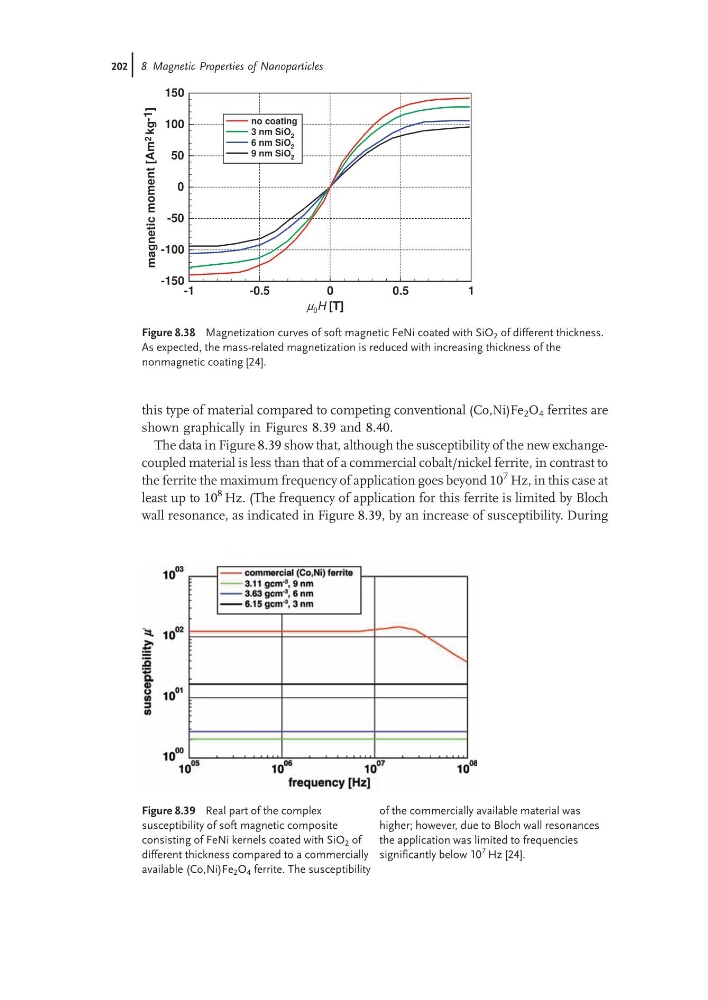
Figure 8.38 Magnetization curves of soft magnetic FeNi coated with SiO 2 of different thickness.
As expected, the mass-related magnetization is reduced with increasing thickness of the
nonmagnetic coating [24].
Figure 8.39 Real part of the complex
susceptibility of soft magnetic composite
consisting of FeNi kernels coated with SiO 2 of
different thickness compared to a commercially
available (Co,Ni)Fe 2 O 4 ferrite. The susceptibility
of the commercially available material was
higher; however, due to Bloch wall resonances
the application was limited to frequencies
significantly below 10
7 Hz [24].
202j 8 Magnetic Properties of Nanoparticles
shown graphically in Figures 8.39 and 8.40.
The data in Figure 8.39 show that, although the susceptibility of the new exchangecoupled material is less than that of a commercial cobalt/nickel ferrite, in contrast to
the ferrite the maximum frequency of application goes beyond 10
7 Hz, in this case at
least up to 10
8 Hz. (The frequency of application for this ferrite is limited by Bloch
wall resonance, as indicated in Figure 8.39, by an increase of susceptibility. During
-1
-0.5
0
0.5
1
-150
-100
-50
0
50
100
150
magnetic
moment
[Am
2 kg
-1 ]
no coating
3 nm SiO 2
6 nm SiO 2
9 nm SiO 2
μ 0 H [T]
Figure 8.38 Magnetization curves of soft magnetic FeNi coated with SiO 2 of different thickness.
As expected, the mass-related magnetization is reduced with increasing thickness of the
nonmagnetic coating [24].
Figure 8.39 Real part of the complex
susceptibility of soft magnetic composite
consisting of FeNi kernels coated with SiO 2 of
different thickness compared to a commercially
available (Co,Ni)Fe 2 O 4 ferrite. The susceptibility
of the commercially available material was
higher; however, due to Bloch wall resonances
the application was limited to frequencies
significantly below 10
7 Hz [24].
202j 8 Magnetic Properties of Nanoparticles