

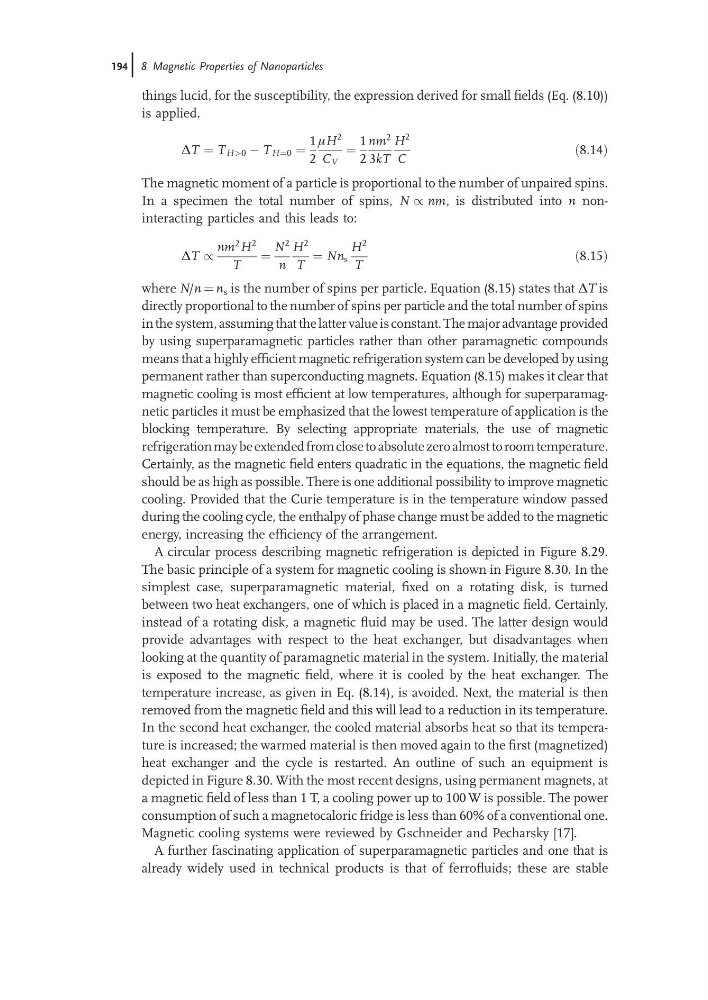
things lucid, for the susceptibility, the expression derived for small fields (Eq. (8.10))
is applied.
DT ¼ T H>0 À T H¼0 ¼
1
2
mH
2
C V
¼
1
2
nm
2
3kT
H
2
C
ð8:14Þ
The magnetic moment of a particle is proportional to the number of unpaired spins.
In a specimen the total number of spins, N / nm, is distributed into n noninteracting particles and this leads to:
DT /
nm
2
H
2
T
¼
N
2
n
H
2
T
¼ Nn s
H
2
T
ð8:15Þ
where N/n ¼ n s is the number of spins per particle. Equation (8.15) states that DT is
directly proportional to the number of spins per particle and the total number of spins
in the system, assuming that the latter value is constant. The major advantage provided
by using superparamagnetic particles rather than other paramagnetic compounds
means that a highly efficient magnetic refrigeration system can be developed by using
permanent rather than superconducting magnets. Equation (8.15) makes it clear that
magnetic cooling is most efficient at low temperatures, although for superparamagnetic particles it must be emphasized that the lowest temperature of application is the
blocking temperature. By selecting appropriate materials, the use of magnetic
refrigeration may be extended from close to absolute zero almost to room temperature.
Certainly, as the magnetic field enters quadratic in the equations, the magnetic field
should be as high as possible. There is one additional possibility to improve magnetic
cooling. Provided that the Curie temperature is in the temperature window passed
during the cooling cycle, the enthalpy of phase change must be added to the magnetic
energy, increasing the efficiency of the arrangement.
A circular process describing magnetic refrigeration is depicted in Figure 8.29.
The basic principle of a system for magnetic cooling is shown in Figure 8.30. In the
simplest case, superparamagnetic material, fixed on a rotating disk, is turned
between two heat exchangers, one of which is placed in a magnetic field. Certainly,
instead of a rotating disk, a magnetic fluid may be used. The latter design would
provide advantages with respect to the heat exchanger, but disadvantages when
looking at the quantity of paramagnetic material in the system. Initially, the material
is exposed to the magnetic field, where it is cooled by the heat exchanger. The
temperature increase, as given in Eq. (8.14), is avoided. Next, the material is then
removed from the magnetic field and this will lead to a reduction in its temperature.
In the second heat exchanger, the cooled material absorbs heat so that its temperature is increased; the warmed material is then moved again to the first (magnetized)
heat exchanger and the cycle is restarted. An outline of such an equipment is
depicted in Figure 8.30. With the most recent designs, using permanent magnets, at
a magnetic field of less than 1 T, a cooling power up to 100 W is possible. The power
consumption of such a magnetocaloric fridge is less than 60% of a conventional one.
Magnetic cooling systems were reviewed by Gschneider and Pecharsky [17].
A further fascinating application of superparamagnetic particles and one that is
already widely used in technical products is that of ferrofluids; these are stable
194j 8 Magnetic Properties of Nanoparticles
is applied.
DT ¼ T H>0 À T H¼0 ¼
1
2
mH
2
C V
¼
1
2
nm
2
3kT
H
2
C
ð8:14Þ
The magnetic moment of a particle is proportional to the number of unpaired spins.
In a specimen the total number of spins, N / nm, is distributed into n noninteracting particles and this leads to:
DT /
nm
2
H
2
T
¼
N
2
n
H
2
T
¼ Nn s
H
2
T
ð8:15Þ
where N/n ¼ n s is the number of spins per particle. Equation (8.15) states that DT is
directly proportional to the number of spins per particle and the total number of spins
in the system, assuming that the latter value is constant. The major advantage provided
by using superparamagnetic particles rather than other paramagnetic compounds
means that a highly efficient magnetic refrigeration system can be developed by using
permanent rather than superconducting magnets. Equation (8.15) makes it clear that
magnetic cooling is most efficient at low temperatures, although for superparamagnetic particles it must be emphasized that the lowest temperature of application is the
blocking temperature. By selecting appropriate materials, the use of magnetic
refrigeration may be extended from close to absolute zero almost to room temperature.
Certainly, as the magnetic field enters quadratic in the equations, the magnetic field
should be as high as possible. There is one additional possibility to improve magnetic
cooling. Provided that the Curie temperature is in the temperature window passed
during the cooling cycle, the enthalpy of phase change must be added to the magnetic
energy, increasing the efficiency of the arrangement.
A circular process describing magnetic refrigeration is depicted in Figure 8.29.
The basic principle of a system for magnetic cooling is shown in Figure 8.30. In the
simplest case, superparamagnetic material, fixed on a rotating disk, is turned
between two heat exchangers, one of which is placed in a magnetic field. Certainly,
instead of a rotating disk, a magnetic fluid may be used. The latter design would
provide advantages with respect to the heat exchanger, but disadvantages when
looking at the quantity of paramagnetic material in the system. Initially, the material
is exposed to the magnetic field, where it is cooled by the heat exchanger. The
temperature increase, as given in Eq. (8.14), is avoided. Next, the material is then
removed from the magnetic field and this will lead to a reduction in its temperature.
In the second heat exchanger, the cooled material absorbs heat so that its temperature is increased; the warmed material is then moved again to the first (magnetized)
heat exchanger and the cycle is restarted. An outline of such an equipment is
depicted in Figure 8.30. With the most recent designs, using permanent magnets, at
a magnetic field of less than 1 T, a cooling power up to 100 W is possible. The power
consumption of such a magnetocaloric fridge is less than 60% of a conventional one.
Magnetic cooling systems were reviewed by Gschneider and Pecharsky [17].
A further fascinating application of superparamagnetic particles and one that is
already widely used in technical products is that of ferrofluids; these are stable
194j 8 Magnetic Properties of Nanoparticles