

refrigerants and energy-consuming compressors, nanocomposites moving in a
magnetic field might be employed. The concept behind magnetic cooling dates
back several decades, having been applied in low-temperature physics.
Magnetic refrigeration is based on the fact that within a magnetic field H, a
magnetic material with the susceptibility m gains the energy U mag ¼ mH
2
=2. The
magnetic energy of a paramagnetic material in a magnetic field is connected to a
parallel orientation of the magnetic dipoles; hence, the entropy of paramagnetic
particles inside a magnetic field is reduced as compared to outside. Ordering of the
spins in a magnetic field reduces the entropy of the system. (In thermodynamics, the
entropy is a measure for the state of disorder in a system. The greater the disorder,
the higher is the entropy. In nature, any isolated system tends toward maximum
entropy.) Therefore, the entropy at zero-field S H ¼ 0 is larger than the entropy S H > 0
in a magnetic field H > 0. As S H>0 À S H¼0 < 0 is valid, the temperature difference
is always positive; hence, putting magnetic material into a magnetic field leads,
under adiabatic conditions, to an increase of the temperature. Assuming adiabatic
conditions, the influence of a magnetic field on the temperature of a magnetic
material is calculated using:
C V DT ¼ U mag ¼
1
2
mH
2 :
ð8:13Þ
where C V is the heat capacity at constant volume and DT ¼ T H>0 À T H¼0 is the
change of the temperature caused by the magnetic field. This equation uses the
correct assumption that the volume of the material is not influenced by the magnetic
field, provided one assumes that field at the starting time was H ¼ 0. To keep the
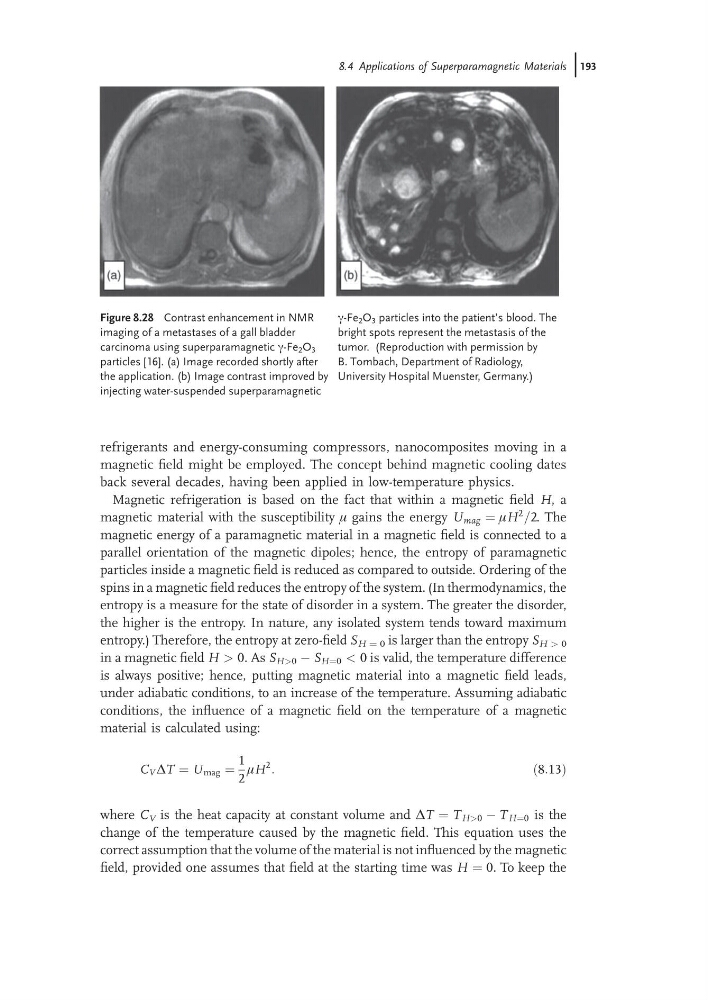
Figure 8.28 Contrast enhancement in NMR
imaging of a metastases of a gall bladder
carcinoma using superparamagnetic c-Fe 2 O 3
particles [16]. (a) Image recorded shortly after
the application. (b) Image contrast improved by
injecting water-suspended superparamagnetic
c-Fe 2 O 3 particles into the patient’s blood. The
bright spots represent the metastasis of the
tumor. (Reproduction with permission by
B. Tombach, Department of Radiology,
University Hospital Muenster, Germany.)
8.4 Applications of Superparamagnetic Materials j193
magnetic field might be employed. The concept behind magnetic cooling dates
back several decades, having been applied in low-temperature physics.
Magnetic refrigeration is based on the fact that within a magnetic field H, a
magnetic material with the susceptibility m gains the energy U mag ¼ mH
2
=2. The
magnetic energy of a paramagnetic material in a magnetic field is connected to a
parallel orientation of the magnetic dipoles; hence, the entropy of paramagnetic
particles inside a magnetic field is reduced as compared to outside. Ordering of the
spins in a magnetic field reduces the entropy of the system. (In thermodynamics, the
entropy is a measure for the state of disorder in a system. The greater the disorder,
the higher is the entropy. In nature, any isolated system tends toward maximum
entropy.) Therefore, the entropy at zero-field S H ¼ 0 is larger than the entropy S H > 0
in a magnetic field H > 0. As S H>0 À S H¼0 < 0 is valid, the temperature difference
is always positive; hence, putting magnetic material into a magnetic field leads,
under adiabatic conditions, to an increase of the temperature. Assuming adiabatic
conditions, the influence of a magnetic field on the temperature of a magnetic
material is calculated using:
C V DT ¼ U mag ¼
1
2
mH
2 :
ð8:13Þ
where C V is the heat capacity at constant volume and DT ¼ T H>0 À T H¼0 is the
change of the temperature caused by the magnetic field. This equation uses the
correct assumption that the volume of the material is not influenced by the magnetic
field, provided one assumes that field at the starting time was H ¼ 0. To keep the
Figure 8.28 Contrast enhancement in NMR
imaging of a metastases of a gall bladder
carcinoma using superparamagnetic c-Fe 2 O 3
particles [16]. (a) Image recorded shortly after
the application. (b) Image contrast improved by
injecting water-suspended superparamagnetic
c-Fe 2 O 3 particles into the patient’s blood. The
bright spots represent the metastasis of the
tumor. (Reproduction with permission by
B. Tombach, Department of Radiology,
University Hospital Muenster, Germany.)
8.4 Applications of Superparamagnetic Materials j193