

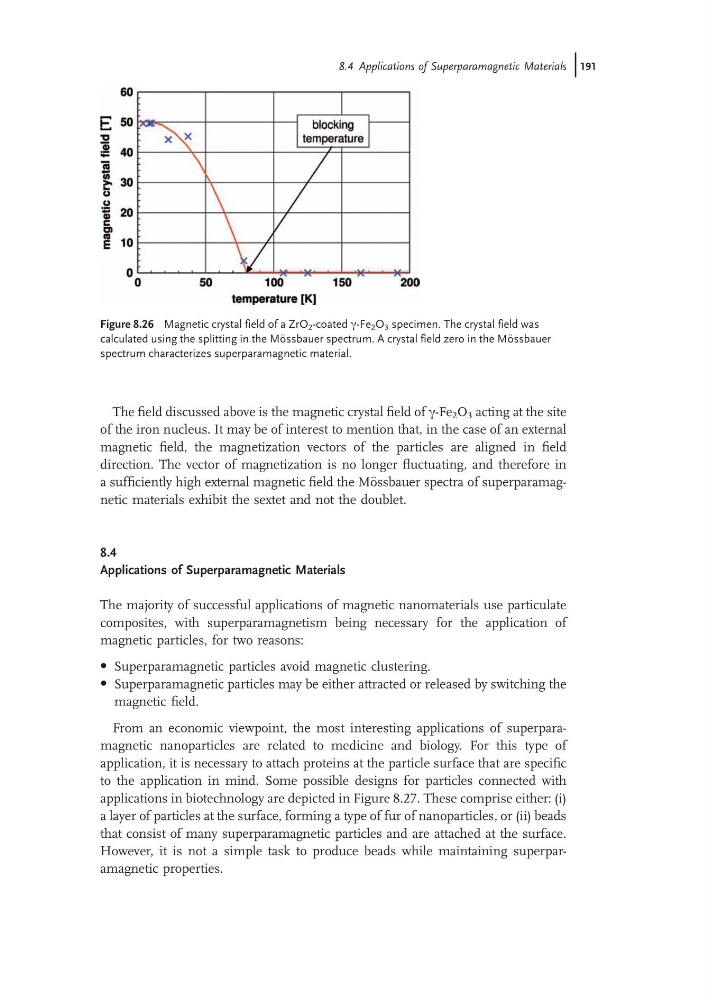
The field discussed above is the magnetic crystal field of c-Fe 2 O 3 acting at the site
of the iron nucleus. It may be of interest to mention that, in the case of an external
magnetic field, the magnetization vectors of the particles are aligned in field
direction. The vector of magnetization is no longer fluctuating, and therefore in
a sufficiently high external magnetic field the M€ ossbauer spectra of superparamagnetic materials exhibit the sextet and not the doublet.
8.4
Applications of Superparamagnetic Materials
The majority of successful applications of magnetic nanomaterials use particulate
composites, with superparamagnetism being necessary for the application of
magnetic particles, for two reasons:
Superparamagnetic particles avoid magnetic clustering.
Superparamagnetic particles may be either attracted or released by switching the
magnetic field.
From an economic viewpoint, the most interesting applications of superparamagnetic nanoparticles are related to medicine and biology. For this type of
application, it is necessary to attach proteins at the particle surface that are specific
to the application in mind. Some possible designs for particles connected with
applications in biotechnology are depicted in Figure 8.27. These comprise either: (i)
a layer of particles at the surface, forming a type of fur of nanoparticles, or (ii) beads
that consist of many superparamagnetic particles and are attached at the surface.
However, it is not a simple task to produce beads while maintaining superparamagnetic properties.
Figure 8.26 Magnetic crystal field of a ZrO 2 -coated c-Fe 2 O 3 specimen. The crystal field was
calculated using the splitting in the M€ ossbauer spectrum. A crystal field zero in the M€ ossbauer
spectrum characterizes superparamagnetic material.
8.4 Applications of Superparamagnetic Materials j191
of the iron nucleus. It may be of interest to mention that, in the case of an external
magnetic field, the magnetization vectors of the particles are aligned in field
direction. The vector of magnetization is no longer fluctuating, and therefore in
a sufficiently high external magnetic field the M€ ossbauer spectra of superparamagnetic materials exhibit the sextet and not the doublet.
8.4
Applications of Superparamagnetic Materials
The majority of successful applications of magnetic nanomaterials use particulate
composites, with superparamagnetism being necessary for the application of
magnetic particles, for two reasons:
Superparamagnetic particles avoid magnetic clustering.
Superparamagnetic particles may be either attracted or released by switching the
magnetic field.
From an economic viewpoint, the most interesting applications of superparamagnetic nanoparticles are related to medicine and biology. For this type of
application, it is necessary to attach proteins at the particle surface that are specific
to the application in mind. Some possible designs for particles connected with
applications in biotechnology are depicted in Figure 8.27. These comprise either: (i)
a layer of particles at the surface, forming a type of fur of nanoparticles, or (ii) beads
that consist of many superparamagnetic particles and are attached at the surface.
However, it is not a simple task to produce beads while maintaining superparamagnetic properties.
Figure 8.26 Magnetic crystal field of a ZrO 2 -coated c-Fe 2 O 3 specimen. The crystal field was
calculated using the splitting in the M€ ossbauer spectrum. A crystal field zero in the M€ ossbauer
spectrum characterizes superparamagnetic material.
8.4 Applications of Superparamagnetic Materials j191