

40%. Hence, the saturation magnetization expected would be only 40% of the
theoretically possible value found with coarse-grained materials. This result should
be examined in relation to the particle size dependency of saturation magnetization,
as described by Eq. (8.7). Assuming a 0.8-nm nonmagnetic surface layer, the particle
size was around 6 nm – a value that fitted well with electron microscopy measurements and the saturation of magnetization as described by Eq. (8.7).
The energy levels of the iron nucleus under the influence of the magnetic crystal
field are shown schematically in Figure 8.21b. As this splitting is directly proportional to the magnetic field, a detailed analysis of the M€ ossbauer spectrum will
provide information concerning the magnetic crystal field. However, in superparamagnetic materials, great care must be taken when interpreting this result,
as the splitting is proportional to the mean value of the crystal field that is seen by the
nucleus during one revolution. Above the blocking temperature, this mean value is
zero, but below the blocking temperature the measured field increases with
decreasing temperature, as long as the fluctuation frequency is lower than the
Lamor frequency of the nucleus. (Careful: this is a plausible explanation of a very
complex phenomenon exactly described by quantum mechanics only!)
This situation is depicted in Figure 8.26, where the magnetic crystal field,
determined from the splitting of the sextet in the M€ ossbauer spectrum, is plotted
as a function of the temperature. A zero field is apparent above the blocking
temperature of 80 K, whereas below around 10 K a constant value of 50 T is reached,
this being the true value of the magnetic crystal field.
It should be mentioned here that this is only one of a few other possible definition
of the blocking temperature and is well suited to materials with a narrow particle size
distribution. For materials with a broader particle size distribution, the temperature
where 50% of the material is found in the doublet is normally used as blocking
temperature.
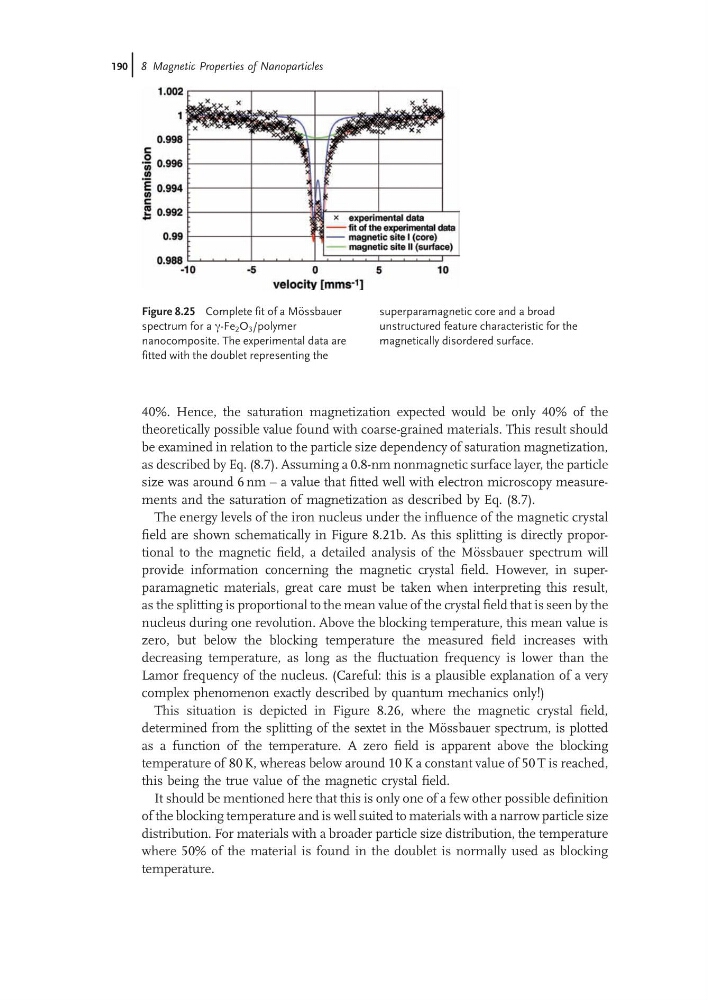
Figure 8.25 Complete fit of a M€ ossbauer
spectrum for a c-Fe 2 O 3 /polymer
nanocomposite. The experimental data are
fitted with the doublet representing the
superparamagnetic core and a broad
unstructured feature characteristic for the
magnetically disordered surface.
190j 8 Magnetic Properties of Nanoparticles
theoretically possible value found with coarse-grained materials. This result should
be examined in relation to the particle size dependency of saturation magnetization,
as described by Eq. (8.7). Assuming a 0.8-nm nonmagnetic surface layer, the particle
size was around 6 nm – a value that fitted well with electron microscopy measurements and the saturation of magnetization as described by Eq. (8.7).
The energy levels of the iron nucleus under the influence of the magnetic crystal
field are shown schematically in Figure 8.21b. As this splitting is directly proportional to the magnetic field, a detailed analysis of the M€ ossbauer spectrum will
provide information concerning the magnetic crystal field. However, in superparamagnetic materials, great care must be taken when interpreting this result,
as the splitting is proportional to the mean value of the crystal field that is seen by the
nucleus during one revolution. Above the blocking temperature, this mean value is
zero, but below the blocking temperature the measured field increases with
decreasing temperature, as long as the fluctuation frequency is lower than the
Lamor frequency of the nucleus. (Careful: this is a plausible explanation of a very
complex phenomenon exactly described by quantum mechanics only!)
This situation is depicted in Figure 8.26, where the magnetic crystal field,
determined from the splitting of the sextet in the M€ ossbauer spectrum, is plotted
as a function of the temperature. A zero field is apparent above the blocking
temperature of 80 K, whereas below around 10 K a constant value of 50 T is reached,
this being the true value of the magnetic crystal field.
It should be mentioned here that this is only one of a few other possible definition
of the blocking temperature and is well suited to materials with a narrow particle size
distribution. For materials with a broader particle size distribution, the temperature
where 50% of the material is found in the doublet is normally used as blocking
temperature.
Figure 8.25 Complete fit of a M€ ossbauer
spectrum for a c-Fe 2 O 3 /polymer
nanocomposite. The experimental data are
fitted with the doublet representing the
superparamagnetic core and a broad
unstructured feature characteristic for the
magnetically disordered surface.
190j 8 Magnetic Properties of Nanoparticles