

300 K, where the particles were coated with ZrO 2 as a distance holder. The material
is purely superparamagnetic and there is no trace of the sextet visible. The transition
from the sextet to a doublet connected with the transition from normal ferrimagnetism to superparamagnetism is not restricted to pure c-Fe 2 O 3 , but is also
found at other ferrites (e.g., of the type Me
2þ Fe 2 O 4 ). This type of ferrite is derived
from Fe 3 O 4 , where iron with valency 2 (Fe
2þ ) is replaced by another metal ion of the
same valency. Most common are the additions of manganese or magnesium, which
reduce, or of cobalt, which increase, the constant of magnetic anisotropy.
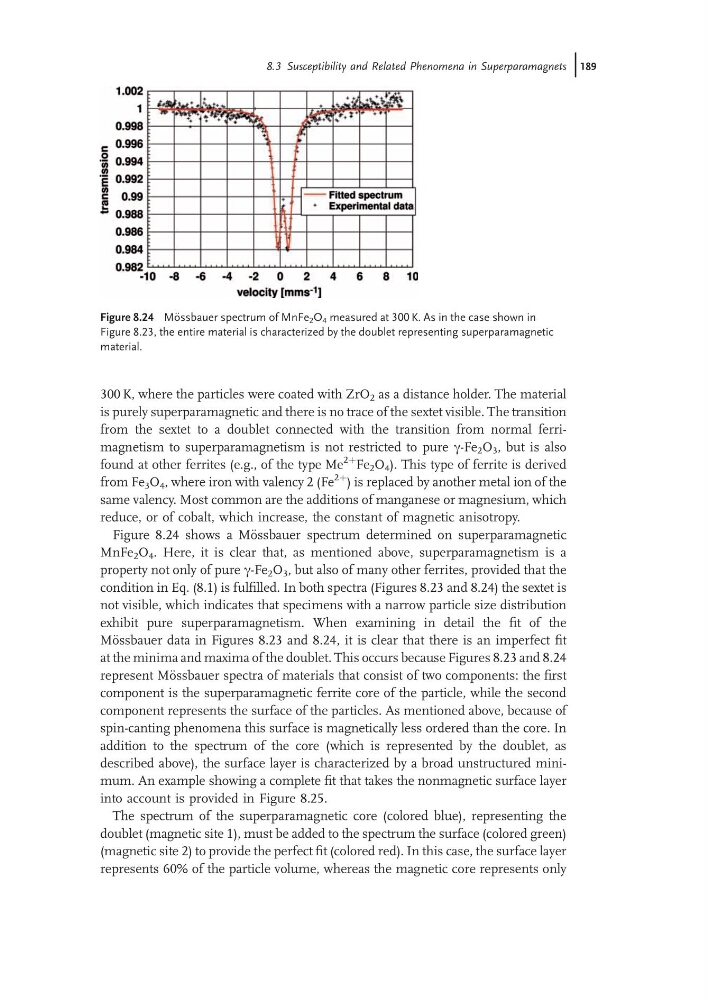
Figure 8.24 shows a M€ ossbauer spectrum determined on superparamagnetic
MnFe 2 O 4 . Here, it is clear that, as mentioned above, superparamagnetism is a
property not only of pure c-Fe 2 O 3 , but also of many other ferrites, provided that the
condition in Eq. (8.1) is fulfilled. In both spectra (Figures 8.23 and 8.24) the sextet is
not visible, which indicates that specimens with a narrow particle size distribution
exhibit pure superparamagnetism. When examining in detail the fit of the
M€ ossbauer data in Figures 8.23 and 8.24, it is clear that there is an imperfect fit
at the minima and maxima of the doublet. This occurs because Figures 8.23 and 8.24
represent M€ ossbauer spectra of materials that consist of two components: the first
component is the superparamagnetic ferrite core of the particle, while the second
component represents the surface of the particles. As mentioned above, because of
spin-canting phenomena this surface is magnetically less ordered than the core. In
addition to the spectrum of the core (which is represented by the doublet, as
described above), the surface layer is characterized by a broad unstructured minimum. An example showing a complete fit that takes the nonmagnetic surface layer
into account is provided in Figure 8.25.
The spectrum of the superparamagnetic core (colored blue), representing the
doublet (magnetic site 1), must be added to the spectrum the surface (colored green)
(magnetic site 2) to provide the perfect fit (colored red). In this case, the surface layer
represents 60% of the particle volume, whereas the magnetic core represents only
Figure 8.24 M€ ossbauer spectrum of MnFe 2 O 4 measured at 300 K. As in the case shown in
Figure 8.23, the entire material is characterized by the doublet representing superparamagnetic
material.
8.3 Susceptibility and Related Phenomena in Superparamagnets j189
is purely superparamagnetic and there is no trace of the sextet visible. The transition
from the sextet to a doublet connected with the transition from normal ferrimagnetism to superparamagnetism is not restricted to pure c-Fe 2 O 3 , but is also
found at other ferrites (e.g., of the type Me
2þ Fe 2 O 4 ). This type of ferrite is derived
from Fe 3 O 4 , where iron with valency 2 (Fe
2þ ) is replaced by another metal ion of the
same valency. Most common are the additions of manganese or magnesium, which
reduce, or of cobalt, which increase, the constant of magnetic anisotropy.
Figure 8.24 shows a M€ ossbauer spectrum determined on superparamagnetic
MnFe 2 O 4 . Here, it is clear that, as mentioned above, superparamagnetism is a
property not only of pure c-Fe 2 O 3 , but also of many other ferrites, provided that the
condition in Eq. (8.1) is fulfilled. In both spectra (Figures 8.23 and 8.24) the sextet is
not visible, which indicates that specimens with a narrow particle size distribution
exhibit pure superparamagnetism. When examining in detail the fit of the
M€ ossbauer data in Figures 8.23 and 8.24, it is clear that there is an imperfect fit
at the minima and maxima of the doublet. This occurs because Figures 8.23 and 8.24
represent M€ ossbauer spectra of materials that consist of two components: the first
component is the superparamagnetic ferrite core of the particle, while the second
component represents the surface of the particles. As mentioned above, because of
spin-canting phenomena this surface is magnetically less ordered than the core. In
addition to the spectrum of the core (which is represented by the doublet, as
described above), the surface layer is characterized by a broad unstructured minimum. An example showing a complete fit that takes the nonmagnetic surface layer
into account is provided in Figure 8.25.
The spectrum of the superparamagnetic core (colored blue), representing the
doublet (magnetic site 1), must be added to the spectrum the surface (colored green)
(magnetic site 2) to provide the perfect fit (colored red). In this case, the surface layer
represents 60% of the particle volume, whereas the magnetic core represents only
Figure 8.24 M€ ossbauer spectrum of MnFe 2 O 4 measured at 300 K. As in the case shown in
Figure 8.23, the entire material is characterized by the doublet representing superparamagnetic
material.
8.3 Susceptibility and Related Phenomena in Superparamagnets j189