

slices using an ultramicrotome. During the cutting process, the “slip-stick” phenomena caused the material to show chatter marks (these are clearly visible in the
scanning force micrograph Figure 8.19b). (The irregular horizontal striations also
seen were caused by notches in the diamond cutting knife.)
8.3
Susceptibility and Related Phenomena in Superparamagnets
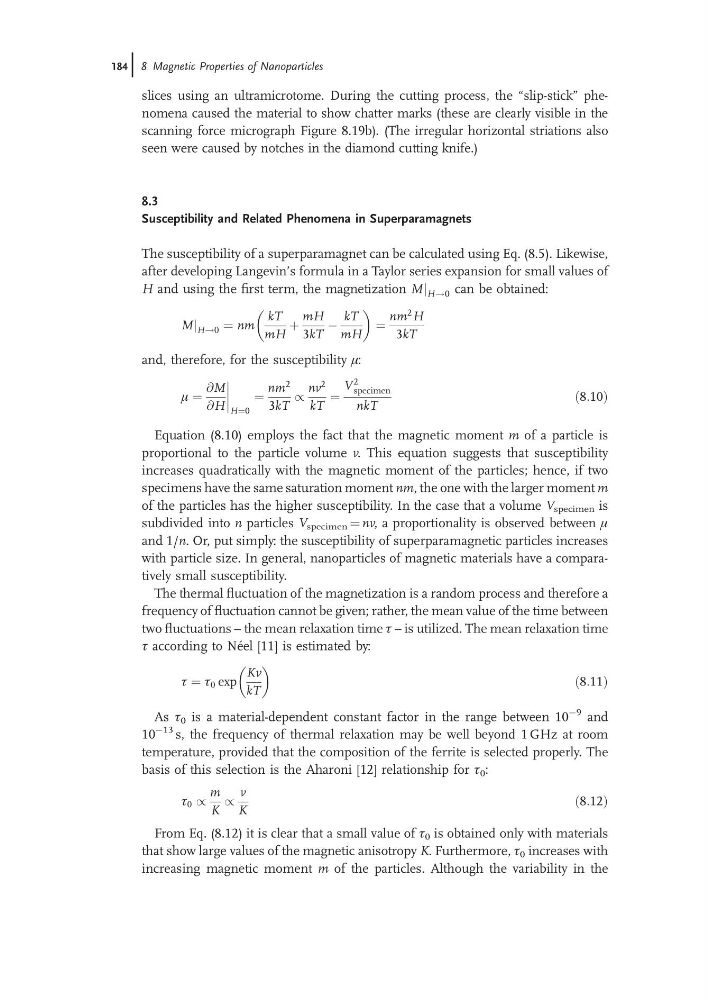
The susceptibility of a superparamagnet can be calculated using Eq. (8.5). Likewise,
after developing Langevin’s formula in a Taylor series expansion for small values of
H and using the first term, the magnetization Mj H!0 can be obtained:
Mj H!0 ¼ nm
kT
mH
þ
mH
3kT
À
kT
mH
¼
nm
2
H
3kT
and, therefore, for the susceptibility m:
m ¼
@M
@H
H¼0
¼
nm
2
3kT
/
nv
2
kT
¼
V
2
specimen
nkT
ð8:10Þ
Equation (8.10) employs the fact that the magnetic moment m of a particle is
proportional to the particle volume v. This equation suggests that susceptibility
increases quadratically with the magnetic moment of the particles; hence, if two
specimens have the same saturation moment nm, the one with the larger moment m
of the particles has the higher susceptibility. In the case that a volume V specimen is
subdivided into n particles V specimen ¼ nv, a proportionality is observed between m
and 1/n. Or, put simply: the susceptibility of superparamagnetic particles increases
with particle size. In general, nanoparticles of magnetic materials have a comparatively small susceptibility.
The thermal fluctuation of the magnetization is a random process and therefore a
frequency of fluctuation cannot be given; rather, the mean value of the time between
two fluctuations – the mean relaxation time t – is utilized. The mean relaxation time
t according to N eel [11] is estimated by:
t ¼ t 0 exp
Kv
kT
ð8:11Þ
As t 0 is a material-dependent constant factor in the range between 10
À9 and
10
À13 s, the frequency of thermal relaxation may be well beyond 1 GHz at room
temperature, provided that the composition of the ferrite is selected properly. The
basis of this selection is the Aharoni [12] relationship for t 0 :
t 0 /
m
K
/
v
K
ð8:12Þ
From Eq. (8.12) it is clear that a small value of t 0 is obtained only with materials
that show large values of the magnetic anisotropy K. Furthermore, t 0 increases with
increasing magnetic moment m of the particles. Although the variability in the
184j 8 Magnetic Properties of Nanoparticles
scanning force micrograph Figure 8.19b). (The irregular horizontal striations also
seen were caused by notches in the diamond cutting knife.)
8.3
Susceptibility and Related Phenomena in Superparamagnets
The susceptibility of a superparamagnet can be calculated using Eq. (8.5). Likewise,
after developing Langevin’s formula in a Taylor series expansion for small values of
H and using the first term, the magnetization Mj H!0 can be obtained:
Mj H!0 ¼ nm
kT
mH
þ
mH
3kT
À
kT
mH
¼
nm
2
H
3kT
and, therefore, for the susceptibility m:
m ¼
@M
@H
H¼0
¼
nm
2
3kT
/
nv
2
kT
¼
V
2
specimen
nkT
ð8:10Þ
Equation (8.10) employs the fact that the magnetic moment m of a particle is
proportional to the particle volume v. This equation suggests that susceptibility
increases quadratically with the magnetic moment of the particles; hence, if two
specimens have the same saturation moment nm, the one with the larger moment m
of the particles has the higher susceptibility. In the case that a volume V specimen is
subdivided into n particles V specimen ¼ nv, a proportionality is observed between m
and 1/n. Or, put simply: the susceptibility of superparamagnetic particles increases
with particle size. In general, nanoparticles of magnetic materials have a comparatively small susceptibility.
The thermal fluctuation of the magnetization is a random process and therefore a
frequency of fluctuation cannot be given; rather, the mean value of the time between
two fluctuations – the mean relaxation time t – is utilized. The mean relaxation time
t according to N eel [11] is estimated by:
t ¼ t 0 exp
Kv
kT
ð8:11Þ
As t 0 is a material-dependent constant factor in the range between 10
À9 and
10
À13 s, the frequency of thermal relaxation may be well beyond 1 GHz at room
temperature, provided that the composition of the ferrite is selected properly. The
basis of this selection is the Aharoni [12] relationship for t 0 :
t 0 /
m
K
/
v
K
ð8:12Þ
From Eq. (8.12) it is clear that a small value of t 0 is obtained only with materials
that show large values of the magnetic anisotropy K. Furthermore, t 0 increases with
increasing magnetic moment m of the particles. Although the variability in the
184j 8 Magnetic Properties of Nanoparticles