

magnetization m is limited, as m is proportional to the particle volume, a small
volume of the particles reduces susceptibility and magnetic moment. In this respect,
the composition of the particle has a significant influence (see Table 8.1).
For technical applications, it is preferable to have small values of relaxation time
that limit the frequency range for application, combined with a large susceptibility,
and in this respect Eqs. (8.10) and (8.11) are contradictory. Therefore, superparamagnetic materials may be optimized for either a high susceptibility or a short
relaxation time; this in turn leads to a high-frequency limit of the applications.
In technical reality, the high-frequency application of superparamagnetic parts is
hampered not only by particle size and the constant of magnetic anisotropy, but also
by magnetic dipole–dipole interaction of the particles.
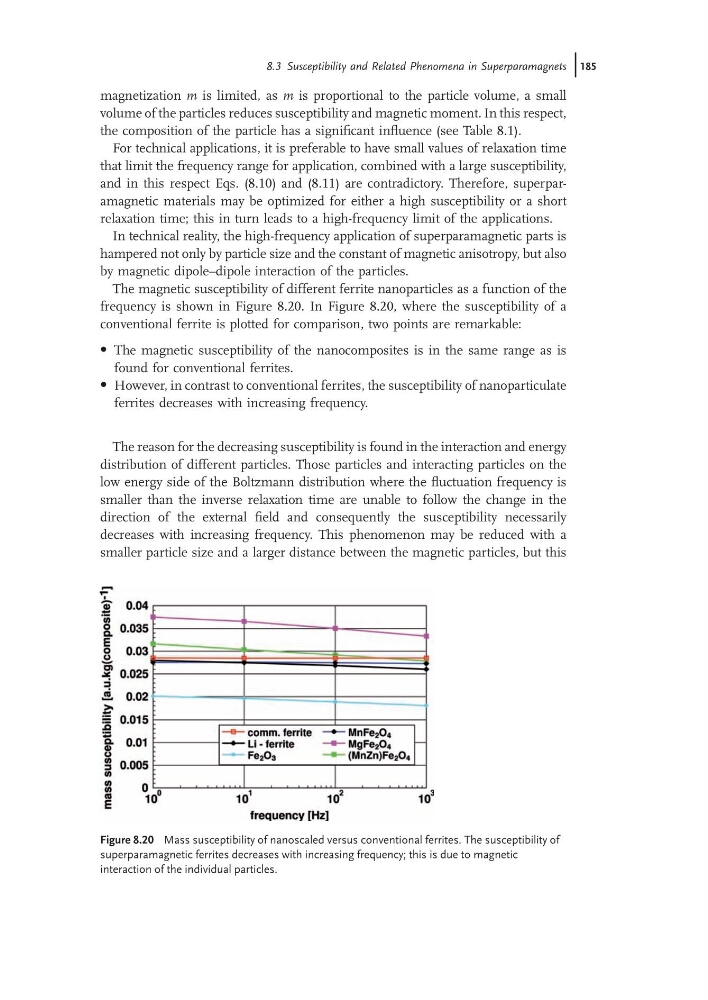
The magnetic susceptibility of different ferrite nanoparticles as a function of the
frequency is shown in Figure 8.20. In Figure 8.20, where the susceptibility of a
conventional ferrite is plotted for comparison, two points are remarkable:
The magnetic susceptibility of the nanocomposites is in the same range as is
found for conventional ferrites.
However, in contrast to conventional ferrites, the susceptibility of nanoparticulate
ferrites decreases with increasing frequency.
The reason for the decreasing susceptibility is found in the interaction and energy
distribution of different particles. Those particles and interacting particles on the
low energy side of the Boltzmann distribution where the fluctuation frequency is
smaller than the inverse relaxation time are unable to follow the change in the
direction of the external field and consequently the susceptibility necessarily
decreases with increasing frequency. This phenomenon may be reduced with a
smaller particle size and a larger distance between the magnetic particles, but this
Figure 8.20 Mass susceptibility of nanoscaled versus conventional ferrites. The susceptibility of
superparamagnetic ferrites decreases with increasing frequency; this is due to magnetic
interaction of the individual particles.
8.3 Susceptibility and Related Phenomena in Superparamagnets j185
volume of the particles reduces susceptibility and magnetic moment. In this respect,
the composition of the particle has a significant influence (see Table 8.1).
For technical applications, it is preferable to have small values of relaxation time
that limit the frequency range for application, combined with a large susceptibility,
and in this respect Eqs. (8.10) and (8.11) are contradictory. Therefore, superparamagnetic materials may be optimized for either a high susceptibility or a short
relaxation time; this in turn leads to a high-frequency limit of the applications.
In technical reality, the high-frequency application of superparamagnetic parts is
hampered not only by particle size and the constant of magnetic anisotropy, but also
by magnetic dipole–dipole interaction of the particles.
The magnetic susceptibility of different ferrite nanoparticles as a function of the
frequency is shown in Figure 8.20. In Figure 8.20, where the susceptibility of a
conventional ferrite is plotted for comparison, two points are remarkable:
The magnetic susceptibility of the nanocomposites is in the same range as is
found for conventional ferrites.
However, in contrast to conventional ferrites, the susceptibility of nanoparticulate
ferrites decreases with increasing frequency.
The reason for the decreasing susceptibility is found in the interaction and energy
distribution of different particles. Those particles and interacting particles on the
low energy side of the Boltzmann distribution where the fluctuation frequency is
smaller than the inverse relaxation time are unable to follow the change in the
direction of the external field and consequently the susceptibility necessarily
decreases with increasing frequency. This phenomenon may be reduced with a
smaller particle size and a larger distance between the magnetic particles, but this
Figure 8.20 Mass susceptibility of nanoscaled versus conventional ferrites. The susceptibility of
superparamagnetic ferrites decreases with increasing frequency; this is due to magnetic
interaction of the individual particles.
8.3 Susceptibility and Related Phenomena in Superparamagnets j185