

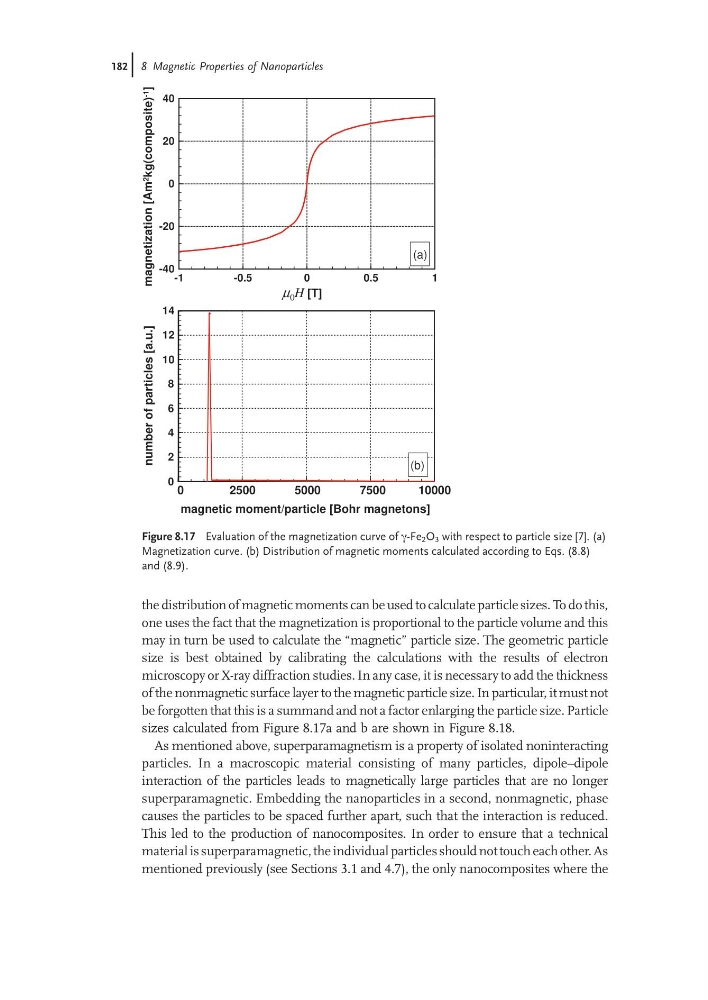
the distribution of magnetic moments can be used to calculate particle sizes. To do this,
one uses the fact that the magnetization is proportional to the particle volume and this
may in turn be used to calculate the “magnetic” particle size. The geometric particle
size is best obtained by calibrating the calculations with the results of electron
microscopy or X-ray diffraction studies. In any case, it is necessary to add the thickness
of the nonmagnetic surface layer to the magnetic particle size. In particular, it must not
be forgotten that this is a summand and not a factor enlarging the particle size. Particle
sizes calculated from Figure 8.17a and b are shown in Figure 8.18.
As mentioned above, superparamagnetism is a property of isolated noninteracting
particles. In a macroscopic material consisting of many particles, dipole–dipole
interaction of the particles leads to magnetically large particles that are no longer
superparamagnetic. Embedding the nanoparticles in a second, nonmagnetic, phase
causes the particles to be spaced further apart, such that the interaction is reduced.
This led to the production of nanocomposites. In order to ensure that a technical
material is superparamagnetic, the individual particles should not touch each other. As
mentioned previously (see Sections 3.1 and 4.7), the only nanocomposites where the
-1
-0.5
0
0.5
1
-40
-20
0
20
40
(a)
(b)
0
2
4
6
8
10
12
14
0
10000
7500
5000
2500
magnetic moment/particle [Bohr magnetons]
number of particles [a.u.]
magnetization [Am 2
kg(composite) -1
]
μ 0 H [T]
Figure 8.17 Evaluation of the magnetization curve of c-Fe 2 O 3 with respect to particle size [7]. (a)
Magnetization curve. (b) Distribution of magnetic moments calculated according to Eqs. (8.8)
and (8.9).
182j 8 Magnetic Properties of Nanoparticles
one uses the fact that the magnetization is proportional to the particle volume and this
may in turn be used to calculate the “magnetic” particle size. The geometric particle
size is best obtained by calibrating the calculations with the results of electron
microscopy or X-ray diffraction studies. In any case, it is necessary to add the thickness
of the nonmagnetic surface layer to the magnetic particle size. In particular, it must not
be forgotten that this is a summand and not a factor enlarging the particle size. Particle
sizes calculated from Figure 8.17a and b are shown in Figure 8.18.
As mentioned above, superparamagnetism is a property of isolated noninteracting
particles. In a macroscopic material consisting of many particles, dipole–dipole
interaction of the particles leads to magnetically large particles that are no longer
superparamagnetic. Embedding the nanoparticles in a second, nonmagnetic, phase
causes the particles to be spaced further apart, such that the interaction is reduced.
This led to the production of nanocomposites. In order to ensure that a technical
material is superparamagnetic, the individual particles should not touch each other. As
mentioned previously (see Sections 3.1 and 4.7), the only nanocomposites where the
-1
-0.5
0
0.5
1
-40
-20
0
20
40
(a)
(b)
0
2
4
6
8
10
12
14
0
10000
7500
5000
2500
magnetic moment/particle [Bohr magnetons]
number of particles [a.u.]
magnetization [Am 2
kg(composite) -1
]
μ 0 H [T]
Figure 8.17 Evaluation of the magnetization curve of c-Fe 2 O 3 with respect to particle size [7]. (a)
Magnetization curve. (b) Distribution of magnetic moments calculated according to Eqs. (8.8)
and (8.9).
182j 8 Magnetic Properties of Nanoparticles