

In bulk materials, dipole–dipole interactions of the particles cannot be excluded
completely. Therefore, a distance holder in between the magnetic particles is needed,
which makes the application of nanocomposites necessary. Hence, for the successful
application of superparamagnetic materials, an optimum must be found between the
superparamagnetic properties and the density of the magnetically active particles in
the matrix. Interaction of the particles in a matrix leads to magnetically larger particles
that are, in some cases, no longer superparamagnetic. Such an interaction can be
described by a fictitious particle size. Caizer and Hrianc [8] described such an apparent
increase in the magnetic particle size of c-Fe 2 O 3 in an amorphous silica matrix by a
reduction of the thickness of the nonmagnetic layer. These authors showed that even a
concentration as low as 0.68 vol% did not eliminate particle interaction completely. In
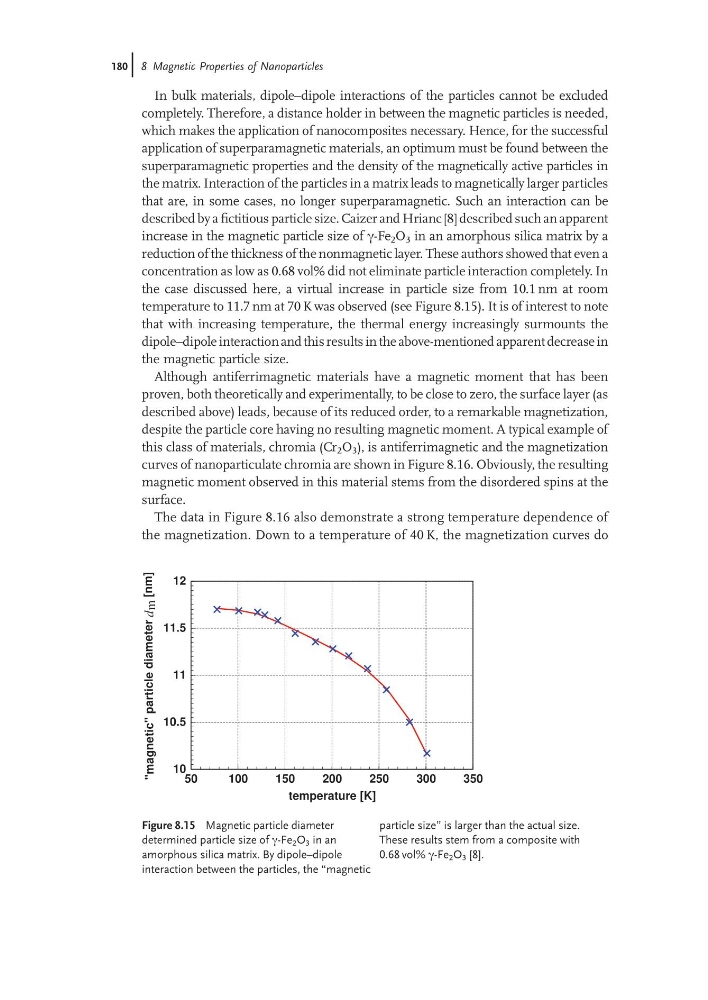
the case discussed here, a virtual increase in particle size from 10.1 nm at room
temperature to 11.7 nm at 70 K was observed (see Figure 8.15). It is of interest to note
that with increasing temperature, the thermal energy increasingly surmounts the
dipole–dipole interaction and this results in the above-mentioned apparent decrease in
the magnetic particle size.
Although antiferrimagnetic materials have a magnetic moment that has been
proven, both theoretically and experimentally, to be close to zero, the surface layer (as
described above) leads, because of its reduced order, to a remarkable magnetization,
despite the particle core having no resulting magnetic moment. A typical example of
this class of materials, chromia (Cr 2 O 3 ), is antiferrimagnetic and the magnetization
curves of nanoparticulate chromia are shown in Figure 8.16. Obviously, the resulting
magnetic moment observed in this material stems from the disordered spins at the
surface.
The data in Figure 8.16 also demonstrate a strong temperature dependence of
the magnetization. Down to a temperature of 40 K, the magnetization curves do
50
100
150
200
250
300
350
temperature [K]
10
10.5
11
11.5
12
"magnetic"
particle
diameter d m
[nm]
Figure 8.15 Magnetic particle diameter
determined particle size of c-Fe 2 O 3 in an
amorphous silica matrix. By dipole–dipole
interaction between the particles, the “magnetic
particle size” is larger than the actual size.
These results stem from a composite with
0.68 vol% c-Fe 2 O 3 [8].
180j 8 Magnetic Properties of Nanoparticles
completely. Therefore, a distance holder in between the magnetic particles is needed,
which makes the application of nanocomposites necessary. Hence, for the successful
application of superparamagnetic materials, an optimum must be found between the
superparamagnetic properties and the density of the magnetically active particles in
the matrix. Interaction of the particles in a matrix leads to magnetically larger particles
that are, in some cases, no longer superparamagnetic. Such an interaction can be
described by a fictitious particle size. Caizer and Hrianc [8] described such an apparent
increase in the magnetic particle size of c-Fe 2 O 3 in an amorphous silica matrix by a
reduction of the thickness of the nonmagnetic layer. These authors showed that even a
concentration as low as 0.68 vol% did not eliminate particle interaction completely. In
the case discussed here, a virtual increase in particle size from 10.1 nm at room
temperature to 11.7 nm at 70 K was observed (see Figure 8.15). It is of interest to note
that with increasing temperature, the thermal energy increasingly surmounts the
dipole–dipole interaction and this results in the above-mentioned apparent decrease in
the magnetic particle size.
Although antiferrimagnetic materials have a magnetic moment that has been
proven, both theoretically and experimentally, to be close to zero, the surface layer (as
described above) leads, because of its reduced order, to a remarkable magnetization,
despite the particle core having no resulting magnetic moment. A typical example of
this class of materials, chromia (Cr 2 O 3 ), is antiferrimagnetic and the magnetization
curves of nanoparticulate chromia are shown in Figure 8.16. Obviously, the resulting
magnetic moment observed in this material stems from the disordered spins at the
surface.
The data in Figure 8.16 also demonstrate a strong temperature dependence of
the magnetization. Down to a temperature of 40 K, the magnetization curves do
50
100
150
200
250
300
350
temperature [K]
10
10.5
11
11.5
12
"magnetic"
particle
diameter d m
[nm]
Figure 8.15 Magnetic particle diameter
determined particle size of c-Fe 2 O 3 in an
amorphous silica matrix. By dipole–dipole
interaction between the particles, the “magnetic
particle size” is larger than the actual size.
These results stem from a composite with
0.68 vol% c-Fe 2 O 3 [8].
180j 8 Magnetic Properties of Nanoparticles