

with a specific surface in a range of about 50–150 m
2 g
À1 shown in Figure 8.13 is
equivalent to a range of mean particle diameters from 7 to 25 nm. Fitting of the
experimental data and extrapolation of the saturation magnetization to a specific
surface area zero leads to a thickness of 0.7 nm of the nonmagnetic surface layer;
extrapolation of the linear relationship to zero surface, equivalent to bulk materials,
leads to a saturation magnetization of 81 A m
2 kg
À1
, which is close to the value
experimentally observed for bulk material.
Following the experimental findings that the saturation magnetization shows a
linear decrease with the inverse surface area [5,6], in a first approximation it may be
assumed that ferrite nanoparticles with diameter d and a nonmagnetic surface layer
of thickness d result in a magnetic active core with a diameter d À 2d
ð
Þ[7]. This
approximation leads to a reduced saturation magnetization of:
M nanoparticle ¼
ðd À 2dÞ
3
d
3
M macroscopic
ð8:7Þ
where M nanoparticle is the saturation magnetization of the specimen made of nanoparticles and M macroscopic is the value expected theoretically for macroscopic particles.
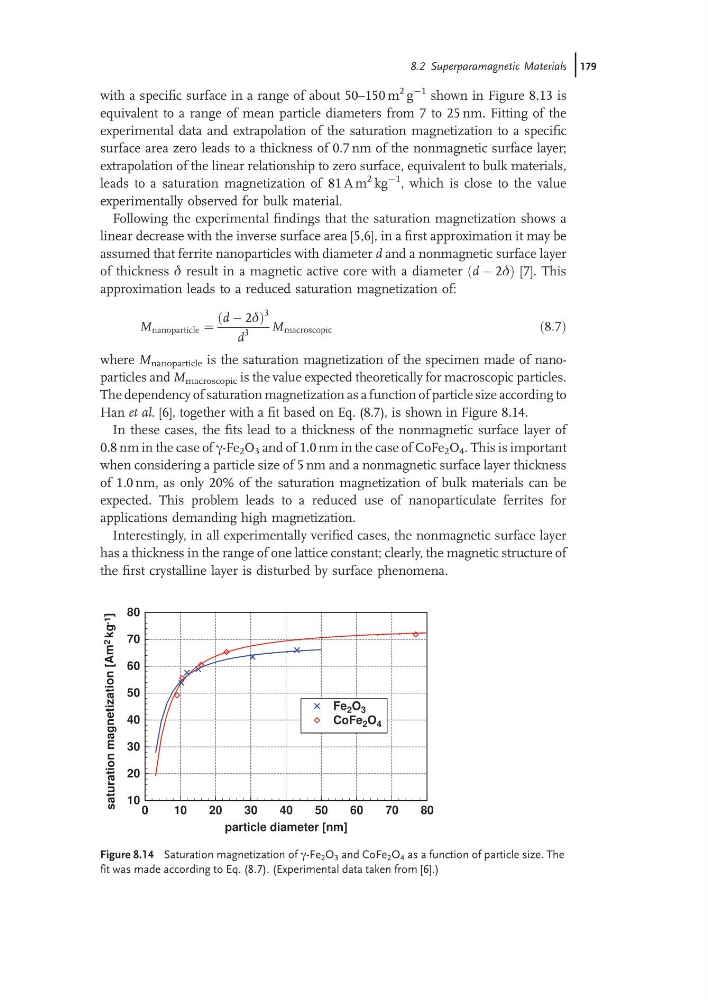
The dependency of saturation magnetization as a function of particle size according to
Han et al. [6], together with a fit based on Eq. (8.7), is shown in Figure 8.14.
In these cases, the fits lead to a thickness of the nonmagnetic surface layer of
0.8 nm in the case of c-Fe 2 O 3 and of 1.0 nm in the case of CoFe 2 O 4 . This is important
when considering a particle size of 5 nm and a nonmagnetic surface layer thickness
of 1.0 nm, as only 20% of the saturation magnetization of bulk materials can be
expected. This problem leads to a reduced use of nanoparticulate ferrites for
applications demanding high magnetization.
Interestingly, in all experimentally verified cases, the nonmagnetic surface layer
has a thickness in the range of one lattice constant; clearly, the magnetic structure of
the first crystalline layer is disturbed by surface phenomena.
0
10
20
30
40
50
60
70
80
particle diameter [nm]
10
20
30
40
50
60
70
80
saturation
magnetization
[Am
2 kg
-1 ]
Fe 2 O 3
CoFe 2 O 4
Figure 8.14 Saturation magnetization of c-Fe 2 O 3 and CoFe 2 O 4 as a function of particle size. The
fit was made according to Eq. (8.7). (Experimental data taken from [6].)
8.2 Superparamagnetic Materials j179
2 g
À1 shown in Figure 8.13 is
equivalent to a range of mean particle diameters from 7 to 25 nm. Fitting of the
experimental data and extrapolation of the saturation magnetization to a specific
surface area zero leads to a thickness of 0.7 nm of the nonmagnetic surface layer;
extrapolation of the linear relationship to zero surface, equivalent to bulk materials,
leads to a saturation magnetization of 81 A m
2 kg
À1
, which is close to the value
experimentally observed for bulk material.
Following the experimental findings that the saturation magnetization shows a
linear decrease with the inverse surface area [5,6], in a first approximation it may be
assumed that ferrite nanoparticles with diameter d and a nonmagnetic surface layer
of thickness d result in a magnetic active core with a diameter d À 2d
ð
Þ[7]. This
approximation leads to a reduced saturation magnetization of:
M nanoparticle ¼
ðd À 2dÞ
3
d
3
M macroscopic
ð8:7Þ
where M nanoparticle is the saturation magnetization of the specimen made of nanoparticles and M macroscopic is the value expected theoretically for macroscopic particles.
The dependency of saturation magnetization as a function of particle size according to
Han et al. [6], together with a fit based on Eq. (8.7), is shown in Figure 8.14.
In these cases, the fits lead to a thickness of the nonmagnetic surface layer of
0.8 nm in the case of c-Fe 2 O 3 and of 1.0 nm in the case of CoFe 2 O 4 . This is important
when considering a particle size of 5 nm and a nonmagnetic surface layer thickness
of 1.0 nm, as only 20% of the saturation magnetization of bulk materials can be
expected. This problem leads to a reduced use of nanoparticulate ferrites for
applications demanding high magnetization.
Interestingly, in all experimentally verified cases, the nonmagnetic surface layer
has a thickness in the range of one lattice constant; clearly, the magnetic structure of
the first crystalline layer is disturbed by surface phenomena.
0
10
20
30
40
50
60
70
80
particle diameter [nm]
10
20
30
40
50
60
70
80
saturation
magnetization
[Am
2 kg
-1 ]
Fe 2 O 3
CoFe 2 O 4
Figure 8.14 Saturation magnetization of c-Fe 2 O 3 and CoFe 2 O 4 as a function of particle size. The
fit was made according to Eq. (8.7). (Experimental data taken from [6].)
8.2 Superparamagnetic Materials j179