

Below the blocking temperature, hysteresis appears. According to the theory of
superparamagnetism [3], coercivity is given by:
H C
H C0
¼ 1 À
T
T B
0:5
ð8:6Þ
where H C is the coercivity at temperature T, H C0 is the coercivity at 0 K, and T B is the
blocking temperature. A graph showing coercivity as a function of T
0.5 is shown in
Figure 8.12.
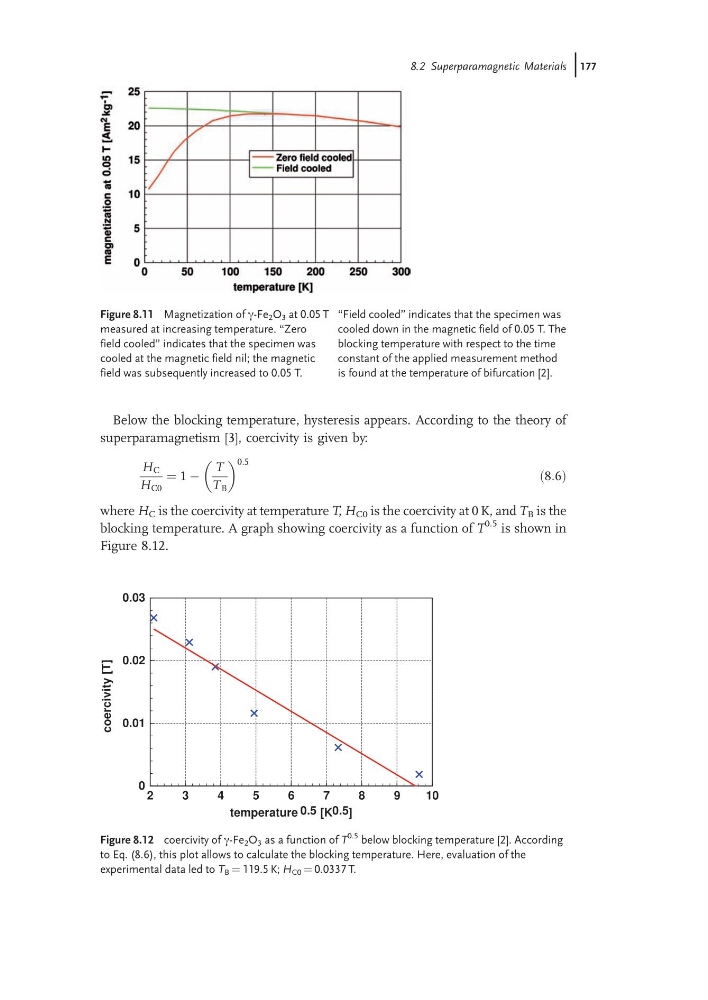
Figure 8.11 Magnetization of c-Fe 2 O 3 at 0.05 T
measured at increasing temperature. “Zero
field cooled” indicates that the specimen was
cooled at the magnetic field nil; the magnetic
field was subsequently increased to 0.05 T.
“Field cooled” indicates that the specimen was
cooled down in the magnetic field of 0.05 T. The
blocking temperature with respect to the time
constant of the applied measurement method
is found at the temperature of bifurcation [2].
2
3
4
5
6
7
8
9
10
temperature 0.5 [K 0.5 ]
0
0.01
0.02
0.03
coercivity
[T]
Figure 8.12 coercivity of c-Fe 2 O 3 as a function of T
0.5 below blocking temperature [2]. According
to Eq. (8.6), this plot allows to calculate the blocking temperature. Here, evaluation of the
experimental data led to T B ¼ 119.5 K; H C0 ¼ 0.0337 T.
8.2 Superparamagnetic Materials j177
superparamagnetism [3], coercivity is given by:
H C
H C0
¼ 1 À
T
T B
0:5
ð8:6Þ
where H C is the coercivity at temperature T, H C0 is the coercivity at 0 K, and T B is the
blocking temperature. A graph showing coercivity as a function of T
0.5 is shown in
Figure 8.12.
Figure 8.11 Magnetization of c-Fe 2 O 3 at 0.05 T
measured at increasing temperature. “Zero
field cooled” indicates that the specimen was
cooled at the magnetic field nil; the magnetic
field was subsequently increased to 0.05 T.
“Field cooled” indicates that the specimen was
cooled down in the magnetic field of 0.05 T. The
blocking temperature with respect to the time
constant of the applied measurement method
is found at the temperature of bifurcation [2].
2
3
4
5
6
7
8
9
10
temperature 0.5 [K 0.5 ]
0
0.01
0.02
0.03
coercivity
[T]
Figure 8.12 coercivity of c-Fe 2 O 3 as a function of T
0.5 below blocking temperature [2]. According
to Eq. (8.6), this plot allows to calculate the blocking temperature. Here, evaluation of the
experimental data led to T B ¼ 119.5 K; H C0 ¼ 0.0337 T.
8.2 Superparamagnetic Materials j177