

where m is the magnetic moment of one particle, which is, in a first approximation,
proportional to the volume of the particle, n is the number of particles, and H is the
external magnetic field. In the case of paramagnetic materials, the magnetic moment
of one molecule is – in most cases – equal to 1 m B , the Bohr magneton. Hence, m/m B is
the number of uncompensated spins in one particle. For superparamagnetic materials, the number of Bohr magnetons per particle may be in the range of 100 and more.
The saturation moment M saturation of the specimen is calculated by:
M saturation ¼ lim
H!1
nm coth
mH
kT
À
kT
mH
¼ nm
The magnetization curves represent the behavior as a function of the magnetic
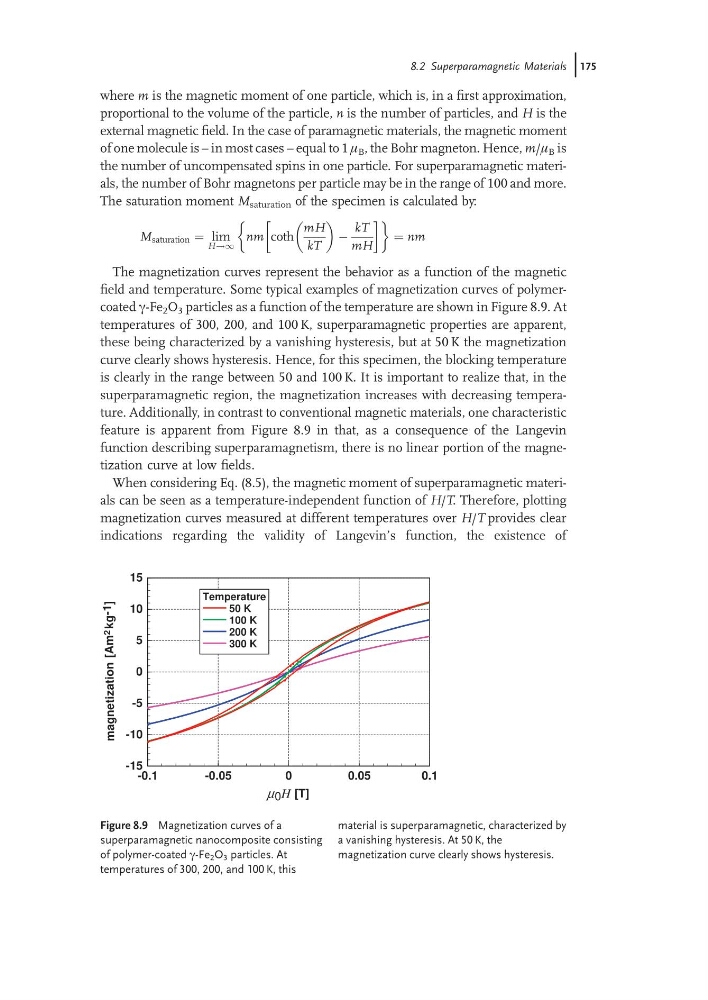
field and temperature. Some typical examples of magnetization curves of polymercoated c-Fe 2 O 3 particles as a function of the temperature are shown in Figure 8.9. At
temperatures of 300, 200, and 100 K, superparamagnetic properties are apparent,
these being characterized by a vanishing hysteresis, but at 50 K the magnetization
curve clearly shows hysteresis. Hence, for this specimen, the blocking temperature
is clearly in the range between 50 and 100 K. It is important to realize that, in the
superparamagnetic region, the magnetization increases with decreasing temperature. Additionally, in contrast to conventional magnetic materials, one characteristic
feature is apparent from Figure 8.9 in that, as a consequence of the Langevin
function describing superparamagnetism, there is no linear portion of the magnetization curve at low fields.
When considering Eq. (8.5), the magnetic moment of superparamagnetic materials can be seen as a temperature-independent function of H/T. Therefore, plotting
magnetization curves measured at different temperatures over H/T provides clear
indications regarding the validity of Langevin’s function, the existence of
-0.1
-0.05
0
0.05
0.1
μ 0 H [T]
-15
-10
-5
0
5
10
15
magnetization
[Am
2 kg
-1 ]
Temperature
50 K
100 K
200 K
300 K
Figure 8.9 Magnetization curves of a
superparamagnetic nanocomposite consisting
of polymer-coated c-Fe 2 O 3 particles. At
temperatures of 300, 200, and 100 K, this
material is superparamagnetic, characterized by
a vanishing hysteresis. At 50 K, the
magnetization curve clearly shows hysteresis.
8.2 Superparamagnetic Materials j175
proportional to the volume of the particle, n is the number of particles, and H is the
external magnetic field. In the case of paramagnetic materials, the magnetic moment
of one molecule is – in most cases – equal to 1 m B , the Bohr magneton. Hence, m/m B is
the number of uncompensated spins in one particle. For superparamagnetic materials, the number of Bohr magnetons per particle may be in the range of 100 and more.
The saturation moment M saturation of the specimen is calculated by:
M saturation ¼ lim
H!1
nm coth
mH
kT
À
kT
mH
¼ nm
The magnetization curves represent the behavior as a function of the magnetic
field and temperature. Some typical examples of magnetization curves of polymercoated c-Fe 2 O 3 particles as a function of the temperature are shown in Figure 8.9. At
temperatures of 300, 200, and 100 K, superparamagnetic properties are apparent,
these being characterized by a vanishing hysteresis, but at 50 K the magnetization
curve clearly shows hysteresis. Hence, for this specimen, the blocking temperature
is clearly in the range between 50 and 100 K. It is important to realize that, in the
superparamagnetic region, the magnetization increases with decreasing temperature. Additionally, in contrast to conventional magnetic materials, one characteristic
feature is apparent from Figure 8.9 in that, as a consequence of the Langevin
function describing superparamagnetism, there is no linear portion of the magnetization curve at low fields.
When considering Eq. (8.5), the magnetic moment of superparamagnetic materials can be seen as a temperature-independent function of H/T. Therefore, plotting
magnetization curves measured at different temperatures over H/T provides clear
indications regarding the validity of Langevin’s function, the existence of
-0.1
-0.05
0
0.05
0.1
μ 0 H [T]
-15
-10
-5
0
5
10
15
magnetization
[Am
2 kg
-1 ]
Temperature
50 K
100 K
200 K
300 K
Figure 8.9 Magnetization curves of a
superparamagnetic nanocomposite consisting
of polymer-coated c-Fe 2 O 3 particles. At
temperatures of 300, 200, and 100 K, this
material is superparamagnetic, characterized by
a vanishing hysteresis. At 50 K, the
magnetization curve clearly shows hysteresis.
8.2 Superparamagnetic Materials j175