

Fe 3 O 4 , which is a cubic material, the easy and hard directions deviate fundamentally;
these were found as follows:
k111i is the easy direction of magnetization.
k110i is the intermediate direction of magnetization.
k100i is the hard direction of magnetization.
Therefore, provided the specimen is allowed to rotate freely, a sphere of magnetite
will magnetize in one of the four k111i space diagonals of a cube.
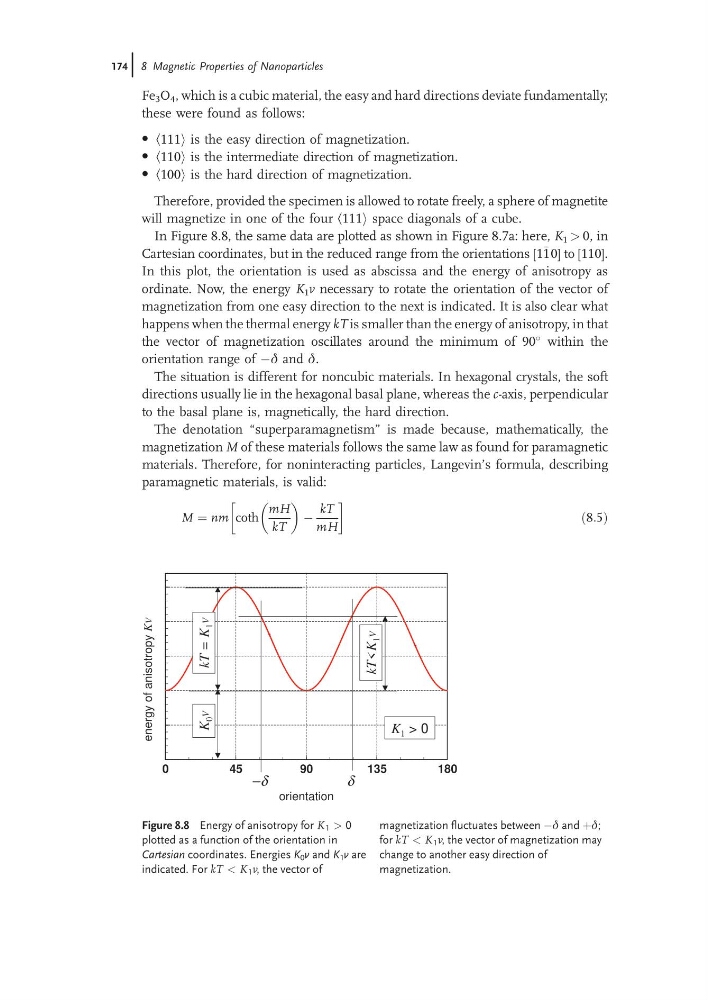
In Figure 8.8, the same data are plotted as shown in Figure 8.7a: here, K 1 > 0, in
Cartesian coordinates, but in the reduced range from the orientations [1 10] to [110].
In this plot, the orientation is used as abscissa and the energy of anisotropy as
ordinate. Now, the energy K 1 v necessary to rotate the orientation of the vector of
magnetization from one easy direction to the next is indicated. It is also clear what
happens when the thermal energy kT is smaller than the energy of anisotropy, in that
the vector of magnetization oscillates around the minimum of 90
within the
orientation range of Àd and d.
The situation is different for noncubic materials. In hexagonal crystals, the soft
directions usually lie in the hexagonal basal plane, whereas the c-axis, perpendicular
to the basal plane is, magnetically, the hard direction.
The denotation “superparamagnetism” is made because, mathematically, the
magnetization M of these materials follows the same law as found for paramagnetic
materials. Therefore, for noninteracting particles, Langevin’s formula, describing
paramagnetic materials, is valid:
M ¼ nm coth
mH
kT
À
kT
mH
ð8:5Þ
0
45
90
135
180
0
0.5
1
1.5
2
2.5
orientation
δ
–δ
energy of anisotropy
KV
kT = K
1 V
K
0 V
kT
K 1 > 0
Figure 8.8 Energy of anisotropy for K 1 > 0
plotted as a function of the orientation in
Cartesian coordinates. Energies K 0 v and K 1 v are
indicated. For kT < K 1 v, the vector of
magnetization fluctuates between Àd and þd;
for kT < K 1 v, the vector of magnetization may
change to another easy direction of
magnetization.
174j 8 Magnetic Properties of Nanoparticles
these were found as follows:
k111i is the easy direction of magnetization.
k110i is the intermediate direction of magnetization.
k100i is the hard direction of magnetization.
Therefore, provided the specimen is allowed to rotate freely, a sphere of magnetite
will magnetize in one of the four k111i space diagonals of a cube.
In Figure 8.8, the same data are plotted as shown in Figure 8.7a: here, K 1 > 0, in
Cartesian coordinates, but in the reduced range from the orientations [1 10] to [110].
In this plot, the orientation is used as abscissa and the energy of anisotropy as
ordinate. Now, the energy K 1 v necessary to rotate the orientation of the vector of
magnetization from one easy direction to the next is indicated. It is also clear what
happens when the thermal energy kT is smaller than the energy of anisotropy, in that
the vector of magnetization oscillates around the minimum of 90
within the
orientation range of Àd and d.
The situation is different for noncubic materials. In hexagonal crystals, the soft
directions usually lie in the hexagonal basal plane, whereas the c-axis, perpendicular
to the basal plane is, magnetically, the hard direction.
The denotation “superparamagnetism” is made because, mathematically, the
magnetization M of these materials follows the same law as found for paramagnetic
materials. Therefore, for noninteracting particles, Langevin’s formula, describing
paramagnetic materials, is valid:
M ¼ nm coth
mH
kT
À
kT
mH
ð8:5Þ
0
45
90
135
180
0
0.5
1
1.5
2
2.5
orientation
δ
–δ
energy of anisotropy
KV
kT = K
1 V
K
0 V
kT
K 1 > 0
Figure 8.8 Energy of anisotropy for K 1 > 0
plotted as a function of the orientation in
Cartesian coordinates. Energies K 0 v and K 1 v are
indicated. For kT < K 1 v, the vector of
magnetization fluctuates between Àd and þd;
for kT < K 1 v, the vector of magnetization may
change to another easy direction of
magnetization.
174j 8 Magnetic Properties of Nanoparticles