

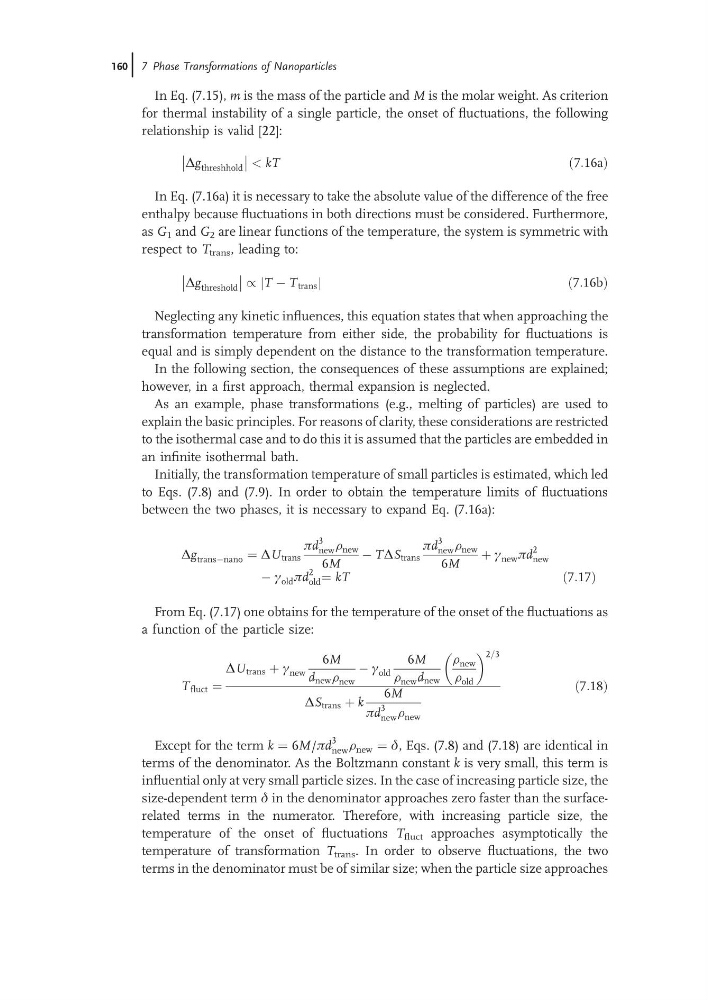
In Eq. (7.15), m is the mass of the particle and M is the molar weight. As criterion
for thermal instability of a single particle, the onset of fluctuations, the following
relationship is valid [22]:
Dg threshhold
< kT
ð7:16aÞ
In Eq. (7.16a) it is necessary to take the absolute value of the difference of the free
enthalpy because fluctuations in both directions must be considered. Furthermore,
as G 1 and G 2 are linear functions of the temperature, the system is symmetric with
respect to T trans , leading to:
Dg threshold
/ T À T trans
j
j
ð7:16bÞ
Neglecting any kinetic influences, this equation states that when approaching the
transformation temperature from either side, the probability for fluctuations is
equal and is simply dependent on the distance to the transformation temperature.
In the following section, the consequences of these assumptions are explained;
however, in a first approach, thermal expansion is neglected.
As an example, phase transformations (e.g., melting of particles) are used to
explain the basic principles. For reasons of clarity, these considerations are restricted
to the isothermal case and to do this it is assumed that the particles are embedded in
an infinite isothermal bath.
Initially, the transformation temperature of small particles is estimated, which led
to Eqs. (7.8) and (7.9). In order to obtain the temperature limits of fluctuations
between the two phases, it is necessary to expand Eq. (7.16a):
Dg transÀnano ¼ DU trans
pd
3
new r new
6M
À TDS trans
pd
3
new r new
6M
þ c new pd
2
new
À c old pd
2
old ¼ kT
ð7:17Þ
From Eq. (7.17) one obtains for the temperature of the onset of the fluctuations as
a function of the particle size:
T fluct ¼
DU trans þ c new
6M
d new r new
À c old
6M
r new d new
r new
r old
2=3
DS trans þ k
6M
pd
3
new r new
ð7:18Þ
Except for the term k ¼ 6M/pd
3
new r new ¼ d, Eqs. (7.8) and (7.18) are identical in
terms of the denominator. As the Boltzmann constant k is very small, this term is
influential only at very small particle sizes. In the case of increasing particle size, the
size-dependent term d in the denominator approaches zero faster than the surfacerelated terms in the numerator. Therefore, with increasing particle size, the
temperature of the onset of fluctuations T fluct approaches asymptotically the
temperature of transformation T trans . In order to observe fluctuations, the two
terms in the denominator must be of similar size; when the particle size approaches
160j 7 Phase Transformations of Nanoparticles
for thermal instability of a single particle, the onset of fluctuations, the following
relationship is valid [22]:
Dg threshhold
< kT
ð7:16aÞ
In Eq. (7.16a) it is necessary to take the absolute value of the difference of the free
enthalpy because fluctuations in both directions must be considered. Furthermore,
as G 1 and G 2 are linear functions of the temperature, the system is symmetric with
respect to T trans , leading to:
Dg threshold
/ T À T trans
j
j
ð7:16bÞ
Neglecting any kinetic influences, this equation states that when approaching the
transformation temperature from either side, the probability for fluctuations is
equal and is simply dependent on the distance to the transformation temperature.
In the following section, the consequences of these assumptions are explained;
however, in a first approach, thermal expansion is neglected.
As an example, phase transformations (e.g., melting of particles) are used to
explain the basic principles. For reasons of clarity, these considerations are restricted
to the isothermal case and to do this it is assumed that the particles are embedded in
an infinite isothermal bath.
Initially, the transformation temperature of small particles is estimated, which led
to Eqs. (7.8) and (7.9). In order to obtain the temperature limits of fluctuations
between the two phases, it is necessary to expand Eq. (7.16a):
Dg transÀnano ¼ DU trans
pd
3
new r new
6M
À TDS trans
pd
3
new r new
6M
þ c new pd
2
new
À c old pd
2
old ¼ kT
ð7:17Þ
From Eq. (7.17) one obtains for the temperature of the onset of the fluctuations as
a function of the particle size:
T fluct ¼
DU trans þ c new
6M
d new r new
À c old
6M
r new d new
r new
r old
2=3
DS trans þ k
6M
pd
3
new r new
ð7:18Þ
Except for the term k ¼ 6M/pd
3
new r new ¼ d, Eqs. (7.8) and (7.18) are identical in
terms of the denominator. As the Boltzmann constant k is very small, this term is
influential only at very small particle sizes. In the case of increasing particle size, the
size-dependent term d in the denominator approaches zero faster than the surfacerelated terms in the numerator. Therefore, with increasing particle size, the
temperature of the onset of fluctuations T fluct approaches asymptotically the
temperature of transformation T trans . In order to observe fluctuations, the two
terms in the denominator must be of similar size; when the particle size approaches
160j 7 Phase Transformations of Nanoparticles