

7.7
Structural Fluctuations
Based on the fluctuations described above, leading particle size-dependent
phase diagrams may be explained by simple thermodynamic considerations. The
simplest case of fluctuations – superparamagnetism (see Chapter 8) – is observed
when the thermal energy kT (k is the Boltzmann constant and T is the temperature) is larger than the energy of magnetic anisotropy Kv (K is the materialdependent constant of magnetic anisotropy and v is the volume of the magnetic
particle). Fluctuations, in this case superparamagnetism, occur when the
condition:
Kv kT
ð7:14Þ
is fulfilled. It is clear that the conditions in Eq. (7.14) are fulfilled only for sufficiently
small particles.
In the case of structural fluctuations, it is necessary to examine more closely the
thermodynamics in the vicinity of a phase transformation [22]. Such a situation is
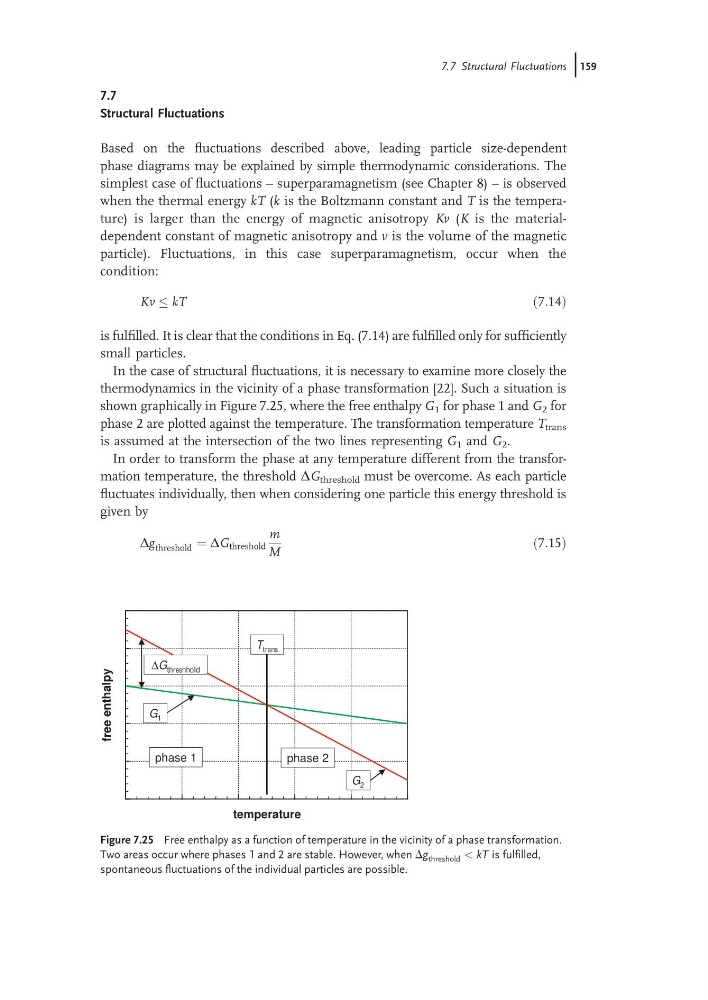
shown graphically in Figure 7.25, where the free enthalpy G 1 for phase 1 and G 2 for
phase 2 are plotted against the temperature. The transformation temperature T trans
is assumed at the intersection of the two lines representing G 1 and G 2 .
In order to transform the phase at any temperature different from the transformation temperature, the threshold DG threshold must be overcome. As each particle
fluctuates individually, then when considering one particle this energy threshold is
given by
Dg threshold ¼ DG threshold
m
M
ð7:15Þ
free
ent
temperature
free
enthalp
alpy
T trans
phase 1
phase 2
G 1
G 2
G threshhold
Δ
Figure 7.25 Free enthalpy as a function of temperature in the vicinity of a phase transformation.
Two areas occur where phases 1 and 2 are stable. However, when Dg threshold < kT is fulfilled,
spontaneous fluctuations of the individual particles are possible.
7.7 Structural Fluctuations j159
Structural Fluctuations
Based on the fluctuations described above, leading particle size-dependent
phase diagrams may be explained by simple thermodynamic considerations. The
simplest case of fluctuations – superparamagnetism (see Chapter 8) – is observed
when the thermal energy kT (k is the Boltzmann constant and T is the temperature) is larger than the energy of magnetic anisotropy Kv (K is the materialdependent constant of magnetic anisotropy and v is the volume of the magnetic
particle). Fluctuations, in this case superparamagnetism, occur when the
condition:
Kv kT
ð7:14Þ
is fulfilled. It is clear that the conditions in Eq. (7.14) are fulfilled only for sufficiently
small particles.
In the case of structural fluctuations, it is necessary to examine more closely the
thermodynamics in the vicinity of a phase transformation [22]. Such a situation is
shown graphically in Figure 7.25, where the free enthalpy G 1 for phase 1 and G 2 for
phase 2 are plotted against the temperature. The transformation temperature T trans
is assumed at the intersection of the two lines representing G 1 and G 2 .
In order to transform the phase at any temperature different from the transformation temperature, the threshold DG threshold must be overcome. As each particle
fluctuates individually, then when considering one particle this energy threshold is
given by
Dg threshold ¼ DG threshold
m
M
ð7:15Þ
free
ent
temperature
free
enthalp
alpy
T trans
phase 1
phase 2
G 1
G 2
G threshhold
Δ
Figure 7.25 Free enthalpy as a function of temperature in the vicinity of a phase transformation.
Two areas occur where phases 1 and 2 are stable. However, when Dg threshold < kT is fulfilled,
spontaneous fluctuations of the individual particles are possible.
7.7 Structural Fluctuations j159