

an inset shows a schematic drawing of the particles according to Figure 7.22c or m
in the pseudocrystalline region.
The region where the crystal embryos occur is referred to by the authors as
“pseudocrystalline.” Clearly, the range of the pseudocrystalline phase is beyond
the line given by T nano ¼ a – (b/d), the thermodynamic boundary of melting
derived from Eq. (7.8). Until now, it has not been clear whether this severe
deviation from the elementary description is due to an insufficient experimental
database or if the simple theory of melting is not applicable. It is important to note
here that, in the whole range denoted as crystalline quasimelt, fluctuations
between different particle shapes occur. This is essentially the same observation
that was described by Ajayan et al. [20] as quasimelted in the case of gold particles.
It is important to realize here that Oshima and Takayanagi [21] showed that
instabilities occurred on both sides of the thermodynamic limit, between the
crystalline and the melted phases.
The phenomenon of pseudocrystallinity is not limited to metallic particles.
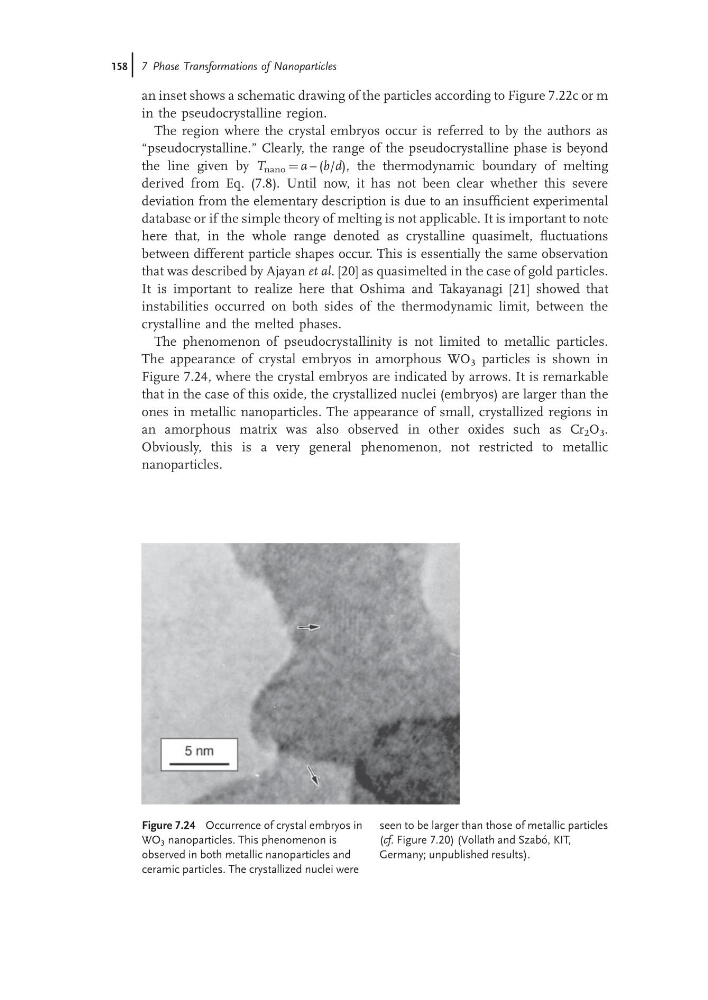
The appearance of crystal embryos in amorphous WO 3 particles is shown in
Figure 7.24, where the crystal embryos are indicated by arrows. It is remarkable
that in the case of this oxide, the crystallized nuclei (embryos) are larger than the
ones in metallic nanoparticles. The appearance of small, crystallized regions in
an amorphous matrix was also observed in other oxides such as Cr 2 O 3 .
Obviously, this is a very general phenomenon, not restricted to metallic
nanoparticles.
Figure 7.24 Occurrence of crystal embryos in
WO 3 nanoparticles. This phenomenon is
observed in both metallic nanoparticles and
ceramic particles. The crystallized nuclei were
seen to be larger than those of metallic particles
(cf. Figure 7.20) (Vollath and Szab o, KIT,
Germany; unpublished results).
158j 7 Phase Transformations of Nanoparticles
in the pseudocrystalline region.
The region where the crystal embryos occur is referred to by the authors as
“pseudocrystalline.” Clearly, the range of the pseudocrystalline phase is beyond
the line given by T nano ¼ a – (b/d), the thermodynamic boundary of melting
derived from Eq. (7.8). Until now, it has not been clear whether this severe
deviation from the elementary description is due to an insufficient experimental
database or if the simple theory of melting is not applicable. It is important to note
here that, in the whole range denoted as crystalline quasimelt, fluctuations
between different particle shapes occur. This is essentially the same observation
that was described by Ajayan et al. [20] as quasimelted in the case of gold particles.
It is important to realize here that Oshima and Takayanagi [21] showed that
instabilities occurred on both sides of the thermodynamic limit, between the
crystalline and the melted phases.
The phenomenon of pseudocrystallinity is not limited to metallic particles.
The appearance of crystal embryos in amorphous WO 3 particles is shown in
Figure 7.24, where the crystal embryos are indicated by arrows. It is remarkable
that in the case of this oxide, the crystallized nuclei (embryos) are larger than the
ones in metallic nanoparticles. The appearance of small, crystallized regions in
an amorphous matrix was also observed in other oxides such as Cr 2 O 3 .
Obviously, this is a very general phenomenon, not restricted to metallic
nanoparticles.
Figure 7.24 Occurrence of crystal embryos in
WO 3 nanoparticles. This phenomenon is
observed in both metallic nanoparticles and
ceramic particles. The crystallized nuclei were
seen to be larger than those of metallic particles
(cf. Figure 7.20) (Vollath and Szab o, KIT,
Germany; unpublished results).
158j 7 Phase Transformations of Nanoparticles