

In Figure 7.10a, it is clear that the temperature of transformation decreases as the
particle size decreases, and that an increasing yttria content has a similar influence
to that of a reduced particle size, which is exactly the expected behavior. It is very
surprising that, in Figure 7.10b, the transformation temperature plotted as a
function of inverse particle size is strictly linear, especially as most of the particles
are more than 100 nm in size. These results show that, despite a relatively large
particle size, the simplified transformation law of Eq. (7.8) is still valid, perhaps due
to the high surface energy of the ceramic material. Furthermore, this is a martensitic
transformation, where the whole particle transforms nearly instantaneously. Hence,
there is no surface layer, initiating the transformation. The strong influence of yttria
additions on the transformation temperature is also clearly visible.
Although the reduction in transformation temperature is found not only in free
particles but also in sintered bodies, experimental evidence to support this is much
more difficult to obtain due to grain growth occurring during sintering. Mayo et al.
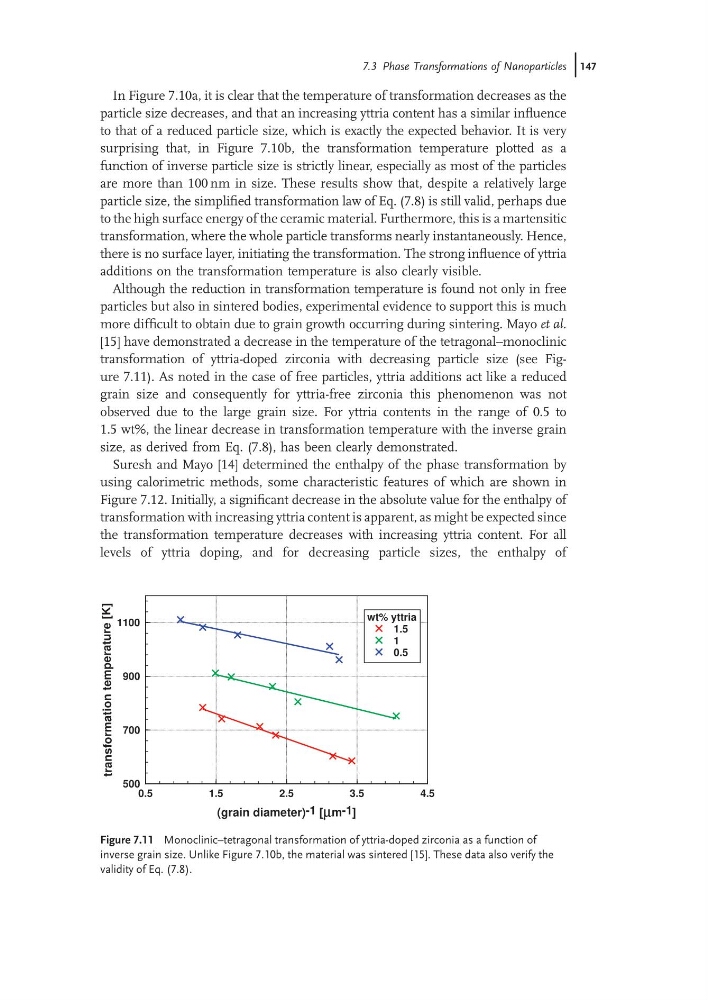
[15] have demonstrated a decrease in the temperature of the tetragonal–monoclinic
transformation of yttria-doped zirconia with decreasing particle size (see Figure 7.11). As noted in the case of free particles, yttria additions act like a reduced
grain size and consequently for yttria-free zirconia this phenomenon was not
observed due to the large grain size. For yttria contents in the range of 0.5 to
1.5 wt%, the linear decrease in transformation temperature with the inverse grain
size, as derived from Eq. (7.8), has been clearly demonstrated.
Suresh and Mayo [14] determined the enthalpy of the phase transformation by
using calorimetric methods, some characteristic features of which are shown in
Figure 7.12. Initially, a significant decrease in the absolute value for the enthalpy of
transformation with increasing yttria content is apparent, as might be expected since
the transformation temperature decreases with increasing yttria content. For all
levels of yttria doping, and for decreasing particle sizes, the enthalpy of
0.5
1.5
2.5
3.5
4.5
(grain diameter) -1 [μm -1 ]
500
700
900
1100
transformation
temperature
[K]
wt% yttria
1.5
1
0.5
Figure 7.11 Monoclinic–tetragonal transformation of yttria-doped zirconia as a function of
inverse grain size. Unlike Figure 7.10b, the material was sintered [15]. These data also verify the
validity of Eq. (7.8).
7.3 Phase Transformations of Nanoparticles j147
particle size decreases, and that an increasing yttria content has a similar influence
to that of a reduced particle size, which is exactly the expected behavior. It is very
surprising that, in Figure 7.10b, the transformation temperature plotted as a
function of inverse particle size is strictly linear, especially as most of the particles
are more than 100 nm in size. These results show that, despite a relatively large
particle size, the simplified transformation law of Eq. (7.8) is still valid, perhaps due
to the high surface energy of the ceramic material. Furthermore, this is a martensitic
transformation, where the whole particle transforms nearly instantaneously. Hence,
there is no surface layer, initiating the transformation. The strong influence of yttria
additions on the transformation temperature is also clearly visible.
Although the reduction in transformation temperature is found not only in free
particles but also in sintered bodies, experimental evidence to support this is much
more difficult to obtain due to grain growth occurring during sintering. Mayo et al.
[15] have demonstrated a decrease in the temperature of the tetragonal–monoclinic
transformation of yttria-doped zirconia with decreasing particle size (see Figure 7.11). As noted in the case of free particles, yttria additions act like a reduced
grain size and consequently for yttria-free zirconia this phenomenon was not
observed due to the large grain size. For yttria contents in the range of 0.5 to
1.5 wt%, the linear decrease in transformation temperature with the inverse grain
size, as derived from Eq. (7.8), has been clearly demonstrated.
Suresh and Mayo [14] determined the enthalpy of the phase transformation by
using calorimetric methods, some characteristic features of which are shown in
Figure 7.12. Initially, a significant decrease in the absolute value for the enthalpy of
transformation with increasing yttria content is apparent, as might be expected since
the transformation temperature decreases with increasing yttria content. For all
levels of yttria doping, and for decreasing particle sizes, the enthalpy of
0.5
1.5
2.5
3.5
4.5
(grain diameter) -1 [μm -1 ]
500
700
900
1100
transformation
temperature
[K]
wt% yttria
1.5
1
0.5
Figure 7.11 Monoclinic–tetragonal transformation of yttria-doped zirconia as a function of
inverse grain size. Unlike Figure 7.10b, the material was sintered [15]. These data also verify the
validity of Eq. (7.8).
7.3 Phase Transformations of Nanoparticles j147