

For ceramic materials, the monoclinic–tetragonal transformation of zirconia is
often studied as a function of the particle size. At room temperature with particle
sizes in the micrometer range, zirconia is monoclinic and transforms at 1475 K to
the tetragonal phase, and later at 2650 K into the cubic phase. However, by adding
metals with valencies of 2 or 3 it is possible to shift these transformations to lower
temperatures. The most successful method for stabilizing the tetragonal and cubic
phases is the addition of Y 2 O 3 and MgO. As zirconia dissolves yttria (Y 2 O 3 ) and yttria
stabilizes the tetragonal phase, it would be interesting to see how the particle size
and yttria content might influence the monoclinic–tetragonal transformation. Such
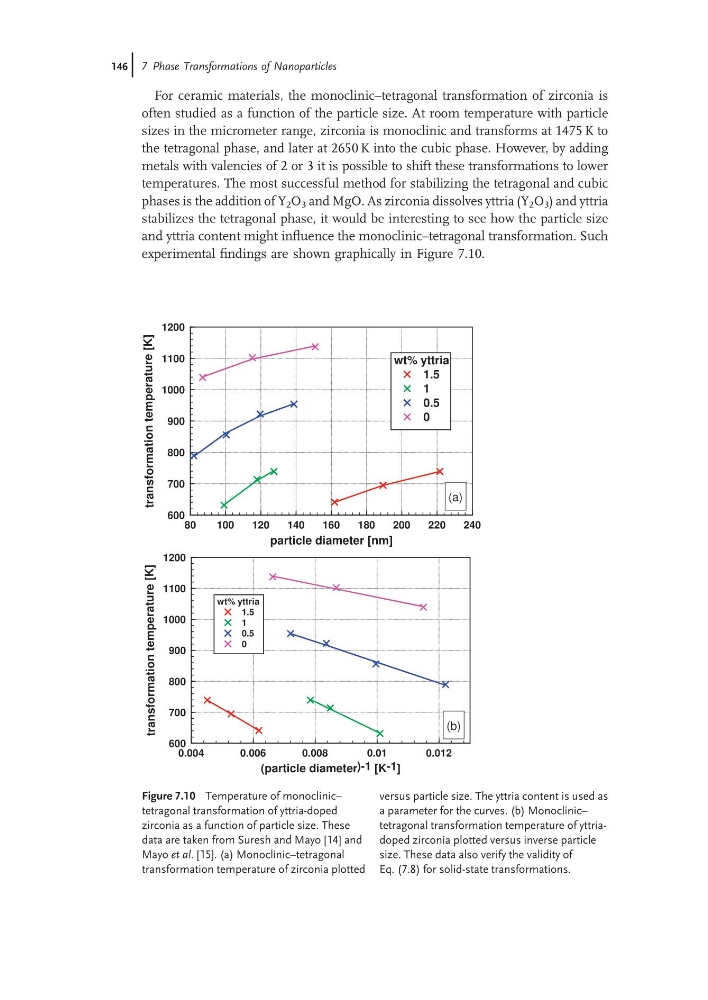
experimental findings are shown graphically in Figure 7.10.
0.004
0.006
0.008
0.01
0.012
(particle diameter )-1 [K -1 ]
600
700
800
900
1000
1100
1200
transformation
temperature
[K]
wt% yttria
1.5
1
0.5
0
80
100
120
140
160
180
200
220
240
particle diameter [nm]
600
700
800
900
1000
1100
1200
transformation
temperature
[K]
wt% yttria
1.5
1
0.5
0
(a)
(b)
Figure 7.10 Temperature of monoclinic–
tetragonal transformation of yttria-doped
zirconia as a function of particle size. These
data are taken from Suresh and Mayo [14] and
Mayo et al. [15]. (a) Monoclinic–tetragonal
transformation temperature of zirconia plotted
versus particle size. The yttria content is used as
a parameter for the curves. (b) Monoclinic–
tetragonal transformation temperature of yttriadoped zirconia plotted versus inverse particle
size. These data also verify the validity of
Eq. (7.8) for solid-state transformations.
146j 7 Phase Transformations of Nanoparticles
often studied as a function of the particle size. At room temperature with particle
sizes in the micrometer range, zirconia is monoclinic and transforms at 1475 K to
the tetragonal phase, and later at 2650 K into the cubic phase. However, by adding
metals with valencies of 2 or 3 it is possible to shift these transformations to lower
temperatures. The most successful method for stabilizing the tetragonal and cubic
phases is the addition of Y 2 O 3 and MgO. As zirconia dissolves yttria (Y 2 O 3 ) and yttria
stabilizes the tetragonal phase, it would be interesting to see how the particle size
and yttria content might influence the monoclinic–tetragonal transformation. Such
experimental findings are shown graphically in Figure 7.10.
0.004
0.006
0.008
0.01
0.012
(particle diameter )-1 [K -1 ]
600
700
800
900
1000
1100
1200
transformation
temperature
[K]
wt% yttria
1.5
1
0.5
0
80
100
120
140
160
180
200
220
240
particle diameter [nm]
600
700
800
900
1000
1100
1200
transformation
temperature
[K]
wt% yttria
1.5
1
0.5
0
(a)
(b)
Figure 7.10 Temperature of monoclinic–
tetragonal transformation of yttria-doped
zirconia as a function of particle size. These
data are taken from Suresh and Mayo [14] and
Mayo et al. [15]. (a) Monoclinic–tetragonal
transformation temperature of zirconia plotted
versus particle size. The yttria content is used as
a parameter for the curves. (b) Monoclinic–
tetragonal transformation temperature of yttriadoped zirconia plotted versus inverse particle
size. These data also verify the validity of
Eq. (7.8) for solid-state transformations.
146j 7 Phase Transformations of Nanoparticles