

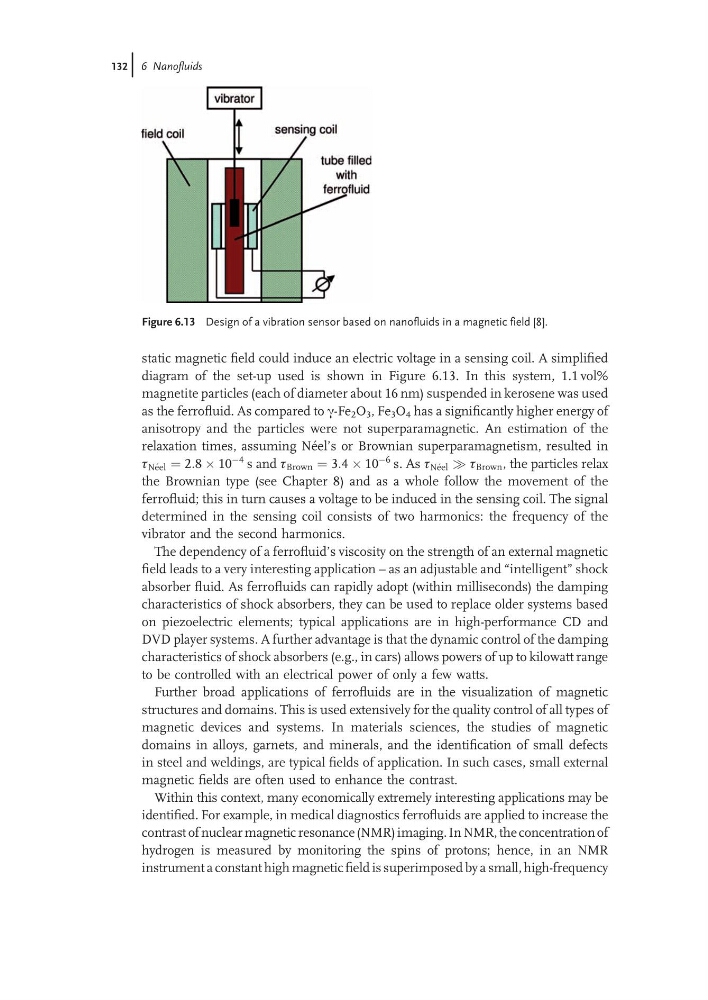
static magnetic field could induce an electric voltage in a sensing coil. A simplified
diagram of the set-up used is shown in Figure 6.13. In this system, 1.1 vol%
magnetite particles (each of diameter about 16 nm) suspended in kerosene was used
as the ferrofluid. As compared to c-Fe 2 O 3 , Fe 3 O 4 has a significantly higher energy of
anisotropy and the particles were not superparamagnetic. An estimation of the
relaxation times, assuming N eel’s or Brownian superparamagnetism, resulted in
t N eel ¼ 2:8 Â 10
À4 s and t Brown ¼ 3:4 Â 10
À6 s. As t N eel ) t Brown , the particles relax
the Brownian type (see Chapter 8) and as a whole follow the movement of the
ferrofluid; this in turn causes a voltage to be induced in the sensing coil. The signal
determined in the sensing coil consists of two harmonics: the frequency of the
vibrator and the second harmonics.
The dependency of a ferrofluid’s viscosity on the strength of an external magnetic
field leads to a very interesting application – as an adjustable and “intelligent” shock
absorber fluid. As ferrofluids can rapidly adopt (within milliseconds) the damping
characteristics of shock absorbers, they can be used to replace older systems based
on piezoelectric elements; typical applications are in high-performance CD and
DVD player systems. A further advantage is that the dynamic control of the damping
characteristics of shock absorbers (e.g., in cars) allows powers of up to kilowatt range
to be controlled with an electrical power of only a few watts.
Further broad applications of ferrofluids are in the visualization of magnetic
structures and domains. This is used extensively for the quality control of all types of
magnetic devices and systems. In materials sciences, the studies of magnetic
domains in alloys, garnets, and minerals, and the identification of small defects
in steel and weldings, are typical fields of application. In such cases, small external
magnetic fields are often used to enhance the contrast.
Within this context, many economically extremely interesting applications may be
identified. For example, in medical diagnostics ferrofluids are applied to increase the
contrast of nuclear magnetic resonance (NMR) imaging. In NMR, the concentration of
hydrogen is measured by monitoring the spins of protons; hence, in an NMR
instrument a constant high magnetic field is superimposed by a small, high-frequency
Figure 6.13 Design of a vibration sensor based on nanofluids in a magnetic field [8].
132j 6 Nanofluids
diagram of the set-up used is shown in Figure 6.13. In this system, 1.1 vol%
magnetite particles (each of diameter about 16 nm) suspended in kerosene was used
as the ferrofluid. As compared to c-Fe 2 O 3 , Fe 3 O 4 has a significantly higher energy of
anisotropy and the particles were not superparamagnetic. An estimation of the
relaxation times, assuming N eel’s or Brownian superparamagnetism, resulted in
t N eel ¼ 2:8 Â 10
À4 s and t Brown ¼ 3:4 Â 10
À6 s. As t N eel ) t Brown , the particles relax
the Brownian type (see Chapter 8) and as a whole follow the movement of the
ferrofluid; this in turn causes a voltage to be induced in the sensing coil. The signal
determined in the sensing coil consists of two harmonics: the frequency of the
vibrator and the second harmonics.
The dependency of a ferrofluid’s viscosity on the strength of an external magnetic
field leads to a very interesting application – as an adjustable and “intelligent” shock
absorber fluid. As ferrofluids can rapidly adopt (within milliseconds) the damping
characteristics of shock absorbers, they can be used to replace older systems based
on piezoelectric elements; typical applications are in high-performance CD and
DVD player systems. A further advantage is that the dynamic control of the damping
characteristics of shock absorbers (e.g., in cars) allows powers of up to kilowatt range
to be controlled with an electrical power of only a few watts.
Further broad applications of ferrofluids are in the visualization of magnetic
structures and domains. This is used extensively for the quality control of all types of
magnetic devices and systems. In materials sciences, the studies of magnetic
domains in alloys, garnets, and minerals, and the identification of small defects
in steel and weldings, are typical fields of application. In such cases, small external
magnetic fields are often used to enhance the contrast.
Within this context, many economically extremely interesting applications may be
identified. For example, in medical diagnostics ferrofluids are applied to increase the
contrast of nuclear magnetic resonance (NMR) imaging. In NMR, the concentration of
hydrogen is measured by monitoring the spins of protons; hence, in an NMR
instrument a constant high magnetic field is superimposed by a small, high-frequency
Figure 6.13 Design of a vibration sensor based on nanofluids in a magnetic field [8].
132j 6 Nanofluids