

magnetic field. The spins of the hydrogen nuclei (the protons) are oriented either
parallel or antiparallel to the magnetic field and, under the influence of the superimposed high-frequency field, they may “flip” into the other direction. In an NMR
system, the resonance frequency of this flipping process is measured and found to be
directly proportional to the external magnetic field. Local variations of the amount of
ferrofluid or the particle concentration cause changes in the magnetic field and,
therefore, in the resonance frequency of the protons. This leads to variations of
contrast that are more pronounced than those based on the concentration of protons
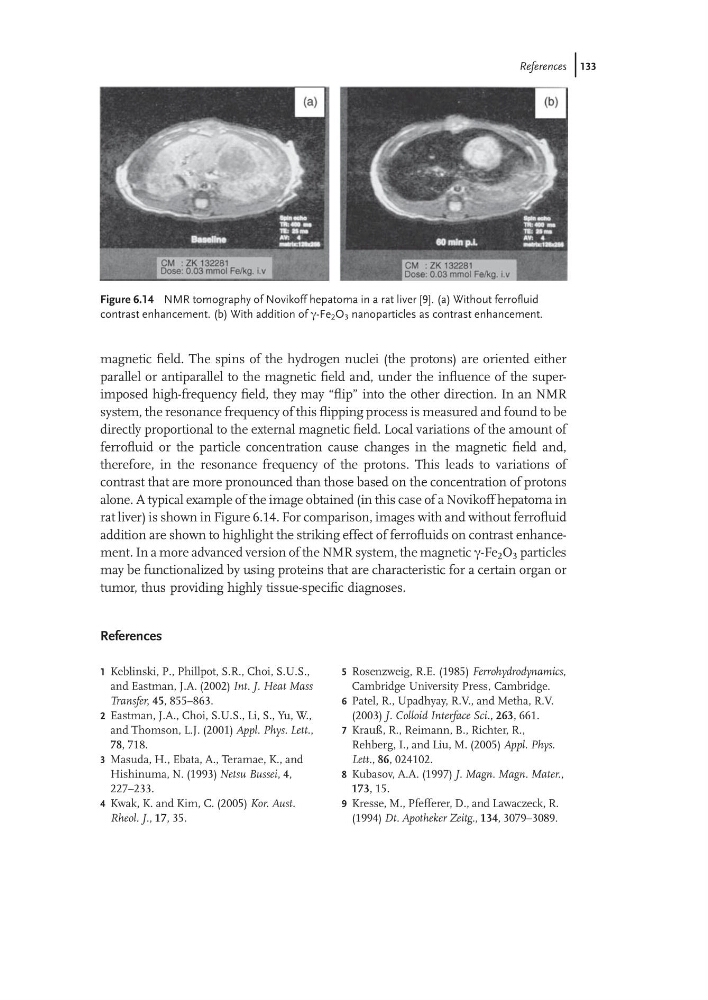
alone. A typical example of the image obtained (in this case of a Novikoff hepatoma in
rat liver) is shown in Figure 6.14. For comparison, images with and without ferrofluid
addition are shown to highlight the striking effect of ferrofluids on contrast enhancement. In a more advanced version of the NMR system, the magnetic c-Fe 2 O 3 particles
may be functionalized by using proteins that are characteristic for a certain organ or
tumor, thus providing highly tissue-specific diagnoses.
References
1 Keblinski, P., Phillpot, S.R., Choi, S.U.S.,
and Eastman, J.A. (2002) Int. J. Heat Mass
Transfer, 45, 855–863.
2 Eastman, J.A., Choi, S.U.S., Li, S., Yu, W.,
and Thomson, L.J. (2001) Appl. Phys. Lett.,
78, 718.
3 Masuda, H., Ebata, A., Teramae, K., and
Hishinuma, N. (1993) Netsu Bussei, 4,
227–233.
4 Kwak, K. and Kim, C. (2005) Kor. Aust.
Rheol. J., 17, 35.
5 Rosenzweig, R.E. (1985) Ferrohydrodynamics,
Cambridge University Press, Cambridge.
6 Patel, R., Upadhyay, R.V., and Metha, R.V.
(2003) J. Colloid Interface Sci., 263, 661.
7 Krauß, R., Reimann, B., Richter, R.,
Rehberg, I., and Liu, M. (2005) Appl. Phys.
Lett., 86, 024102.
8 Kubasov, A.A. (1997) J. Magn. Magn. Mater.,
173, 15.
9 Kresse, M., Pfefferer, D., and Lawaczeck, R.
(1994) Dt. Apotheker Zeitg., 134, 3079–3089.
Figure 6.14 NMR tomography of Novikoff hepatoma in a rat liver [9]. (a) Without ferrofluid
contrast enhancement. (b) With addition of c-Fe 2 O 3 nanoparticles as contrast enhancement.
References j133
parallel or antiparallel to the magnetic field and, under the influence of the superimposed high-frequency field, they may “flip” into the other direction. In an NMR
system, the resonance frequency of this flipping process is measured and found to be
directly proportional to the external magnetic field. Local variations of the amount of
ferrofluid or the particle concentration cause changes in the magnetic field and,
therefore, in the resonance frequency of the protons. This leads to variations of
contrast that are more pronounced than those based on the concentration of protons
alone. A typical example of the image obtained (in this case of a Novikoff hepatoma in
rat liver) is shown in Figure 6.14. For comparison, images with and without ferrofluid
addition are shown to highlight the striking effect of ferrofluids on contrast enhancement. In a more advanced version of the NMR system, the magnetic c-Fe 2 O 3 particles
may be functionalized by using proteins that are characteristic for a certain organ or
tumor, thus providing highly tissue-specific diagnoses.
References
1 Keblinski, P., Phillpot, S.R., Choi, S.U.S.,
and Eastman, J.A. (2002) Int. J. Heat Mass
Transfer, 45, 855–863.
2 Eastman, J.A., Choi, S.U.S., Li, S., Yu, W.,
and Thomson, L.J. (2001) Appl. Phys. Lett.,
78, 718.
3 Masuda, H., Ebata, A., Teramae, K., and
Hishinuma, N. (1993) Netsu Bussei, 4,
227–233.
4 Kwak, K. and Kim, C. (2005) Kor. Aust.
Rheol. J., 17, 35.
5 Rosenzweig, R.E. (1985) Ferrohydrodynamics,
Cambridge University Press, Cambridge.
6 Patel, R., Upadhyay, R.V., and Metha, R.V.
(2003) J. Colloid Interface Sci., 263, 661.
7 Krauß, R., Reimann, B., Richter, R.,
Rehberg, I., and Liu, M. (2005) Appl. Phys.
Lett., 86, 024102.
8 Kubasov, A.A. (1997) J. Magn. Magn. Mater.,
173, 15.
9 Kresse, M., Pfefferer, D., and Lawaczeck, R.
(1994) Dt. Apotheker Zeitg., 134, 3079–3089.
Figure 6.14 NMR tomography of Novikoff hepatoma in a rat liver [9]. (a) Without ferrofluid
contrast enhancement. (b) With addition of c-Fe 2 O 3 nanoparticles as contrast enhancement.
References j133