

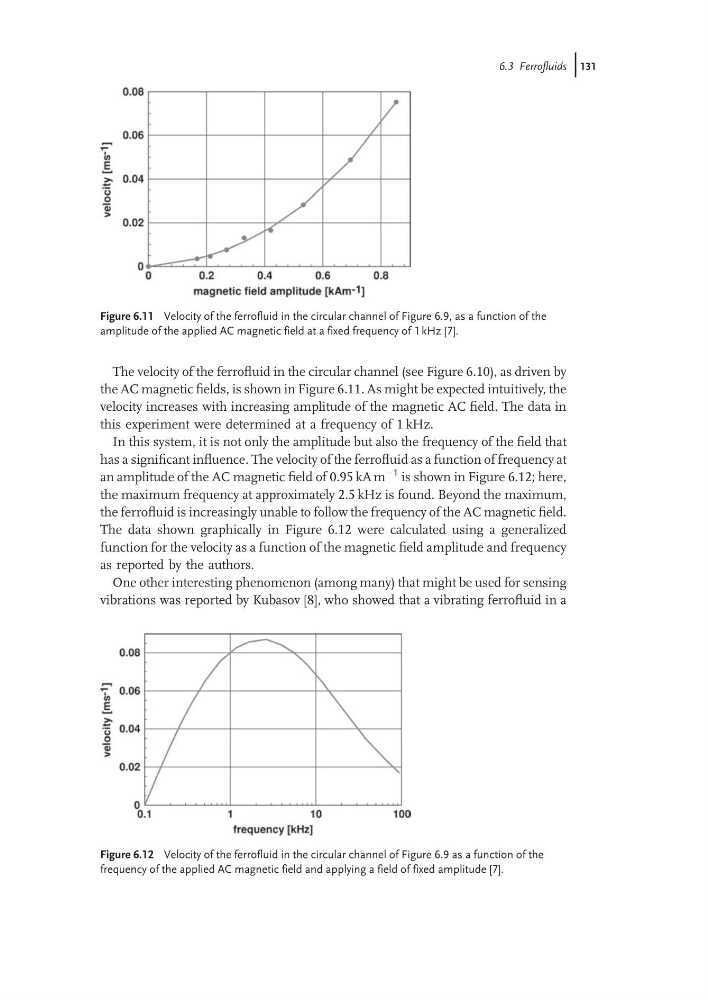
The velocity of the ferrofluid in the circular channel (see Figure 6.10), as driven by
the AC magnetic fields, is shown in Figure 6.11. As might be expected intuitively, the
velocity increases with increasing amplitude of the magnetic AC field. The data in
this experiment were determined at a frequency of 1 kHz.
In this system, it is not only the amplitude but also the frequency of the field that
has a significant influence. The velocity of the ferrofluid as a function of frequency at
an amplitude of the AC magnetic field of 0.95 kA m
À1 is shown in Figure 6.12; here,
the maximum frequency at approximately 2.5 kHz is found. Beyond the maximum,
the ferrofluid is increasingly unable to follow the frequency of the AC magnetic field.
The data shown graphically in Figure 6.12 were calculated using a generalized
function for the velocity as a function of the magnetic field amplitude and frequency
as reported by the authors.
One other interesting phenomenon (among many) that might be used for sensing
vibrations was reported by Kubasov [8], who showed that a vibrating ferrofluid in a
Figure 6.11 Velocity of the ferrofluid in the circular channel of Figure 6.9, as a function of the
amplitude of the applied AC magnetic field at a fixed frequency of 1 kHz [7].
Figure 6.12 Velocity of the ferrofluid in the circular channel of Figure 6.9 as a function of the
frequency of the applied AC magnetic field and applying a field of fixed amplitude [7].
6.3 Ferrofluids j131
the AC magnetic fields, is shown in Figure 6.11. As might be expected intuitively, the
velocity increases with increasing amplitude of the magnetic AC field. The data in
this experiment were determined at a frequency of 1 kHz.
In this system, it is not only the amplitude but also the frequency of the field that
has a significant influence. The velocity of the ferrofluid as a function of frequency at
an amplitude of the AC magnetic field of 0.95 kA m
À1 is shown in Figure 6.12; here,
the maximum frequency at approximately 2.5 kHz is found. Beyond the maximum,
the ferrofluid is increasingly unable to follow the frequency of the AC magnetic field.
The data shown graphically in Figure 6.12 were calculated using a generalized
function for the velocity as a function of the magnetic field amplitude and frequency
as reported by the authors.
One other interesting phenomenon (among many) that might be used for sensing
vibrations was reported by Kubasov [8], who showed that a vibrating ferrofluid in a
Figure 6.11 Velocity of the ferrofluid in the circular channel of Figure 6.9, as a function of the
amplitude of the applied AC magnetic field at a fixed frequency of 1 kHz [7].
Figure 6.12 Velocity of the ferrofluid in the circular channel of Figure 6.9 as a function of the
frequency of the applied AC magnetic field and applying a field of fixed amplitude [7].
6.3 Ferrofluids j131