

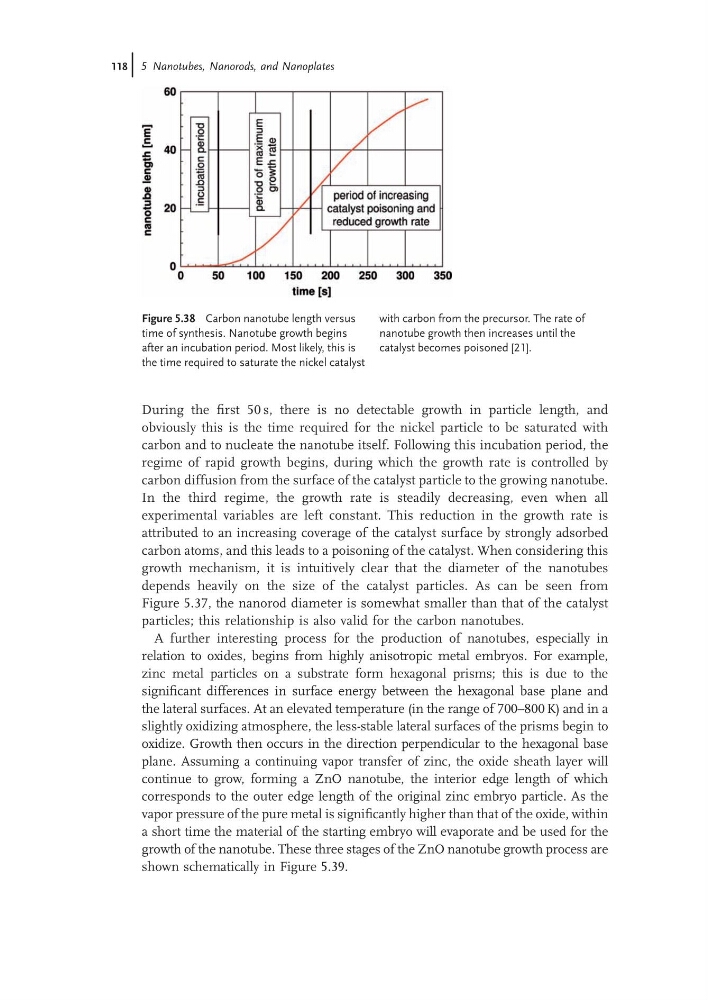
During the first 50 s, there is no detectable growth in particle length, and
obviously this is the time required for the nickel particle to be saturated with
carbon and to nucleate the nanotube itself. Following this incubation period, the
regime of rapid growth begins, during which the growth rate is controlled by
carbon diffusion from the surface of the catalyst particle to the growing nanotube.
In the third regime, the growth rate is steadily decreasing, even when all
experimental variables are left constant. This reduction in the growth rate is
attributed to an increasing coverage of the catalyst surface by strongly adsorbed
carbon atoms, and this leads to a poisoning of the catalyst. When considering this
growth mechanism, it is intuitively clear that the diameter of the nanotubes
depends heavily on the size of the catalyst particles. As can be seen from
Figure 5.37, the nanorod diameter is somewhat smaller than that of the catalyst
particles; this relationship is also valid for the carbon nanotubes.
A further interesting process for the production of nanotubes, especially in
relation to oxides, begins from highly anisotropic metal embryos. For example,
zinc metal particles on a substrate form hexagonal prisms; this is due to the
significant differences in surface energy between the hexagonal base plane and
the lateral surfaces. At an elevated temperature (in the range of 700–800 K) and in a
slightly oxidizing atmosphere, the less-stable lateral surfaces of the prisms begin to
oxidize. Growth then occurs in the direction perpendicular to the hexagonal base
plane. Assuming a continuing vapor transfer of zinc, the oxide sheath layer will
continue to grow, forming a ZnO nanotube, the interior edge length of which
corresponds to the outer edge length of the original zinc embryo particle. As the
vapor pressure of the pure metal is significantly higher than that of the oxide, within
a short time the material of the starting embryo will evaporate and be used for the
growth of the nanotube. These three stages of the ZnO nanotube growth process are
shown schematically in Figure 5.39.
Figure 5.38 Carbon nanotube length versus
time of synthesis. Nanotube growth begins
after an incubation period. Most likely, this is
the time required to saturate the nickel catalyst
with carbon from the precursor. The rate of
nanotube growth then increases until the
catalyst becomes poisoned [21].
118j 5 Nanotubes, Nanorods, and Nanoplates
obviously this is the time required for the nickel particle to be saturated with
carbon and to nucleate the nanotube itself. Following this incubation period, the
regime of rapid growth begins, during which the growth rate is controlled by
carbon diffusion from the surface of the catalyst particle to the growing nanotube.
In the third regime, the growth rate is steadily decreasing, even when all
experimental variables are left constant. This reduction in the growth rate is
attributed to an increasing coverage of the catalyst surface by strongly adsorbed
carbon atoms, and this leads to a poisoning of the catalyst. When considering this
growth mechanism, it is intuitively clear that the diameter of the nanotubes
depends heavily on the size of the catalyst particles. As can be seen from
Figure 5.37, the nanorod diameter is somewhat smaller than that of the catalyst
particles; this relationship is also valid for the carbon nanotubes.
A further interesting process for the production of nanotubes, especially in
relation to oxides, begins from highly anisotropic metal embryos. For example,
zinc metal particles on a substrate form hexagonal prisms; this is due to the
significant differences in surface energy between the hexagonal base plane and
the lateral surfaces. At an elevated temperature (in the range of 700–800 K) and in a
slightly oxidizing atmosphere, the less-stable lateral surfaces of the prisms begin to
oxidize. Growth then occurs in the direction perpendicular to the hexagonal base
plane. Assuming a continuing vapor transfer of zinc, the oxide sheath layer will
continue to grow, forming a ZnO nanotube, the interior edge length of which
corresponds to the outer edge length of the original zinc embryo particle. As the
vapor pressure of the pure metal is significantly higher than that of the oxide, within
a short time the material of the starting embryo will evaporate and be used for the
growth of the nanotube. These three stages of the ZnO nanotube growth process are
shown schematically in Figure 5.39.
Figure 5.38 Carbon nanotube length versus
time of synthesis. Nanotube growth begins
after an incubation period. Most likely, this is
the time required to saturate the nickel catalyst
with carbon from the precursor. The rate of
nanotube growth then increases until the
catalyst becomes poisoned [21].
118j 5 Nanotubes, Nanorods, and Nanoplates