

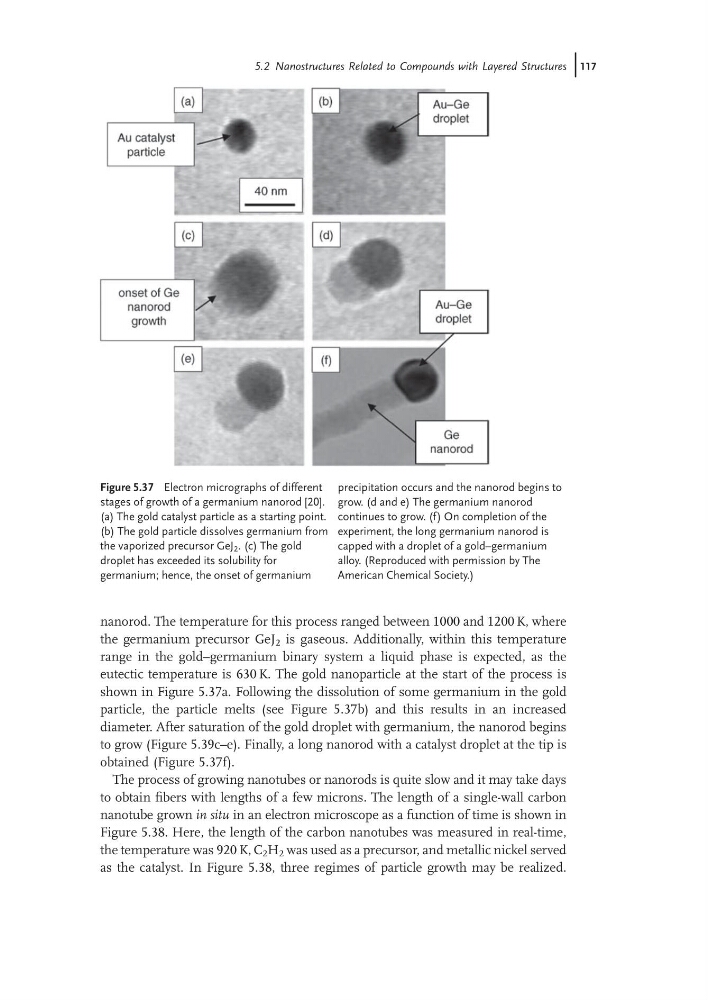
nanorod. The temperature for this process ranged between 1000 and 1200 K, where
the germanium precursor GeJ 2 is gaseous. Additionally, within this temperature
range in the gold–germanium binary system a liquid phase is expected, as the
eutectic temperature is 630 K. The gold nanoparticle at the start of the process is
shown in Figure 5.37a. Following the dissolution of some germanium in the gold
particle, the particle melts (see Figure 5.37b) and this results in an increased
diameter. After saturation of the gold droplet with germanium, the nanorod begins
to grow (Figure 5.39c–e). Finally, a long nanorod with a catalyst droplet at the tip is
obtained (Figure 5.37f).
The process of growing nanotubes or nanorods is quite slow and it may take days
to obtain fibers with lengths of a few microns. The length of a single-wall carbon
nanotube grown in situ in an electron microscope as a function of time is shown in
Figure 5.38. Here, the length of the carbon nanotubes was measured in real-time,
the temperature was 920 K, C 2 H 2 was used as a precursor, and metallic nickel served
as the catalyst. In Figure 5.38, three regimes of particle growth may be realized.
Figure 5.37 Electron micrographs of different
stages of growth of a germanium nanorod [20].
(a) The gold catalyst particle as a starting point.
(b) The gold particle dissolves germanium from
the vaporized precursor GeJ 2 . (c) The gold
droplet has exceeded its solubility for
germanium; hence, the onset of germanium
precipitation occurs and the nanorod begins to
grow. (d and e) The germanium nanorod
continues to grow. (f) On completion of the
experiment, the long germanium nanorod is
capped with a droplet of a gold–germanium
alloy. (Reproduced with permission by The
American Chemical Society.)
5.2 Nanostructures Related to Compounds with Layered Structures j117
the germanium precursor GeJ 2 is gaseous. Additionally, within this temperature
range in the gold–germanium binary system a liquid phase is expected, as the
eutectic temperature is 630 K. The gold nanoparticle at the start of the process is
shown in Figure 5.37a. Following the dissolution of some germanium in the gold
particle, the particle melts (see Figure 5.37b) and this results in an increased
diameter. After saturation of the gold droplet with germanium, the nanorod begins
to grow (Figure 5.39c–e). Finally, a long nanorod with a catalyst droplet at the tip is
obtained (Figure 5.37f).
The process of growing nanotubes or nanorods is quite slow and it may take days
to obtain fibers with lengths of a few microns. The length of a single-wall carbon
nanotube grown in situ in an electron microscope as a function of time is shown in
Figure 5.38. Here, the length of the carbon nanotubes was measured in real-time,
the temperature was 920 K, C 2 H 2 was used as a precursor, and metallic nickel served
as the catalyst. In Figure 5.38, three regimes of particle growth may be realized.
Figure 5.37 Electron micrographs of different
stages of growth of a germanium nanorod [20].
(a) The gold catalyst particle as a starting point.
(b) The gold particle dissolves germanium from
the vaporized precursor GeJ 2 . (c) The gold
droplet has exceeded its solubility for
germanium; hence, the onset of germanium
precipitation occurs and the nanorod begins to
grow. (d and e) The germanium nanorod
continues to grow. (f) On completion of the
experiment, the long germanium nanorod is
capped with a droplet of a gold–germanium
alloy. (Reproduced with permission by The
American Chemical Society.)
5.2 Nanostructures Related to Compounds with Layered Structures j117