

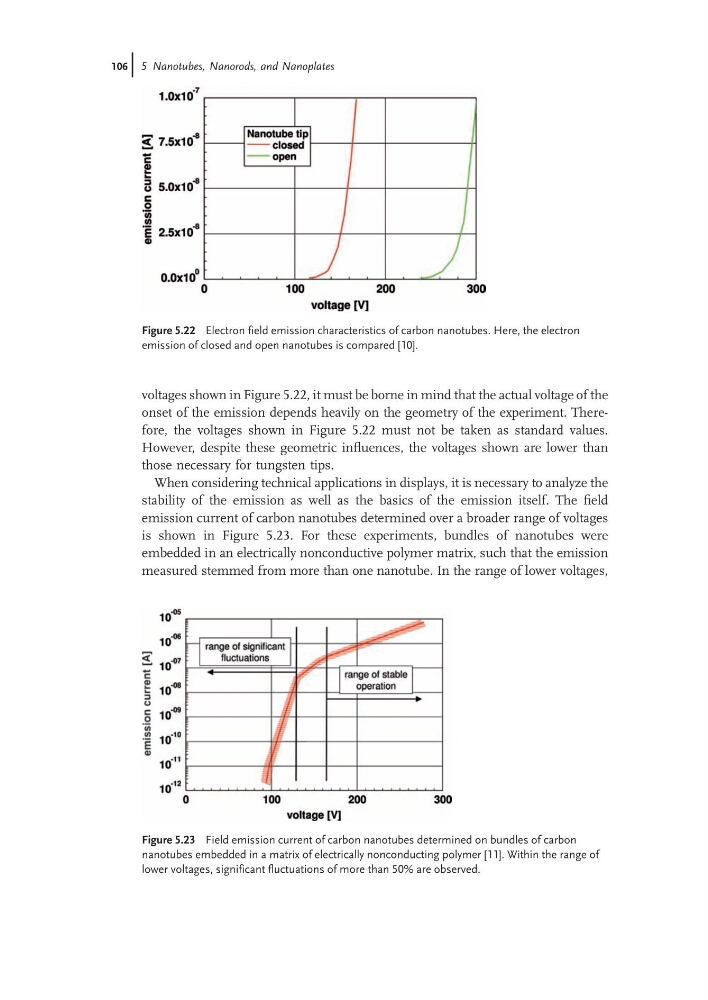
voltages shown in Figure 5.22, it must be borne in mind that the actual voltage of the
onset of the emission depends heavily on the geometry of the experiment. Therefore, the voltages shown in Figure 5.22 must not be taken as standard values.
However, despite these geometric influences, the voltages shown are lower than
those necessary for tungsten tips.
When considering technical applications in displays, it is necessary to analyze the
stability of the emission as well as the basics of the emission itself. The field
emission current of carbon nanotubes determined over a broader range of voltages
is shown in Figure 5.23. For these experiments, bundles of nanotubes were
embedded in an electrically nonconductive polymer matrix, such that the emission
measured stemmed from more than one nanotube. In the range of lower voltages,
Figure 5.22 Electron field emission characteristics of carbon nanotubes. Here, the electron
emission of closed and open nanotubes is compared [10].
Figure 5.23 Field emission current of carbon nanotubes determined on bundles of carbon
nanotubes embedded in a matrix of electrically nonconducting polymer [11]. Within the range of
lower voltages, significant fluctuations of more than 50% are observed.
106j 5 Nanotubes, Nanorods, and Nanoplates
onset of the emission depends heavily on the geometry of the experiment. Therefore, the voltages shown in Figure 5.22 must not be taken as standard values.
However, despite these geometric influences, the voltages shown are lower than
those necessary for tungsten tips.
When considering technical applications in displays, it is necessary to analyze the
stability of the emission as well as the basics of the emission itself. The field
emission current of carbon nanotubes determined over a broader range of voltages
is shown in Figure 5.23. For these experiments, bundles of nanotubes were
embedded in an electrically nonconductive polymer matrix, such that the emission
measured stemmed from more than one nanotube. In the range of lower voltages,
Figure 5.22 Electron field emission characteristics of carbon nanotubes. Here, the electron
emission of closed and open nanotubes is compared [10].
Figure 5.23 Field emission current of carbon nanotubes determined on bundles of carbon
nanotubes embedded in a matrix of electrically nonconducting polymer [11]. Within the range of
lower voltages, significant fluctuations of more than 50% are observed.
106j 5 Nanotubes, Nanorods, and Nanoplates