

multiwall nanotubes consist of a series of coiled graphene layers and can be depicted
perfectly using electron microscopy (see Figure 5.21). Previously, many excellent
electron micrographs of multiwall nanotubes comprising up to six layers have been
prepared. However, the actual structure can be demonstrated to better effect in
calculated examples. A typical calculated example consisting of four layers is shown
in Figure 5.21 where, for the individual nanotubes, the chirality vectors were chosen as
7; 0
ð Þ, 10; 0
ð
Þ, 13; 0
ð
Þ, and 16; 0
ð
Þ; this indicates that all four nanotubes are of the zigzag type. The outer diameter of this multiwall nanotube was 1.25 nm. Most of the
production processes involved deliver primarily multiwall nanotubes, with single-wall
nanotubes being the exception. However, the relative amount of the different types of
carbon nanotubes may be influenced by selecting appropriate catalysts for synthesis.
One property is common for the carbon structures, graphene, fullerenes, and
carbon nanotubes: each carbon atom has only three neighbors. Therefore, each
carbon atom has two single and bonds one double bond. The latter one may be used
for functionalization (e.g., it is possible to attach hydrogen). By attaching one
hydrogen atom per carbon atom, one obtains graphane. Graphane is, in contrast
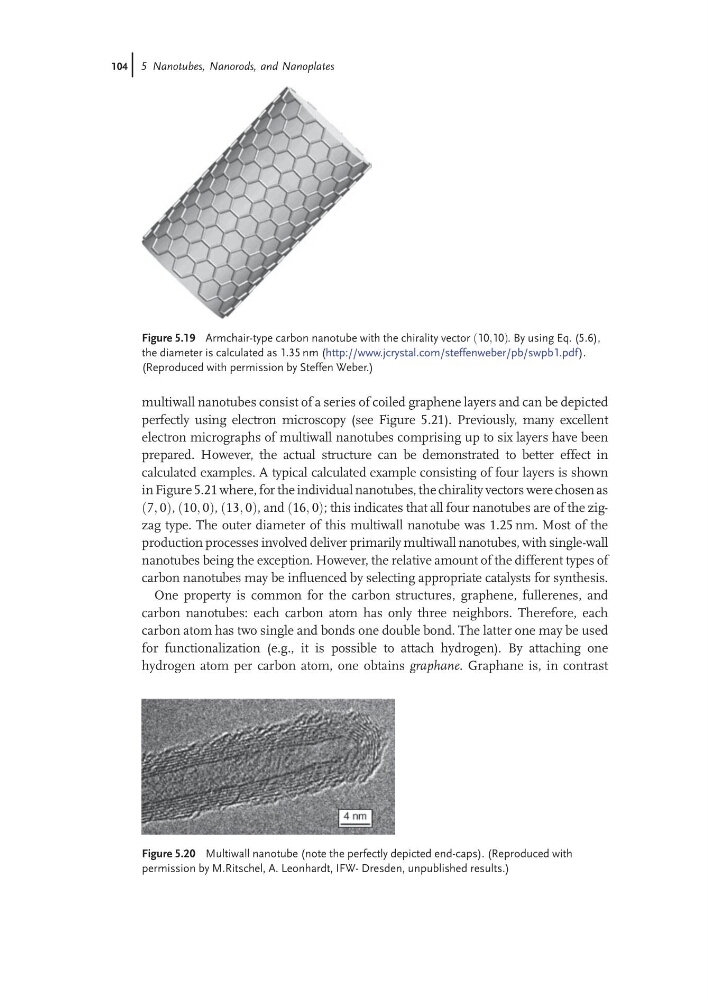
Figure 5.19 Armchair-type carbon nanotube with the chirality vector 10;10
ð
Þ . By using Eq. (5.6),
the diameter is calculated as 1.35 nm (http://www.jcrystal.com/steffenweber/pb/swpb1.pdf ).
(Reproduced with permission by Steffen Weber.)
Figure 5.20 Multiwall nanotube (note the perfectly depicted end-caps). (Reproduced with
permission by M.Ritschel, A. Leonhardt, IFW- Dresden, unpublished results.)
104j 5 Nanotubes, Nanorods, and Nanoplates
perfectly using electron microscopy (see Figure 5.21). Previously, many excellent
electron micrographs of multiwall nanotubes comprising up to six layers have been
prepared. However, the actual structure can be demonstrated to better effect in
calculated examples. A typical calculated example consisting of four layers is shown
in Figure 5.21 where, for the individual nanotubes, the chirality vectors were chosen as
7; 0
ð Þ, 10; 0
ð
Þ, 13; 0
ð
Þ, and 16; 0
ð
Þ; this indicates that all four nanotubes are of the zigzag type. The outer diameter of this multiwall nanotube was 1.25 nm. Most of the
production processes involved deliver primarily multiwall nanotubes, with single-wall
nanotubes being the exception. However, the relative amount of the different types of
carbon nanotubes may be influenced by selecting appropriate catalysts for synthesis.
One property is common for the carbon structures, graphene, fullerenes, and
carbon nanotubes: each carbon atom has only three neighbors. Therefore, each
carbon atom has two single and bonds one double bond. The latter one may be used
for functionalization (e.g., it is possible to attach hydrogen). By attaching one
hydrogen atom per carbon atom, one obtains graphane. Graphane is, in contrast
Figure 5.19 Armchair-type carbon nanotube with the chirality vector 10;10
ð
Þ . By using Eq. (5.6),
the diameter is calculated as 1.35 nm (http://www.jcrystal.com/steffenweber/pb/swpb1.pdf ).
(Reproduced with permission by Steffen Weber.)
Figure 5.20 Multiwall nanotube (note the perfectly depicted end-caps). (Reproduced with
permission by M.Ritschel, A. Leonhardt, IFW- Dresden, unpublished results.)
104j 5 Nanotubes, Nanorods, and Nanoplates