

Nanotubes are formed by wrapping graphene layers of limited size to form a tube. In
order to describe carbon nanotubes, the convention 0
m
j j n was adopted. The tube
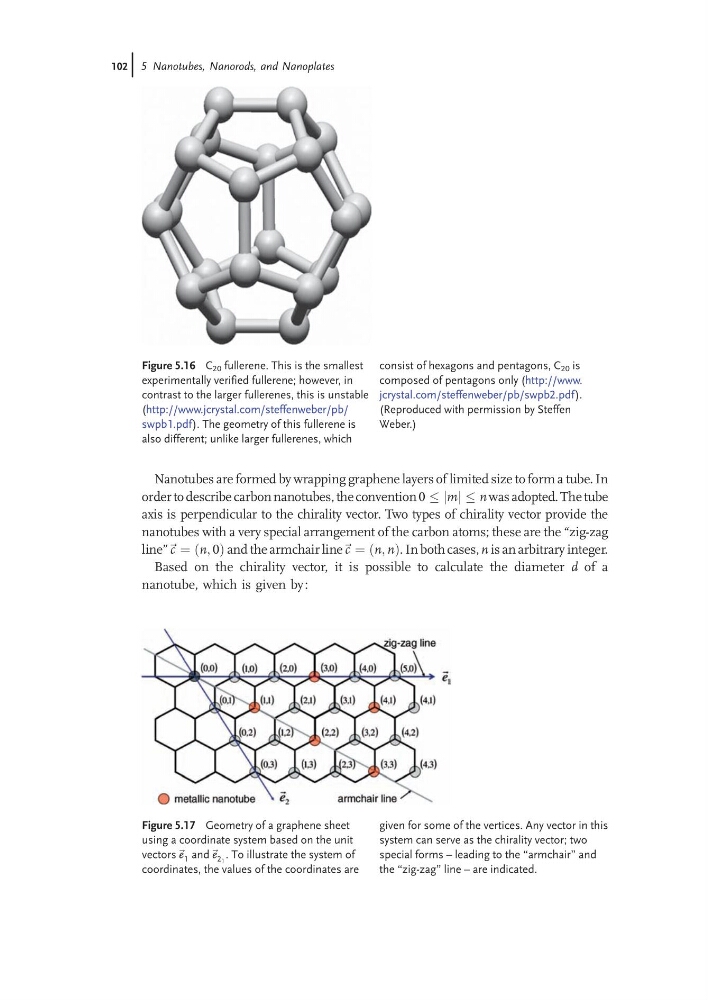
axis is perpendicular to the chirality vector. Two types of chirality vector provide the
nanotubes with a very special arrangement of the carbon atoms; these are the “zig-zag
line” ~ c ¼ ðn ; 0Þ and the armchair line ~ c ¼ ðn; n Þ. In both cases, n is an arbitrary integer.
Based on the chirality vector, it is possible to calculate the diameter d of a
nanotube, which is given by :
Figure 5.16 C 20 fullerene. This is the smallest
experimentally verified fullerene; however, in
contrast to the larger fullerenes, this is unstable
(http://www.jcrystal.com/steffenweber/pb/
swpb1.pdf ). The geometry of this fullerene is
also different; unlike larger fullerenes, which
consist of hexagons and pentagons, C 20 is
composed of pentagons only (http://www.
jcrystal.com/steffenweber/pb/swpb2.pdf ).
(Reproduced with permission by Steffen
Weber.)
Figure 5.17 Geometry of a graphene sheet
using a coordinate system based on the unit
vectors~ e 1 and~ e 21 . To illustrate the system of
coordinates, the values of the coordinates are
given for some of the vertices. Any vector in this
system can serve as the chirality vector; two
special forms – leading to the “armchair” and
the “zig-zag” line – are indicated.
102j 5 Nanotubes, Nanorods, and Nanoplates
order to describe carbon nanotubes, the convention 0
m
j j n was adopted. The tube
axis is perpendicular to the chirality vector. Two types of chirality vector provide the
nanotubes with a very special arrangement of the carbon atoms; these are the “zig-zag
line” ~ c ¼ ðn ; 0Þ and the armchair line ~ c ¼ ðn; n Þ. In both cases, n is an arbitrary integer.
Based on the chirality vector, it is possible to calculate the diameter d of a
nanotube, which is given by :
Figure 5.16 C 20 fullerene. This is the smallest
experimentally verified fullerene; however, in
contrast to the larger fullerenes, this is unstable
(http://www.jcrystal.com/steffenweber/pb/
swpb1.pdf ). The geometry of this fullerene is
also different; unlike larger fullerenes, which
consist of hexagons and pentagons, C 20 is
composed of pentagons only (http://www.
jcrystal.com/steffenweber/pb/swpb2.pdf ).
(Reproduced with permission by Steffen
Weber.)
Figure 5.17 Geometry of a graphene sheet
using a coordinate system based on the unit
vectors~ e 1 and~ e 21 . To illustrate the system of
coordinates, the values of the coordinates are
given for some of the vertices. Any vector in this
system can serve as the chirality vector; two
special forms – leading to the “armchair” and
the “zig-zag” line – are indicated.
102j 5 Nanotubes, Nanorods, and Nanoplates