

the simple formula: N ¼ 2 10 þ n
ð
Þ ; n 2 N ; polyhedrons with n < 2 consist of
pentagons only. Therefore, the smallest fullerene should consist of 20 carbon
atoms. Those fullerenes are most stable, where each pentagon is surrounded by
hexagons only. In addition to C 60 , the most important other fullerenes are C 70 , C 76 ,
C 78 , and C 84 . The appearances of C 60 and C 70 are shown in Figure 5.14a and b.
Clearly, C 60 resembles a soccer ball and therefore is often referred to as the “soccer
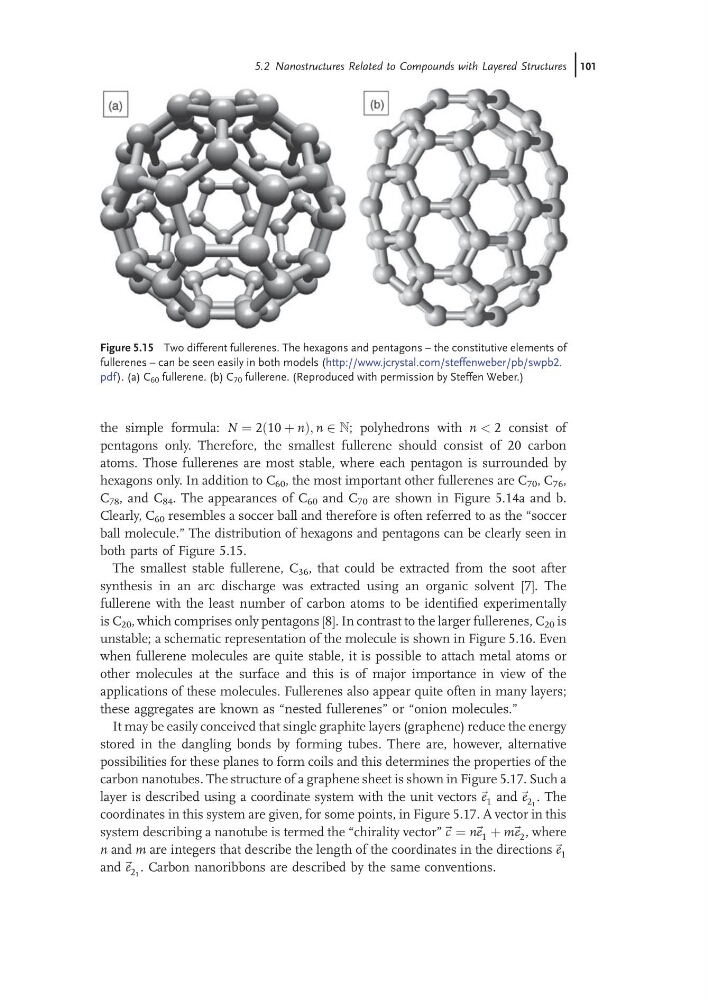
ball molecule.” The distribution of hexagons and pentagons can be clearly seen in
both parts of Figure 5.15.
The smallest stable fullerene, C 36 , that could be extracted from the soot after
synthesis in an arc discharge was extracted using an organic solvent [7]. The
fullerene with the least number of carbon atoms to be identi fied experimentally
is C 20 , which comprises only pentagons [8]. In contrast to the larger fullerenes, C 20 is
unstable; a schematic representation of the molecule is shown in Figure 5.16. Even
when fullerene molecules are quite stable, it is possible to attach metal atoms or
other molecules at the surface and this is of major importance in view of the
applications of these molecules. Fullerenes also appear quite often in many layers;
these aggregates are known as “nested fullerenes ” or “onion molecules.”
It may be easily conceived that single graphite layers (graphene) reduce the energy
stored in the dangling bonds by forming tubes. There are, however, alternative
possibilities for these planes to form coils and this determines the properties of the
carbon nanotubes. The structure of a graphene sheet is shown in Figure 5.17. Such a
layer is described using a coordinate system with the unit vectors ~ e 1 and ~ e 21 . The
coordinates in this system are given, for some points, in Figure 5.17. A vector in this
system describing a nanotube is termed the “chirality vector ” ~ c ¼ n~ e 1 þ m~ e 2 , where
n and m are integers that describe the length of the coordinates in the directions~ e 1
and ~ e 21 . Carbon nanoribbons are described by the same conventions.
Figure 5.15 Two different fullerenes. The hexagons and pentagons – the constitutive elements of
fullerenes – can be seen easily in both models (http://www.jcrystal.com/steffenweber/pb/swpb2.
pdf ). (a) C 60 fullerene. (b) C 70 fullerene. (Reproduced with permission by Steffen Weber.)
5.2 Nanostructures Related to Compounds with Layered Structures j101
ð
Þ ; n 2 N ; polyhedrons with n < 2 consist of
pentagons only. Therefore, the smallest fullerene should consist of 20 carbon
atoms. Those fullerenes are most stable, where each pentagon is surrounded by
hexagons only. In addition to C 60 , the most important other fullerenes are C 70 , C 76 ,
C 78 , and C 84 . The appearances of C 60 and C 70 are shown in Figure 5.14a and b.
Clearly, C 60 resembles a soccer ball and therefore is often referred to as the “soccer
ball molecule.” The distribution of hexagons and pentagons can be clearly seen in
both parts of Figure 5.15.
The smallest stable fullerene, C 36 , that could be extracted from the soot after
synthesis in an arc discharge was extracted using an organic solvent [7]. The
fullerene with the least number of carbon atoms to be identi fied experimentally
is C 20 , which comprises only pentagons [8]. In contrast to the larger fullerenes, C 20 is
unstable; a schematic representation of the molecule is shown in Figure 5.16. Even
when fullerene molecules are quite stable, it is possible to attach metal atoms or
other molecules at the surface and this is of major importance in view of the
applications of these molecules. Fullerenes also appear quite often in many layers;
these aggregates are known as “nested fullerenes ” or “onion molecules.”
It may be easily conceived that single graphite layers (graphene) reduce the energy
stored in the dangling bonds by forming tubes. There are, however, alternative
possibilities for these planes to form coils and this determines the properties of the
carbon nanotubes. The structure of a graphene sheet is shown in Figure 5.17. Such a
layer is described using a coordinate system with the unit vectors ~ e 1 and ~ e 21 . The
coordinates in this system are given, for some points, in Figure 5.17. A vector in this
system describing a nanotube is termed the “chirality vector ” ~ c ¼ n~ e 1 þ m~ e 2 , where
n and m are integers that describe the length of the coordinates in the directions~ e 1
and ~ e 21 . Carbon nanoribbons are described by the same conventions.
Figure 5.15 Two different fullerenes. The hexagons and pentagons – the constitutive elements of
fullerenes – can be seen easily in both models (http://www.jcrystal.com/steffenweber/pb/swpb2.
pdf ). (a) C 60 fullerene. (b) C 70 fullerene. (Reproduced with permission by Steffen Weber.)
5.2 Nanostructures Related to Compounds with Layered Structures j101