

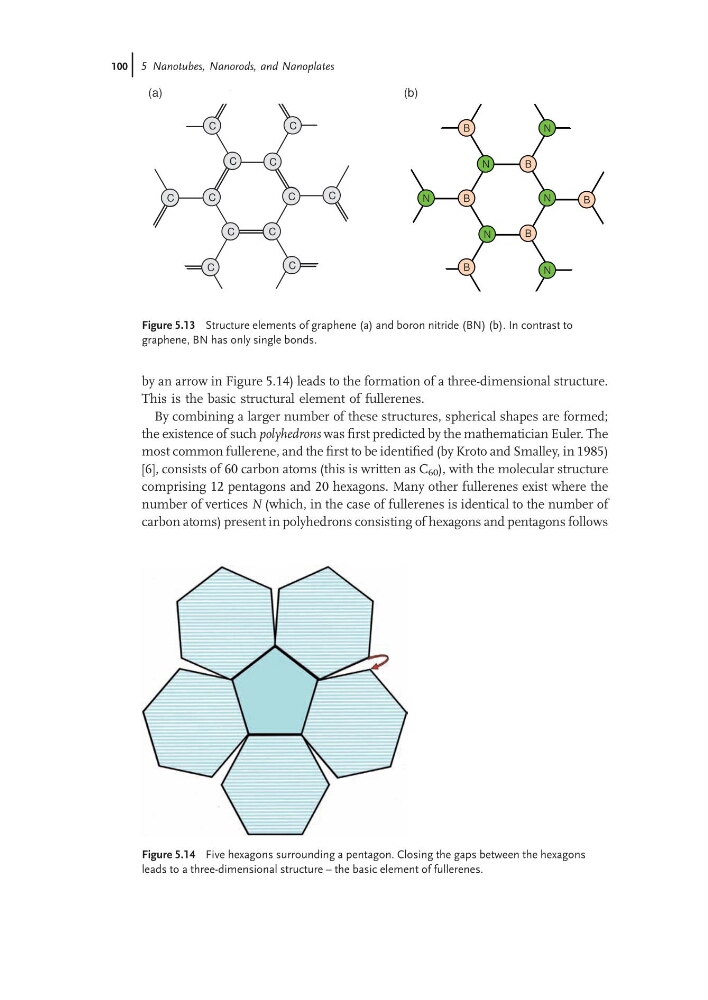
by an arrow in Figure 5.14) leads to the formation of a three-dimensional structure.
This is the basic structural element of fullerenes.
By combining a larger number of these structures, spherical shapes are formed;
the existence of such polyhedrons was first predicted by the mathematician Euler. The
most common fullerene, and the first to be identified (by Kroto and Smalley, in 1985)
[6], consists of 60 carbon atoms (this is written as C 60 ), with the molecular structure
comprising 12 pentagons and 20 hexagons. Many other fullerenes exist where the
number of vertices N (which, in the case of fullerenes is identical to the number of
carbon atoms) present in polyhedrons consisting of hexagons and pentagons follows
C
C
C
C
C
C
C
C
C
C
C
C
C
C
C
C
C
C
C
C
C
C
C
(a)
(b)
C
B
B
B
B
B
B
N
N
N
N
N
N
Figure 5.13 Structure elements of graphene (a) and boron nitride (BN) (b). In contrast to
graphene, BN has only single bonds.
Figure 5.14 Five hexagons surrounding a pentagon. Closing the gaps between the hexagons
leads to a three-dimensional structure – the basic element of fullerenes.
100j 5 Nanotubes, Nanorods, and Nanoplates
This is the basic structural element of fullerenes.
By combining a larger number of these structures, spherical shapes are formed;
the existence of such polyhedrons was first predicted by the mathematician Euler. The
most common fullerene, and the first to be identified (by Kroto and Smalley, in 1985)
[6], consists of 60 carbon atoms (this is written as C 60 ), with the molecular structure
comprising 12 pentagons and 20 hexagons. Many other fullerenes exist where the
number of vertices N (which, in the case of fullerenes is identical to the number of
carbon atoms) present in polyhedrons consisting of hexagons and pentagons follows
C
C
C
C
C
C
C
C
C
C
C
C
C
C
C
C
C
C
C
C
C
C
C
(a)
(b)
C
B
B
B
B
B
B
N
N
N
N
N
N
Figure 5.13 Structure elements of graphene (a) and boron nitride (BN) (b). In contrast to
graphene, BN has only single bonds.
Figure 5.14 Five hexagons surrounding a pentagon. Closing the gaps between the hexagons
leads to a three-dimensional structure – the basic element of fullerenes.
100j 5 Nanotubes, Nanorods, and Nanoplates