

Hence, only three of the four valences of the carbon atom are saturated. The fourth
electron of the atoms remains unbound and becomes delocalized across the
hexagonal atomic sheets of carbon. As these electrons are mobile, graphite shows
electrical conductivity within the layers; perpendicularly to the layers, graphite is an
insulator. Within the layers are strong covalent bonds, whereas in between the layers
are weak van der Waals bonds and, consequently, it is possible to cleave pieces of
monocrystalline graphite. These single layers of graphite are known as graphene, and
because of its structure and bonding graphene is often denominated as an infinitely
extended, two-dimensional aromatic compound. (The simplest aromatic compound
is benzene; this consists of one hexagon of carbon atoms, each connected to one
hydrogen atom.)
With respect to the bondings, this situation is depicted in Figure 5.13a. Figure
5.13a, showing one elementary hexagon and its first row of neighbors, clearly depicts
the interplay between single and double bonds. Boron nitride (BN) is isostructural
with graphite; however, with one important difference: in BN, one observes single
bonds only, as nitrogen as well as boron are both in their three valency state. Hence,
there are no free electrons, with the consequence that bulk BN is an isolator. (BN
nanotubes, however, are wide-band semiconductors.) In analogy to Figure 5.13a,
Figure 5.13b displays the elementary hexagon of BN and its first neighbors.
In the sense that graphene is a two-dimensional aromatic compound, fullerenes,
which also exist in the case of BN, are three-dimensional aromatics. Instead
of hexagons, fullerenes consist of a combination of hexagons and pentagons;
Figure 5.14 depicts one pentagon surrounded by five hexagons. As such an
arrangement leaves gaps between the hexagons, the closure of these (as indicated
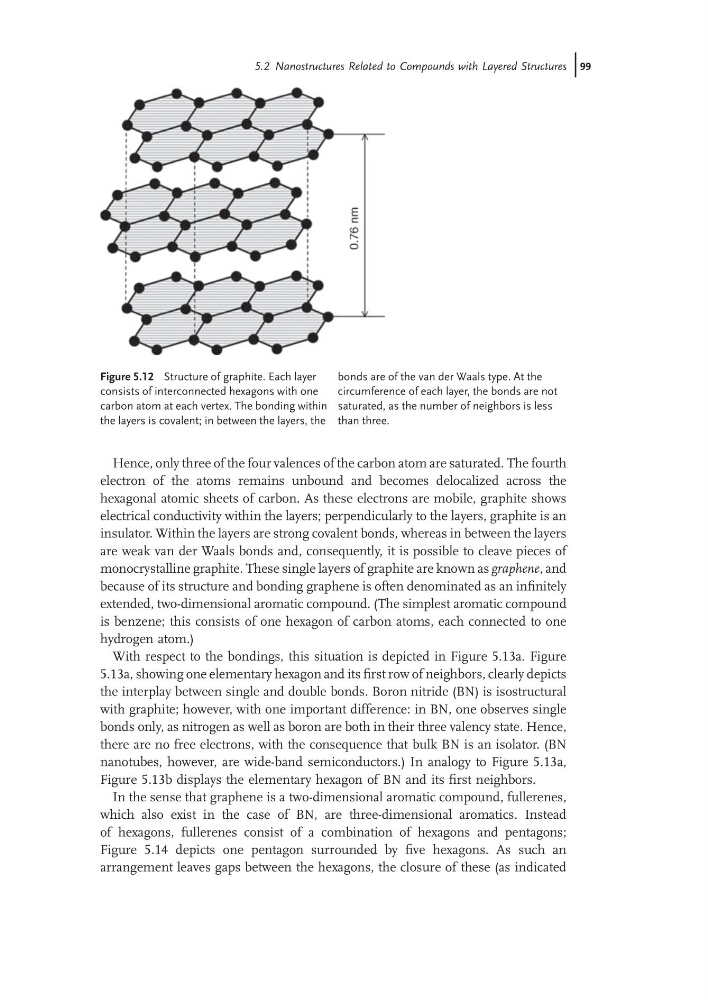
Figure 5.12 Structure of graphite. Each layer
consists of interconnected hexagons with one
carbon atom at each vertex. The bonding within
the layers is covalent; in between the layers, the
bonds are of the van der Waals type. At the
circumference of each layer, the bonds are not
saturated, as the number of neighbors is less
than three.
5.2 Nanostructures Related to Compounds with Layered Structures j99
electron of the atoms remains unbound and becomes delocalized across the
hexagonal atomic sheets of carbon. As these electrons are mobile, graphite shows
electrical conductivity within the layers; perpendicularly to the layers, graphite is an
insulator. Within the layers are strong covalent bonds, whereas in between the layers
are weak van der Waals bonds and, consequently, it is possible to cleave pieces of
monocrystalline graphite. These single layers of graphite are known as graphene, and
because of its structure and bonding graphene is often denominated as an infinitely
extended, two-dimensional aromatic compound. (The simplest aromatic compound
is benzene; this consists of one hexagon of carbon atoms, each connected to one
hydrogen atom.)
With respect to the bondings, this situation is depicted in Figure 5.13a. Figure
5.13a, showing one elementary hexagon and its first row of neighbors, clearly depicts
the interplay between single and double bonds. Boron nitride (BN) is isostructural
with graphite; however, with one important difference: in BN, one observes single
bonds only, as nitrogen as well as boron are both in their three valency state. Hence,
there are no free electrons, with the consequence that bulk BN is an isolator. (BN
nanotubes, however, are wide-band semiconductors.) In analogy to Figure 5.13a,
Figure 5.13b displays the elementary hexagon of BN and its first neighbors.
In the sense that graphene is a two-dimensional aromatic compound, fullerenes,
which also exist in the case of BN, are three-dimensional aromatics. Instead
of hexagons, fullerenes consist of a combination of hexagons and pentagons;
Figure 5.14 depicts one pentagon surrounded by five hexagons. As such an
arrangement leaves gaps between the hexagons, the closure of these (as indicated
Figure 5.12 Structure of graphite. Each layer
consists of interconnected hexagons with one
carbon atom at each vertex. The bonding within
the layers is covalent; in between the layers, the
bonds are of the van der Waals type. At the
circumference of each layer, the bonds are not
saturated, as the number of neighbors is less
than three.
5.2 Nanostructures Related to Compounds with Layered Structures j99