

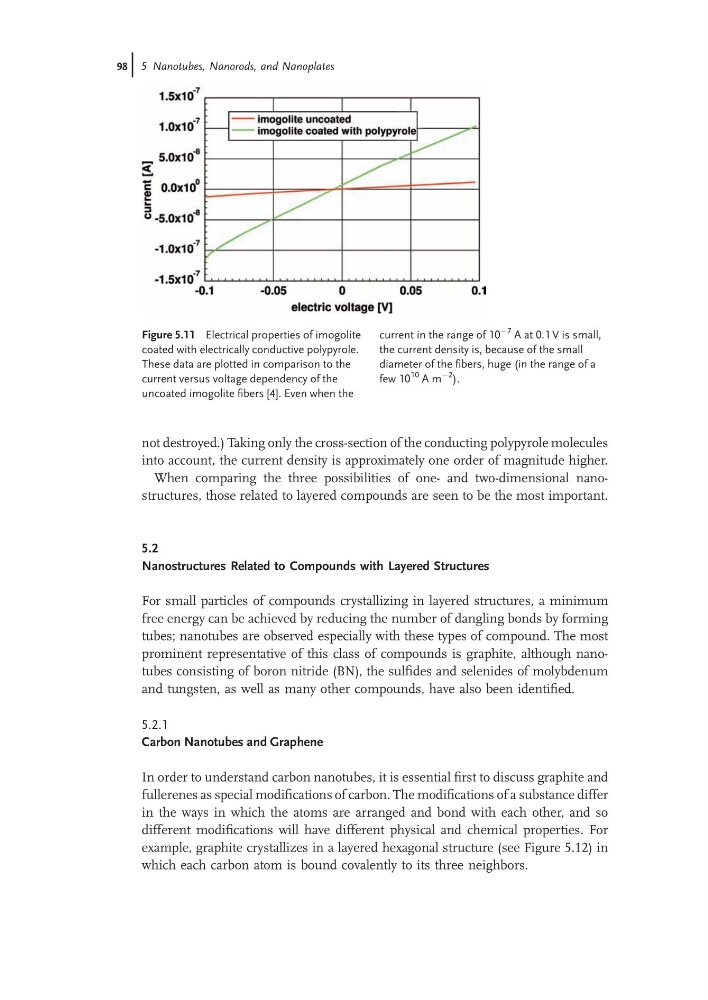
not destroyed.) Taking only the cross-section of the conducting polypyrole molecules
into account, the current density is approximately one order of magnitude higher.
When comparing the three possibilities of one- and two-dimensional nanostructures, those related to layered compounds are seen to be the most important.
5.2
Nanostructures Related to Compounds with Layered Structures
For small particles of compounds crystallizing in layered structures, a minimum
free energy can be achieved by reducing the number of dangling bonds by forming
tubes; nanotubes are observed especially with these types of compound. The most
prominent representative of this class of compounds is graphite, although nanotubes consisting of boron nitride (BN), the sulfides and selenides of molybdenum
and tungsten, as well as many other compounds, have also been identified.
5.2.1
Carbon Nanotubes and Graphene
In order to understand carbon nanotubes, it is essential first to discuss graphite and
fullerenes as special modifications of carbon. The modifications of a substance differ
in the ways in which the atoms are arranged and bond with each other, and so
different modifications will have different physical and chemical properties. For
example, graphite crystallizes in a layered hexagonal structure (see Figure 5.12) in
which each carbon atom is bound covalently to its three neighbors.
Figure 5.11 Electrical properties of imogolite
coated with electrically conductive polypyrole.
These data are plotted in comparison to the
current versus voltage dependency of the
uncoated imogolite fibers [4]. Even when the
current in the range of 10
À7 A at 0.1 V is small,
the current density is, because of the small
diameter of the fibers, huge (in the range of a
few 10
10 A m
À2
).
98j 5 Nanotubes, Nanorods, and Nanoplates
into account, the current density is approximately one order of magnitude higher.
When comparing the three possibilities of one- and two-dimensional nanostructures, those related to layered compounds are seen to be the most important.
5.2
Nanostructures Related to Compounds with Layered Structures
For small particles of compounds crystallizing in layered structures, a minimum
free energy can be achieved by reducing the number of dangling bonds by forming
tubes; nanotubes are observed especially with these types of compound. The most
prominent representative of this class of compounds is graphite, although nanotubes consisting of boron nitride (BN), the sulfides and selenides of molybdenum
and tungsten, as well as many other compounds, have also been identified.
5.2.1
Carbon Nanotubes and Graphene
In order to understand carbon nanotubes, it is essential first to discuss graphite and
fullerenes as special modifications of carbon. The modifications of a substance differ
in the ways in which the atoms are arranged and bond with each other, and so
different modifications will have different physical and chemical properties. For
example, graphite crystallizes in a layered hexagonal structure (see Figure 5.12) in
which each carbon atom is bound covalently to its three neighbors.
Figure 5.11 Electrical properties of imogolite
coated with electrically conductive polypyrole.
These data are plotted in comparison to the
current versus voltage dependency of the
uncoated imogolite fibers [4]. Even when the
current in the range of 10
À7 A at 0.1 V is small,
the current density is, because of the small
diameter of the fibers, huge (in the range of a
few 10
10 A m
À2
).
98j 5 Nanotubes, Nanorods, and Nanoplates