

electrical conductivity is demonstrated in Figure 5.11, which shows a clear increase
from 1.21 Â 10
À7 S for the uncoated imogolite to 1:04 Â 10
À6 S for the polypyrolecoated fibers. Even when the resistance of such wires is relatively high, the increase
in electrical conductivity by an order of magnitude promises many interesting
technical applications. The huge current density, which was applied to measure the
data depicted in Figure 5.11, of approximately 3 Â 10
10 A m
À2 (¼ 3 Â 10
4 A mm
À2 ) is
remarkable. (It must be pointed out that, at this current density, the specimen was
Figure 5.10 Imogolite nanotubes as synthesized by Koenderink et al. [5]. The fibers form bundles
with diameters ranging from 5 to 30 nm. The fibers may be up to a few micrometers in length.
(Reproduced with permission by Elsevier.)
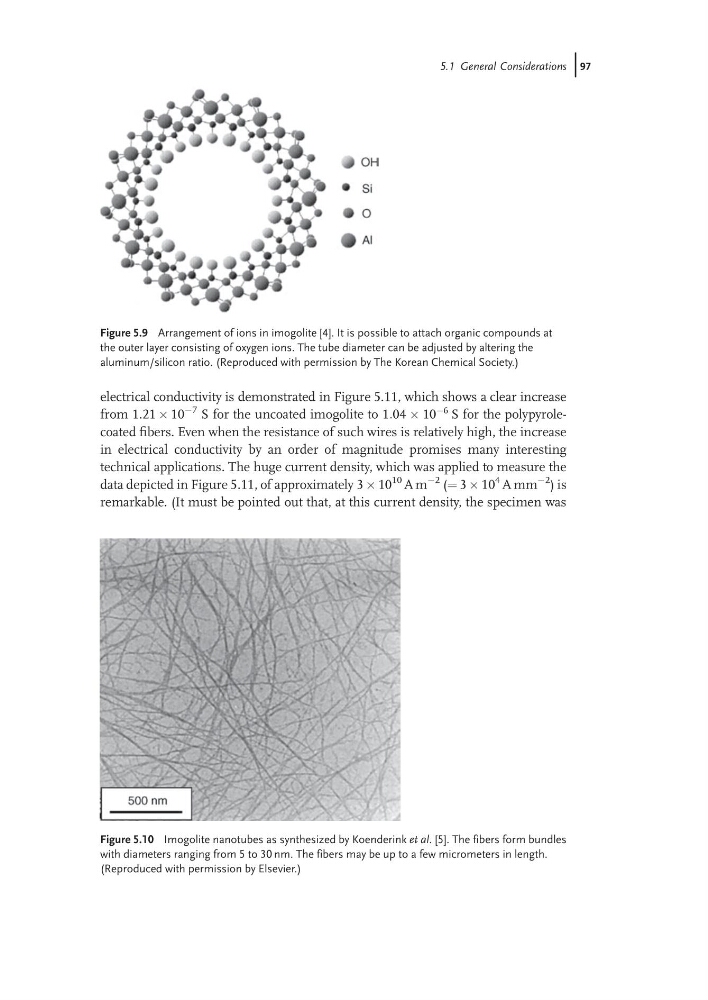
Figure 5.9 Arrangement of ions in imogolite [4]. It is possible to attach organic compounds at
the outer layer consisting of oxygen ions. The tube diameter can be adjusted by altering the
aluminum/silicon ratio. (Reproduced with permission by The Korean Chemical Society.)
5.1 General Considerations j97
from 1.21 Â 10
À7 S for the uncoated imogolite to 1:04 Â 10
À6 S for the polypyrolecoated fibers. Even when the resistance of such wires is relatively high, the increase
in electrical conductivity by an order of magnitude promises many interesting
technical applications. The huge current density, which was applied to measure the
data depicted in Figure 5.11, of approximately 3 Â 10
10 A m
À2 (¼ 3 Â 10
4 A mm
À2 ) is
remarkable. (It must be pointed out that, at this current density, the specimen was
Figure 5.10 Imogolite nanotubes as synthesized by Koenderink et al. [5]. The fibers form bundles
with diameters ranging from 5 to 30 nm. The fibers may be up to a few micrometers in length.
(Reproduced with permission by Elsevier.)
Figure 5.9 Arrangement of ions in imogolite [4]. It is possible to attach organic compounds at
the outer layer consisting of oxygen ions. The tube diameter can be adjusted by altering the
aluminum/silicon ratio. (Reproduced with permission by The Korean Chemical Society.)
5.1 General Considerations j97