

dimensional compounds is in the class of silicates called allophanes. These are shortrange, ordered aluminosilicates that follow the chemical formula
Al 2 O 3 Á(SiO 2 ) x Á(H 2 O) y , with 1:3 < x < 2 and 2:5 < y < 3. In most cases, allophanes
crystallize in tubes with diameters ranging from 2 to 5 nm. To some extent, the
aluminum in allophanes may be replaced by iron, magnesium, or manganese.
These substitutions influence the diameter of the tube and the color of the material.
The most important compound in this context is imogolite, with an ideal composition of Al 2 SiO 3 (OH) 4 . The ratio of silicon over aluminum is somewhat flexible and
can be used to adjust the tube diameter. Imogolite tubes with the ideal composition
are very narrow, with internal diameters of 1 nm and external diameters of 2 nm.
The structure of imogolite (see Figure 5.9) is characterized by aluminum, silicon,
oxygen, and OH
À ions arranged in rings. This structure allows the addition of
organic molecules (to “functionalize”) at the surface.
Imogolite fibers synthesized using a wet-chemical process are shown in Figure 5.10. In this way, fiber bundles with different diameters can be created and the
extremely high aspect ratio is clearly apparent. The tubes may be up to a few
micrometers in length, and both natural and synthesized imogolite tubes form
bundles with diameters ranging from 5 to 30 nm. The surface area of imogolite has
been determined experimentally as being in the range of 1000 Æ 100 m
2 g
À1 . The
Mohs hardness is quite low, ranging from 2 to 3. Although the geometry of the fibers
suggests a possible use as a filler in composite with polymer matrix, the relatively
poor strength of these fibers greatly limits the benefits of such composites.
It is possible to functionalize the surface of imogolite with organic molecules in
order to add new properties to the material. A typical example, reported by Lee et al.
[4], demonstrates the synthesis and functionalization of the surface with electrically
conductive polypyrole. The effect of surface functionalization with polypyrole on
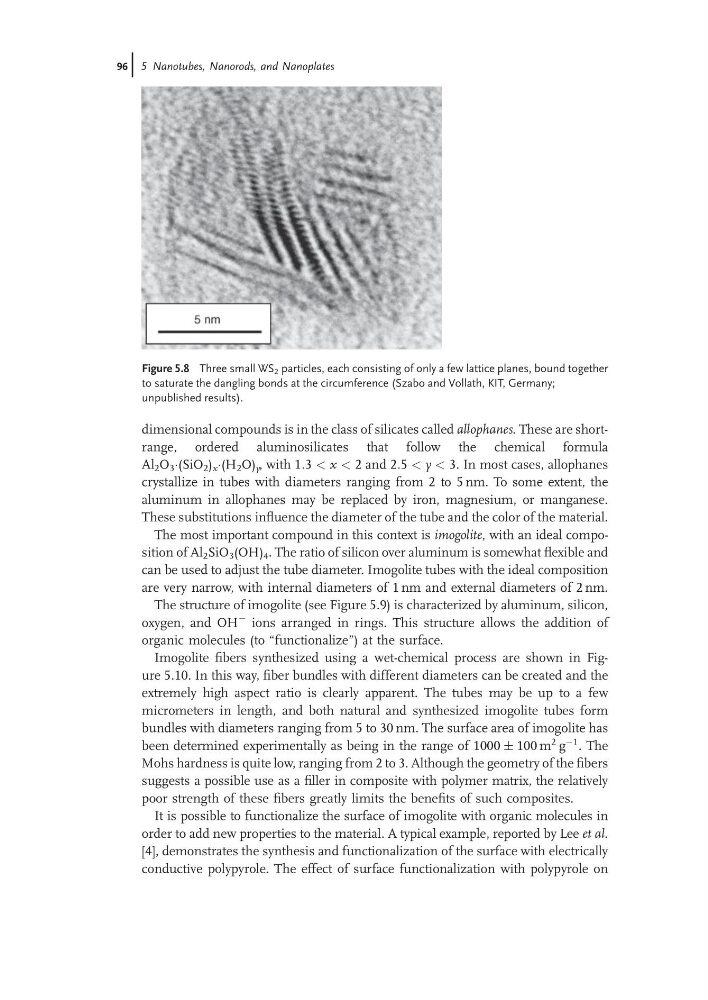
Figure 5.8 Three small WS 2 particles, each consisting of only a few lattice planes, bound together
to saturate the dangling bonds at the circumference (Szabo and Vollath, KIT, Germany;
unpublished results).
96j 5 Nanotubes, Nanorods, and Nanoplates
Al 2 O 3 Á(SiO 2 ) x Á(H 2 O) y , with 1:3 < x < 2 and 2:5 < y < 3. In most cases, allophanes
crystallize in tubes with diameters ranging from 2 to 5 nm. To some extent, the
aluminum in allophanes may be replaced by iron, magnesium, or manganese.
These substitutions influence the diameter of the tube and the color of the material.
The most important compound in this context is imogolite, with an ideal composition of Al 2 SiO 3 (OH) 4 . The ratio of silicon over aluminum is somewhat flexible and
can be used to adjust the tube diameter. Imogolite tubes with the ideal composition
are very narrow, with internal diameters of 1 nm and external diameters of 2 nm.
The structure of imogolite (see Figure 5.9) is characterized by aluminum, silicon,
oxygen, and OH
À ions arranged in rings. This structure allows the addition of
organic molecules (to “functionalize”) at the surface.
Imogolite fibers synthesized using a wet-chemical process are shown in Figure 5.10. In this way, fiber bundles with different diameters can be created and the
extremely high aspect ratio is clearly apparent. The tubes may be up to a few
micrometers in length, and both natural and synthesized imogolite tubes form
bundles with diameters ranging from 5 to 30 nm. The surface area of imogolite has
been determined experimentally as being in the range of 1000 Æ 100 m
2 g
À1 . The
Mohs hardness is quite low, ranging from 2 to 3. Although the geometry of the fibers
suggests a possible use as a filler in composite with polymer matrix, the relatively
poor strength of these fibers greatly limits the benefits of such composites.
It is possible to functionalize the surface of imogolite with organic molecules in
order to add new properties to the material. A typical example, reported by Lee et al.
[4], demonstrates the synthesis and functionalization of the surface with electrically
conductive polypyrole. The effect of surface functionalization with polypyrole on
Figure 5.8 Three small WS 2 particles, each consisting of only a few lattice planes, bound together
to saturate the dangling bonds at the circumference (Szabo and Vollath, KIT, Germany;
unpublished results).
96j 5 Nanotubes, Nanorods, and Nanoplates