

Waals forces rather than by electrostatic attraction. The general arrangement of
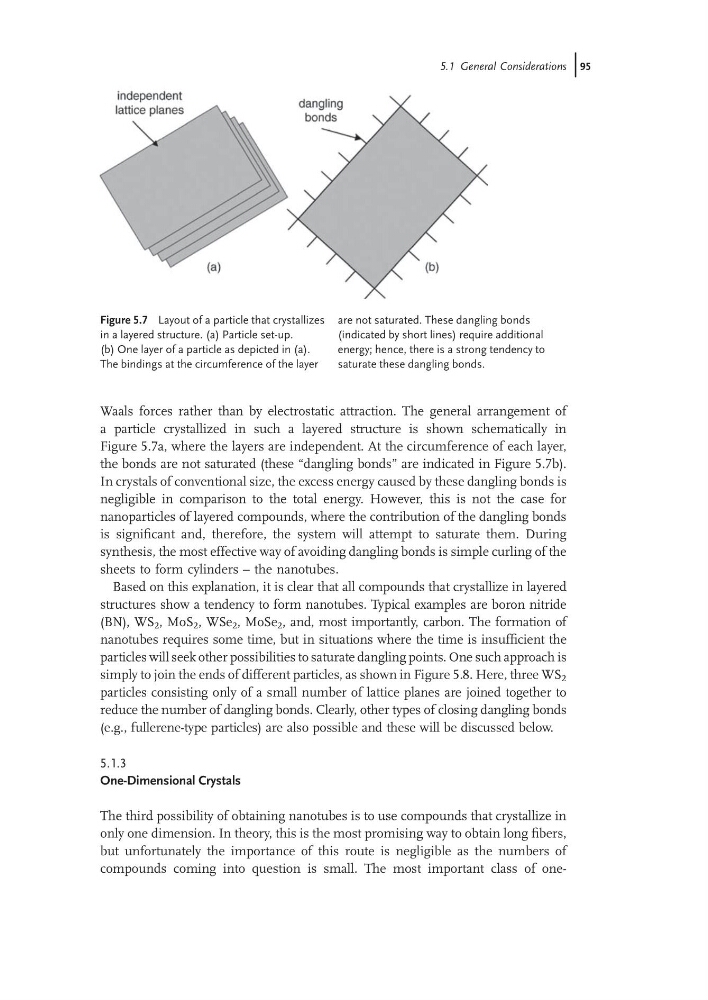
a particle crystallized in such a layered structure is shown schematically in
Figure 5.7a, where the layers are independent. At the circumference of each layer,
the bonds are not saturated (these “dangling bonds” are indicated in Figure 5.7b).
In crystals of conventional size, the excess energy caused by these dangling bonds is
negligible in comparison to the total energy. However, this is not the case for
nanoparticles of layered compounds, where the contribution of the dangling bonds
is significant and, therefore, the system will attempt to saturate them. During
synthesis, the most effective way of avoiding dangling bonds is simple curling of the
sheets to form cylinders – the nanotubes.
Based on this explanation, it is clear that all compounds that crystallize in layered
structures show a tendency to form nanotubes. Typical examples are boron nitride
(BN), WS 2 , MoS 2 , WSe 2 , MoSe 2 , and, most importantly, carbon. The formation of
nanotubes requires some time, but in situations where the time is insufficient the
particles will seek other possibilities to saturate dangling points. One such approach is
simply to join the ends of different particles, as shown in Figure 5.8. Here, three WS 2
particles consisting only of a small number of lattice planes are joined together to
reduce the number of dangling bonds. Clearly, other types of closing dangling bonds
(e.g., fullerene-type particles) are also possible and these will be discussed below.
5.1.3
One-Dimensional Crystals
The third possibility of obtaining nanotubes is to use compounds that crystallize in
only one dimension. In theory, this is the most promising way to obtain long fibers,
but unfortunately the importance of this route is negligible as the numbers of
compounds coming into question is small. The most important class of oneFigure 5.7 Layout of a particle that crystallizes
in a layered structure. (a) Particle set-up.
(b) One layer of a particle as depicted in (a).
The bindings at the circumference of the layer
are not saturated. These dangling bonds
(indicated by short lines) require additional
energy; hence, there is a strong tendency to
saturate these dangling bonds.
5.1 General Considerations j95
a particle crystallized in such a layered structure is shown schematically in
Figure 5.7a, where the layers are independent. At the circumference of each layer,
the bonds are not saturated (these “dangling bonds” are indicated in Figure 5.7b).
In crystals of conventional size, the excess energy caused by these dangling bonds is
negligible in comparison to the total energy. However, this is not the case for
nanoparticles of layered compounds, where the contribution of the dangling bonds
is significant and, therefore, the system will attempt to saturate them. During
synthesis, the most effective way of avoiding dangling bonds is simple curling of the
sheets to form cylinders – the nanotubes.
Based on this explanation, it is clear that all compounds that crystallize in layered
structures show a tendency to form nanotubes. Typical examples are boron nitride
(BN), WS 2 , MoS 2 , WSe 2 , MoSe 2 , and, most importantly, carbon. The formation of
nanotubes requires some time, but in situations where the time is insufficient the
particles will seek other possibilities to saturate dangling points. One such approach is
simply to join the ends of different particles, as shown in Figure 5.8. Here, three WS 2
particles consisting only of a small number of lattice planes are joined together to
reduce the number of dangling bonds. Clearly, other types of closing dangling bonds
(e.g., fullerene-type particles) are also possible and these will be discussed below.
5.1.3
One-Dimensional Crystals
The third possibility of obtaining nanotubes is to use compounds that crystallize in
only one dimension. In theory, this is the most promising way to obtain long fibers,
but unfortunately the importance of this route is negligible as the numbers of
compounds coming into question is small. The most important class of oneFigure 5.7 Layout of a particle that crystallizes
in a layered structure. (a) Particle set-up.
(b) One layer of a particle as depicted in (a).
The bindings at the circumference of the layer
are not saturated. These dangling bonds
(indicated by short lines) require additional
energy; hence, there is a strong tendency to
saturate these dangling bonds.
5.1 General Considerations j95