

By comparing Eqs. (5.3) and (5.4), one obtains for the stability condition of
arrangement (a):
8c a ac þ 2c c a
2 < 6c a ac þ 4c c a
2 )
c a
c c
c
a
< 1 or
c a
c c
<
a
c
ð5:5aÞ
Equation (5.5a) is, lastly, equivalent to Eq. (5.2). A system fulfilling Eq. (5.5a) leads to
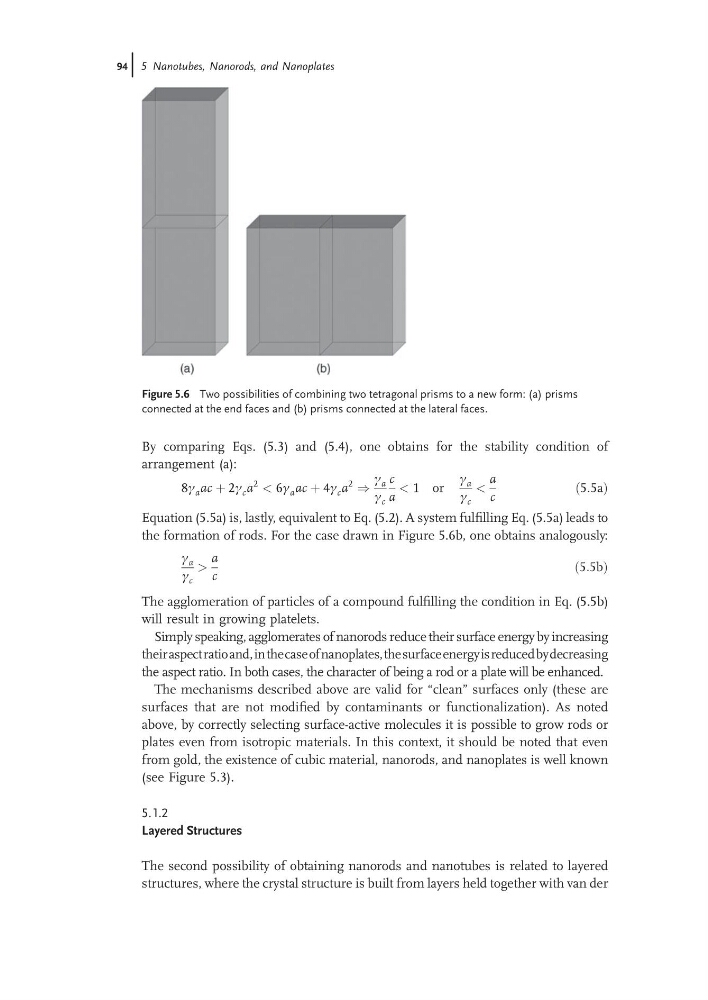
the formation of rods. For the case drawn in Figure 5.6b, one obtains analogously:
c a
c c
>
a
c
ð5:5bÞ
The agglomeration of particles of a compound fulfilling the condition in Eq. (5.5b)
will result in growing platelets.
Simply speaking, agglomerates of nanorods reduce their surface energy by increasing
theiraspectratioand,inthecaseofnanoplates,thesurfaceenergyisreducedbydecreasing
the aspect ratio. In both cases, the character of being a rod or a plate will be enhanced.
The mechanisms described above are valid for “clean” surfaces only (these are
surfaces that are not modified by contaminants or functionalization). As noted
above, by correctly selecting surface-active molecules it is possible to grow rods or
plates even from isotropic materials. In this context, it should be noted that even
from gold, the existence of cubic material, nanorods, and nanoplates is well known
(see Figure 5.3).
5.1.2
Layered Structures
The second possibility of obtaining nanorods and nanotubes is related to layered
structures, where the crystal structure is built from layers held together with van der
Figure 5.6 Two possibilities of combining two tetragonal prisms to a new form: (a) prisms
connected at the end faces and (b) prisms connected at the lateral faces.
94j 5 Nanotubes, Nanorods, and Nanoplates
arrangement (a):
8c a ac þ 2c c a
2 < 6c a ac þ 4c c a
2 )
c a
c c
c
a
< 1 or
c a
c c
<
a
c
ð5:5aÞ
Equation (5.5a) is, lastly, equivalent to Eq. (5.2). A system fulfilling Eq. (5.5a) leads to
the formation of rods. For the case drawn in Figure 5.6b, one obtains analogously:
c a
c c
>
a
c
ð5:5bÞ
The agglomeration of particles of a compound fulfilling the condition in Eq. (5.5b)
will result in growing platelets.
Simply speaking, agglomerates of nanorods reduce their surface energy by increasing
theiraspectratioand,inthecaseofnanoplates,thesurfaceenergyisreducedbydecreasing
the aspect ratio. In both cases, the character of being a rod or a plate will be enhanced.
The mechanisms described above are valid for “clean” surfaces only (these are
surfaces that are not modified by contaminants or functionalization). As noted
above, by correctly selecting surface-active molecules it is possible to grow rods or
plates even from isotropic materials. In this context, it should be noted that even
from gold, the existence of cubic material, nanorods, and nanoplates is well known
(see Figure 5.3).
5.1.2
Layered Structures
The second possibility of obtaining nanorods and nanotubes is related to layered
structures, where the crystal structure is built from layers held together with van der
Figure 5.6 Two possibilities of combining two tetragonal prisms to a new form: (a) prisms
connected at the end faces and (b) prisms connected at the lateral faces.
94j 5 Nanotubes, Nanorods, and Nanoplates