

in aqueous solution, and the size and shape of the gold platelets were controlled by
the addition of polyvinylpyrrolidone in different quantities. The application of other
organic agents may also lead to the formation of nanorods.
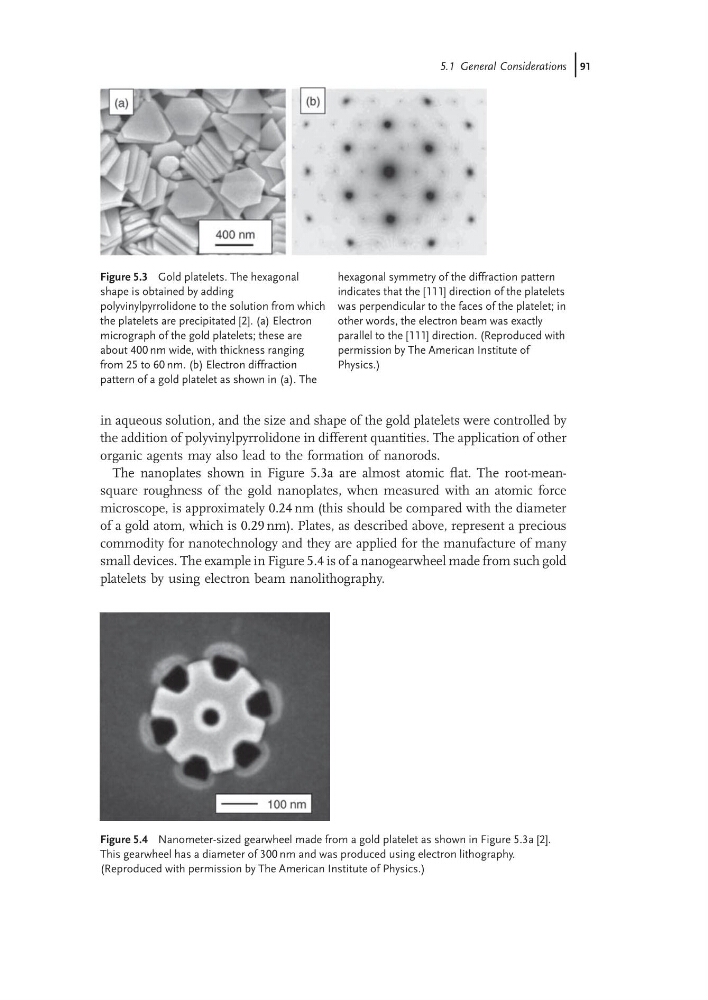
The nanoplates shown in Figure 5.3a are almost atomic flat. The root-meansquare roughness of the gold nanoplates, when measured with an atomic force
microscope, is approximately 0.24 nm (this should be compared with the diameter
of a gold atom, which is 0.29 nm). Plates, as described above, represent a precious
commodity for nanotechnology and they are applied for the manufacture of many
small devices. The example in Figure 5.4 is of a nanogearwheel made from such gold
platelets by using electron beam nanolithography.
Figure 5.3 Gold platelets. The hexagonal
shape is obtained by adding
polyvinylpyrrolidone to the solution from which
the platelets are precipitated [2]. (a) Electron
micrograph of the gold platelets; these are
about 400 nm wide, with thickness ranging
from 25 to 60 nm. (b) Electron diffraction
pattern of a gold platelet as shown in (a). The
hexagonal symmetry of the diffraction pattern
indicates that the [111] direction of the platelets
was perpendicular to the faces of the platelet; in
other words, the electron beam was exactly
parallel to the [111] direction. (Reproduced with
permission by The American Institute of
Physics.)
Figure 5.4 Nanometer-sized gearwheel made from a gold platelet as shown in Figure 5.3a [2].
This gearwheel has a diameter of 300 nm and was produced using electron lithography.
(Reproduced with permission by The American Institute of Physics.)
5.1 General Considerations j91
the addition of polyvinylpyrrolidone in different quantities. The application of other
organic agents may also lead to the formation of nanorods.
The nanoplates shown in Figure 5.3a are almost atomic flat. The root-meansquare roughness of the gold nanoplates, when measured with an atomic force
microscope, is approximately 0.24 nm (this should be compared with the diameter
of a gold atom, which is 0.29 nm). Plates, as described above, represent a precious
commodity for nanotechnology and they are applied for the manufacture of many
small devices. The example in Figure 5.4 is of a nanogearwheel made from such gold
platelets by using electron beam nanolithography.
Figure 5.3 Gold platelets. The hexagonal
shape is obtained by adding
polyvinylpyrrolidone to the solution from which
the platelets are precipitated [2]. (a) Electron
micrograph of the gold platelets; these are
about 400 nm wide, with thickness ranging
from 25 to 60 nm. (b) Electron diffraction
pattern of a gold platelet as shown in (a). The
hexagonal symmetry of the diffraction pattern
indicates that the [111] direction of the platelets
was perpendicular to the faces of the platelet; in
other words, the electron beam was exactly
parallel to the [111] direction. (Reproduced with
permission by The American Institute of
Physics.)
Figure 5.4 Nanometer-sized gearwheel made from a gold platelet as shown in Figure 5.3a [2].
This gearwheel has a diameter of 300 nm and was produced using electron lithography.
(Reproduced with permission by The American Institute of Physics.)
5.1 General Considerations j91