

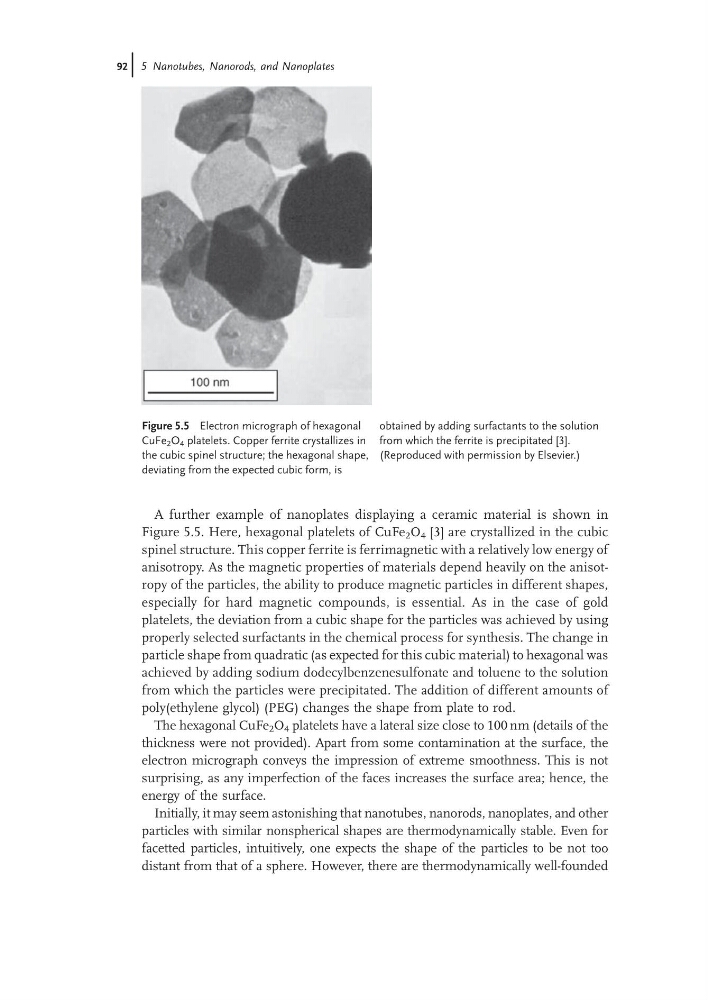
A further example of nanoplates displaying a ceramic material is shown in
Figure 5.5. Here, hexagonal platelets of CuFe 2 O 4 [3] are crystallized in the cubic
spinel structure. This copper ferrite is ferrimagnetic with a relatively low energy of
anisotropy. As the magnetic properties of materials depend heavily on the anisotropy of the particles, the ability to produce magnetic particles in different shapes,
especially for hard magnetic compounds, is essential. As in the case of gold
platelets, the deviation from a cubic shape for the particles was achieved by using
properly selected surfactants in the chemical process for synthesis. The change in
particle shape from quadratic (as expected for this cubic material) to hexagonal was
achieved by adding sodium dodecylbenzenesulfonate and toluene to the solution
from which the particles were precipitated. The addition of different amounts of
poly(ethylene glycol) (PEG) changes the shape from plate to rod.
The hexagonal CuFe 2 O 4 platelets have a lateral size close to 100 nm (details of the
thickness were not provided). Apart from some contamination at the surface, the
electron micrograph conveys the impression of extreme smoothness. This is not
surprising, as any imperfection of the faces increases the surface area; hence, the
energy of the surface.
Initially, it may seem astonishing that nanotubes, nanorods, nanoplates, and other
particles with similar nonspherical shapes are thermodynamically stable. Even for
facetted particles, intuitively, one expects the shape of the particles to be not too
distant from that of a sphere. However, there are thermodynamically well-founded
Figure 5.5 Electron micrograph of hexagonal
CuFe 2 O 4 platelets. Copper ferrite crystallizes in
the cubic spinel structure; the hexagonal shape,
deviating from the expected cubic form, is
obtained by adding surfactants to the solution
from which the ferrite is precipitated [3].
(Reproduced with permission by Elsevier.)
92j 5 Nanotubes, Nanorods, and Nanoplates
Figure 5.5. Here, hexagonal platelets of CuFe 2 O 4 [3] are crystallized in the cubic
spinel structure. This copper ferrite is ferrimagnetic with a relatively low energy of
anisotropy. As the magnetic properties of materials depend heavily on the anisotropy of the particles, the ability to produce magnetic particles in different shapes,
especially for hard magnetic compounds, is essential. As in the case of gold
platelets, the deviation from a cubic shape for the particles was achieved by using
properly selected surfactants in the chemical process for synthesis. The change in
particle shape from quadratic (as expected for this cubic material) to hexagonal was
achieved by adding sodium dodecylbenzenesulfonate and toluene to the solution
from which the particles were precipitated. The addition of different amounts of
poly(ethylene glycol) (PEG) changes the shape from plate to rod.
The hexagonal CuFe 2 O 4 platelets have a lateral size close to 100 nm (details of the
thickness were not provided). Apart from some contamination at the surface, the
electron micrograph conveys the impression of extreme smoothness. This is not
surprising, as any imperfection of the faces increases the surface area; hence, the
energy of the surface.
Initially, it may seem astonishing that nanotubes, nanorods, nanoplates, and other
particles with similar nonspherical shapes are thermodynamically stable. Even for
facetted particles, intuitively, one expects the shape of the particles to be not too
distant from that of a sphere. However, there are thermodynamically well-founded
Figure 5.5 Electron micrograph of hexagonal
CuFe 2 O 4 platelets. Copper ferrite crystallizes in
the cubic spinel structure; the hexagonal shape,
deviating from the expected cubic form, is
obtained by adding surfactants to the solution
from which the ferrite is precipitated [3].
(Reproduced with permission by Elsevier.)
92j 5 Nanotubes, Nanorods, and Nanoplates