

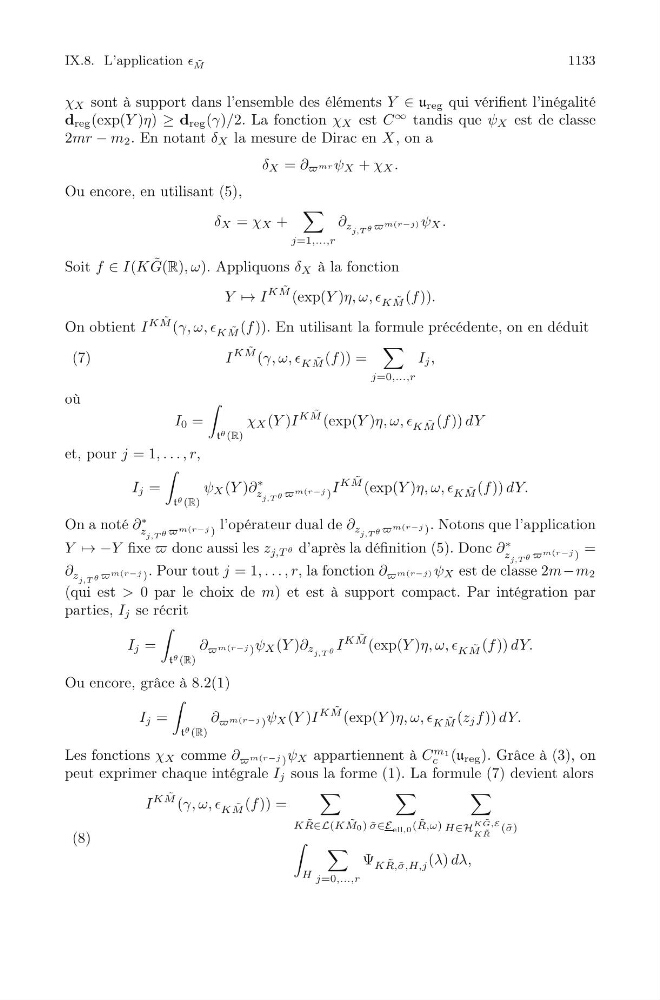
IX.8. L’application ˜
M
1133
χ X sont à support dans l’ensemble des éléments Y ∈ u reg qui vérifient l’inégalité
d reg (exp(Y )η) ≥ d reg (γ)/2. La fonction χ X est C
∞ tandis que ψ X est de classe
2mr − m 2 . En notant δ X la mesure de Dirac en X, on a
δ X = ∂ mr ψ X + χ X .
Ou encore, en utilisant (5),
δ X = χ X +
j=1,...,r
∂ z j,T θ m(r−j) ψ X .
Soit f ∈ I(K ˜
G(R), ω). Appliquons δ X à la fonction
Y → I
K ˜
M (exp(Y )η, ω, , K ˜
M (f )).
On obtient I
K ˜
M (γ, ω, , K ˜
M (f )). En utilisant la formule précédente, on en déduit
(7)
I
K ˜
M (γ, ω, , K ˜
M (f )) =
j=0,...,r
I j ,
où
I 0 =
t θ (R)
χ X (Y )I
K ˜
M (exp(Y )η, ω, , K ˜
M (f )) dY
et, pour j = 1, . . . , r,
I j =
t θ (R)
ψ X (Y )∂
∗
z j,T θ m(r−j ) I
K ˜
M (exp(Y )η, ω, , K ˜
M (f )) dY.
On a noté ∂
∗
z j,T θ m(r−j )
l’opérateur dual de ∂ z j,T θ m(r−j ) . Notons que l’application
Y → −Y fixe donc aussi les z j,T θ d’après la définition (5). Donc ∂
∗
z j,T θ m(r−j )
=
∂ z j,T θ m(r−j ) . Pour tout j = 1, . . . , r, la fonction ∂ m(r−j) ψ X est de classe 2m−m 2
(qui est > 0 par le choix de m) et est à support compact. Par intégration par
parties, I j se récrit
I j =
t θ (R)
∂ m(r−j ) ψ X (Y )∂ z j,T θ I
K ˜
M (exp(Y )η, ω, , K ˜
M (f )) dY.
Ou encore, grâce à 8.2(1)
I j =
t θ (R)
∂ m(r−j ) ψ X (Y )I
K ˜
M (exp(Y )η, ω, , K ˜
M (z j f )) dY.
Les fonctions χ X comme ∂ m(r−j ) ψ X appartiennent à C
m1
c (u reg ). Grâce à (3), on
peut exprimer chaque intégrale I j sous la forme (1). La formule (7) devient alors
(8)
I
K ˜
M (γ, ω, , K ˜
M (f )) =
K ˜
R∈L(K ˜
M0)
˜
σ∈E ell,0 ( ˜
R,ω)
H∈H
K ˜
G,E
K ˜
R
(˜ σ)
H
j=0,...,r
Ψ K ˜
R,˜ σ,H,j (λ) dλ,
M
1133
χ X sont à support dans l’ensemble des éléments Y ∈ u reg qui vérifient l’inégalité
d reg (exp(Y )η) ≥ d reg (γ)/2. La fonction χ X est C
∞ tandis que ψ X est de classe
2mr − m 2 . En notant δ X la mesure de Dirac en X, on a
δ X = ∂ mr ψ X + χ X .
Ou encore, en utilisant (5),
δ X = χ X +
j=1,...,r
∂ z j,T θ m(r−j) ψ X .
Soit f ∈ I(K ˜
G(R), ω). Appliquons δ X à la fonction
Y → I
K ˜
M (exp(Y )η, ω, , K ˜
M (f )).
On obtient I
K ˜
M (γ, ω, , K ˜
M (f )). En utilisant la formule précédente, on en déduit
(7)
I
K ˜
M (γ, ω, , K ˜
M (f )) =
j=0,...,r
I j ,
où
I 0 =
t θ (R)
χ X (Y )I
K ˜
M (exp(Y )η, ω, , K ˜
M (f )) dY
et, pour j = 1, . . . , r,
I j =
t θ (R)
ψ X (Y )∂
∗
z j,T θ m(r−j ) I
K ˜
M (exp(Y )η, ω, , K ˜
M (f )) dY.
On a noté ∂
∗
z j,T θ m(r−j )
l’opérateur dual de ∂ z j,T θ m(r−j ) . Notons que l’application
Y → −Y fixe donc aussi les z j,T θ d’après la définition (5). Donc ∂
∗
z j,T θ m(r−j )
=
∂ z j,T θ m(r−j ) . Pour tout j = 1, . . . , r, la fonction ∂ m(r−j) ψ X est de classe 2m−m 2
(qui est > 0 par le choix de m) et est à support compact. Par intégration par
parties, I j se récrit
I j =
t θ (R)
∂ m(r−j ) ψ X (Y )∂ z j,T θ I
K ˜
M (exp(Y )η, ω, , K ˜
M (f )) dY.
Ou encore, grâce à 8.2(1)
I j =
t θ (R)
∂ m(r−j ) ψ X (Y )I
K ˜
M (exp(Y )η, ω, , K ˜
M (z j f )) dY.
Les fonctions χ X comme ∂ m(r−j ) ψ X appartiennent à C
m1
c (u reg ). Grâce à (3), on
peut exprimer chaque intégrale I j sous la forme (1). La formule (7) devient alors
(8)
I
K ˜
M (γ, ω, , K ˜
M (f )) =
K ˜
R∈L(K ˜
M0)
˜
σ∈E ell,0 ( ˜
R,ω)
H∈H
K ˜
G,E
K ˜
R
(˜ σ)
H
j=0,...,r
Ψ K ˜
R,˜ σ,H,j (λ) dλ,