

Among them, b is the probability of military aircraft training in the military training
airspace within 1 h. 2E(S) and 2E(O), respectively, indicate how many pairs of military
and civil aircraft are in the same direction and in the opposite direction in the air route
of length 2L. U S , V S , W S , and U O , V O , W O are relative speeds in the longitudinal,
lateral, and vertical directions when aircraft A and aircraft B fly in the same direction
and in the opposite direction. The relative speeds of the two aircrafts in the lateral and
vertical directions are the same whether they are in the same direction or in the reverse
direction, so V S = V O and W S = W O .
In the traditional Event model, GERh is defined as the frequency at which the
collision box passes through the separation sheet, replacing the GERh with the statistical frequency of the civil aircraft’s lateral interval of zero in one hour. However,
there is no corresponding statistical data on the assessment of the risk of collision
between military aircraft and civil aircraft. This paper estimates the GEHR value of
military and civil aircraft based on the lateral position deviation probability model of
the civil aircraft [4] and the lateral position deviation probability model of the military
aircraft.
4 Military and Civil Aircraft Lateral Overlap Probability
4.1 Coordinate System
The track of flight training was plotted on an assumed XY coordinate system with the
center of the track circle as origin. The X-axis is perpendicular to the training airspace
boundary, and the positive half of the X-axis points to the side of the route. According
to the relevant provisions, the safety interval between the training airspace and the air
route is 10 km. Assume that the width of the air route is 20 km. At this time, the
equation of the center line of the air route is x = R 0 + 20 km.
4.2 Lateral Position Deviation of Civil Aviation Aircraft
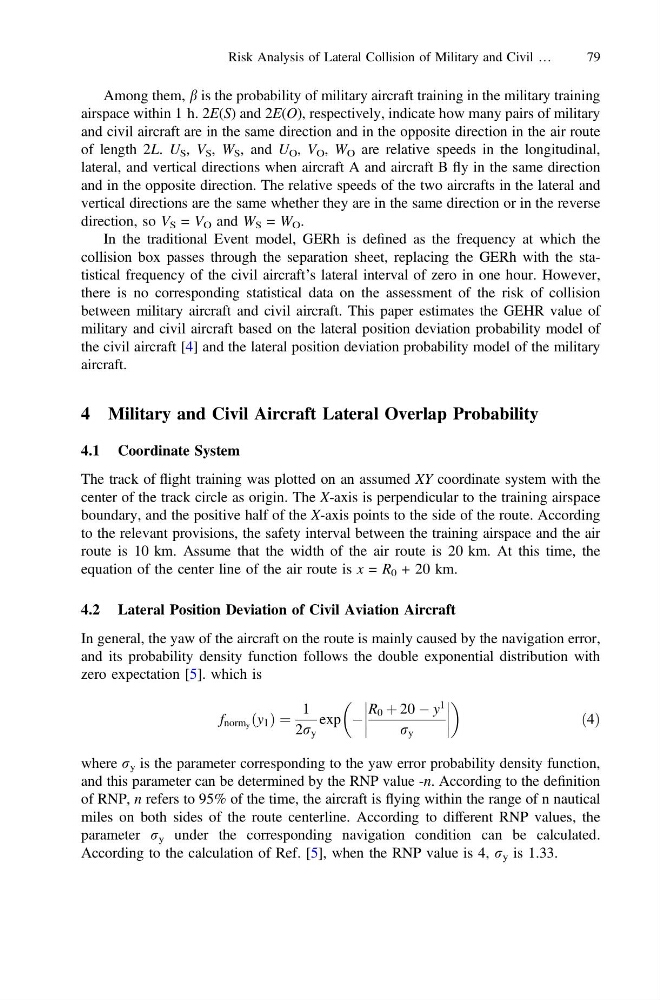
In general, the yaw of the aircraft on the route is mainly caused by the navigation error,
and its probability density function follows the double exponential distribution with
zero expectation [5]. which is
f norm y y 1
ð Þ ¼
1
2r y
exp À
R 0 þ 20 À y
1
r y
ð4Þ
where r y is the parameter corresponding to the yaw error probability density function,
and this parameter can be determined by the RNP value -n. According to the definition
of RNP, n refers to 95% of the time, the aircraft is flying within the range of n nautical
miles on both sides of the route centerline. According to different RNP values, the
parameter r y under the corresponding navigation condition can be calculated.
According to the calculation of Ref. [5], when the RNP value is 4, r y is 1.33.
Risk Analysis of Lateral Collision of Military and Civil …
79
airspace within 1 h. 2E(S) and 2E(O), respectively, indicate how many pairs of military
and civil aircraft are in the same direction and in the opposite direction in the air route
of length 2L. U S , V S , W S , and U O , V O , W O are relative speeds in the longitudinal,
lateral, and vertical directions when aircraft A and aircraft B fly in the same direction
and in the opposite direction. The relative speeds of the two aircrafts in the lateral and
vertical directions are the same whether they are in the same direction or in the reverse
direction, so V S = V O and W S = W O .
In the traditional Event model, GERh is defined as the frequency at which the
collision box passes through the separation sheet, replacing the GERh with the statistical frequency of the civil aircraft’s lateral interval of zero in one hour. However,
there is no corresponding statistical data on the assessment of the risk of collision
between military aircraft and civil aircraft. This paper estimates the GEHR value of
military and civil aircraft based on the lateral position deviation probability model of
the civil aircraft [4] and the lateral position deviation probability model of the military
aircraft.
4 Military and Civil Aircraft Lateral Overlap Probability
4.1 Coordinate System
The track of flight training was plotted on an assumed XY coordinate system with the
center of the track circle as origin. The X-axis is perpendicular to the training airspace
boundary, and the positive half of the X-axis points to the side of the route. According
to the relevant provisions, the safety interval between the training airspace and the air
route is 10 km. Assume that the width of the air route is 20 km. At this time, the
equation of the center line of the air route is x = R 0 + 20 km.
4.2 Lateral Position Deviation of Civil Aviation Aircraft
In general, the yaw of the aircraft on the route is mainly caused by the navigation error,
and its probability density function follows the double exponential distribution with
zero expectation [5]. which is
f norm y y 1
ð Þ ¼
1
2r y
exp À
R 0 þ 20 À y
1
r y
ð4Þ
where r y is the parameter corresponding to the yaw error probability density function,
and this parameter can be determined by the RNP value -n. According to the definition
of RNP, n refers to 95% of the time, the aircraft is flying within the range of n nautical
miles on both sides of the route centerline. According to different RNP values, the
parameter r y under the corresponding navigation condition can be calculated.
According to the calculation of Ref. [5], when the RNP value is 4, r y is 1.33.
Risk Analysis of Lateral Collision of Military and Civil …
79