

4.3 Probability Model of Lateral Position Deviation of Military Aircraft
Military aircraft are often in maneuvers during training flights. And there is no statistical data on the lateral position deviation of military aircraft. Therefore, the lateral
positional deviation of military aircraft in the training airspace can only be studied
through mathematical models. According to the characteristics of circling flight, its
lateral deviation is affected by the turning radius, the center of the turning track, and the
wind.
4.3.1 Turning Radius Probability Density Function
Pilot’s motion error in military training flight follow Gaussian distribution
c M last
ð
Þ¼
1
ffiffiffiffiffi ffi
2p
p r p
exp À
M last À M shlould
ð
Þ
2
2r 2
p
!
ð5Þ
where M shlould is the expected motion, M error is the actual motion, and r p is the standard
deviation. In the process of circling training, the factors affecting the lateral deviation of
the aircraft are mainly the speed of the aircraft, the heading, the turning gradient c, the
crosswind, the position of the starting point of the circling, and the navigation accuracy.
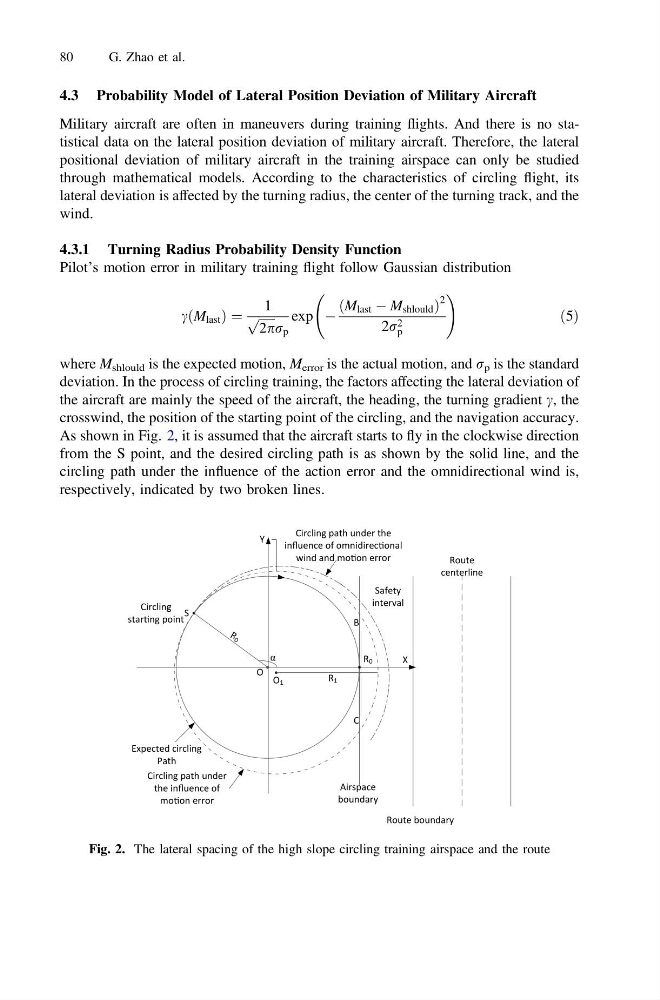
As shown in Fig. 2, it is assumed that the aircraft starts to fly in the clockwise direction
from the S point, and the desired circling path is as shown by the solid line, and the
circling path under the influence of the action error and the omnidirectional wind is,
respectively, indicated by two broken lines.
Circling
starƟng point
Circling path under the
influence of omnidirecƟonal
wind and moƟon error
Safety
interval
Expected circling
Path
Circling path under
the influence of
moƟon error
Airspace
boundary
Route boundary
S
X
Y
O
α
O1
R1
B
C
R0
Route
centerline
Fig. 2. The lateral spacing of the high slope circling training airspace and the route
80
G. Zhao et al.
Military aircraft are often in maneuvers during training flights. And there is no statistical data on the lateral position deviation of military aircraft. Therefore, the lateral
positional deviation of military aircraft in the training airspace can only be studied
through mathematical models. According to the characteristics of circling flight, its
lateral deviation is affected by the turning radius, the center of the turning track, and the
wind.
4.3.1 Turning Radius Probability Density Function
Pilot’s motion error in military training flight follow Gaussian distribution
c M last
ð
Þ¼
1
ffiffiffiffiffi ffi
2p
p r p
exp À
M last À M shlould
ð
Þ
2
2r 2
p
!
ð5Þ
where M shlould is the expected motion, M error is the actual motion, and r p is the standard
deviation. In the process of circling training, the factors affecting the lateral deviation of
the aircraft are mainly the speed of the aircraft, the heading, the turning gradient c, the
crosswind, the position of the starting point of the circling, and the navigation accuracy.
As shown in Fig. 2, it is assumed that the aircraft starts to fly in the clockwise direction
from the S point, and the desired circling path is as shown by the solid line, and the
circling path under the influence of the action error and the omnidirectional wind is,
respectively, indicated by two broken lines.
Circling
starƟng point
Circling path under the
influence of omnidirecƟonal
wind and moƟon error
Safety
interval
Expected circling
Path
Circling path under
the influence of
moƟon error
Airspace
boundary
Route boundary
S
X
Y
O
α
O1
R1
B
C
R0
Route
centerline
Fig. 2. The lateral spacing of the high slope circling training airspace and the route
80
G. Zhao et al.