

In Eq. 1, the parameter GERh is statistical data, and however, such a statistical
database is missing between military and civil aircraft. And in the air route, the aircraft
heading at the same flight level is the same, and the heading of the military training
flight is not fixed. For the above two reasons, the Event model cannot be directly
applied to the assessment of the collision risk of military and civil aviation. Therefore,
the Event model needs to be modified for the characteristics of military and civil
aviation flights.
3 Collision Probability Model of Military and Civil Aviation
3.1 Hypothetical Conditions of the Model
(1) Assuming that the long side of the military training airspace is parallel to the air
route, military aircraft and civil aviation aircraft fly at the same altitude.
(2) The interval between military training airspace and air route is 10 km.
(3) The positions of military aircraft and civil aircraft are independent of each other,
and each uses independent navigation facilities.
(4) Considering that in military flight training, most aircraft are turning when
approaching the boundary of airspace, this paper calculates the collision probability of military and civil aviation aircraft by taking the high slope circling
training as an example.
3.2 Event Collision Model for Military and Civil Aviation
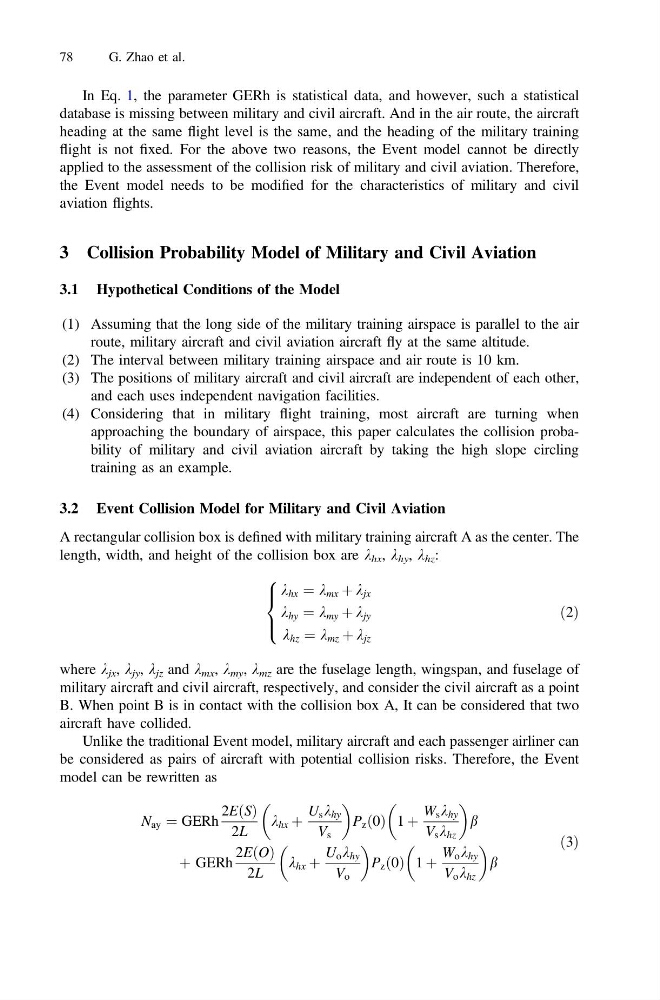
A rectangular collision box is defined with military training aircraft A as the center. The
length, width, and height of the collision box are k hx , k hy , k hz :
k hx ¼ k mx þ k jx
k hy ¼ k my þ k jy
k hz ¼ k mz þ k jz
8
> <
> :
ð2Þ
where k jx , k jy , k jz and k mx , k my , k mz are the fuselage length, wingspan, and fuselage of
military aircraft and civil aircraft, respectively, and consider the civil aircraft as a point
B. When point B is in contact with the collision box A, It can be considered that two
aircraft have collided.
Unlike the traditional Event model, military aircraft and each passenger airliner can
be considered as pairs of aircraft with potential collision risks. Therefore, the Event
model can be rewritten as
N ay ¼ GERh
2EðSÞ
2L
k hx þ
U s k hy
V s
P z ð0Þ 1 þ
W s k hy
V s k hz
b
þ GERh
2EðOÞ
2L
k hx þ
U o k hy
V o
P z ð0Þ 1 þ
W o k hy
V o k hz
b
ð3Þ
78
G. Zhao et al.
database is missing between military and civil aircraft. And in the air route, the aircraft
heading at the same flight level is the same, and the heading of the military training
flight is not fixed. For the above two reasons, the Event model cannot be directly
applied to the assessment of the collision risk of military and civil aviation. Therefore,
the Event model needs to be modified for the characteristics of military and civil
aviation flights.
3 Collision Probability Model of Military and Civil Aviation
3.1 Hypothetical Conditions of the Model
(1) Assuming that the long side of the military training airspace is parallel to the air
route, military aircraft and civil aviation aircraft fly at the same altitude.
(2) The interval between military training airspace and air route is 10 km.
(3) The positions of military aircraft and civil aircraft are independent of each other,
and each uses independent navigation facilities.
(4) Considering that in military flight training, most aircraft are turning when
approaching the boundary of airspace, this paper calculates the collision probability of military and civil aviation aircraft by taking the high slope circling
training as an example.
3.2 Event Collision Model for Military and Civil Aviation
A rectangular collision box is defined with military training aircraft A as the center. The
length, width, and height of the collision box are k hx , k hy , k hz :
k hx ¼ k mx þ k jx
k hy ¼ k my þ k jy
k hz ¼ k mz þ k jz
8
> <
> :
ð2Þ
where k jx , k jy , k jz and k mx , k my , k mz are the fuselage length, wingspan, and fuselage of
military aircraft and civil aircraft, respectively, and consider the civil aircraft as a point
B. When point B is in contact with the collision box A, It can be considered that two
aircraft have collided.
Unlike the traditional Event model, military aircraft and each passenger airliner can
be considered as pairs of aircraft with potential collision risks. Therefore, the Event
model can be rewritten as
N ay ¼ GERh
2EðSÞ
2L
k hx þ
U s k hy
V s
P z ð0Þ 1 þ
W s k hy
V s k hz
b
þ GERh
2EðOÞ
2L
k hx þ
U o k hy
V o
P z ð0Þ 1 þ
W o k hy
V o k hz
b
ð3Þ
78
G. Zhao et al.