

[2] to assess the risk of lateral collision between civil aviation aircraft. With the advent
of various collision risk models, many scholars at home and abroad have made in-depth
research on them and put forward various improved methods [3]. However, the above
studies only focus on the collision probability between civilian aircraft flying in the air
route, and there is little literature on the collision probability between military aviation
and civil aviation. In this paper, the Event model is used to model and calculate the
collision risk between the civilian aviation aircraft in the air route and military aircraft
in the adjacent training airspace.
2 Event Model
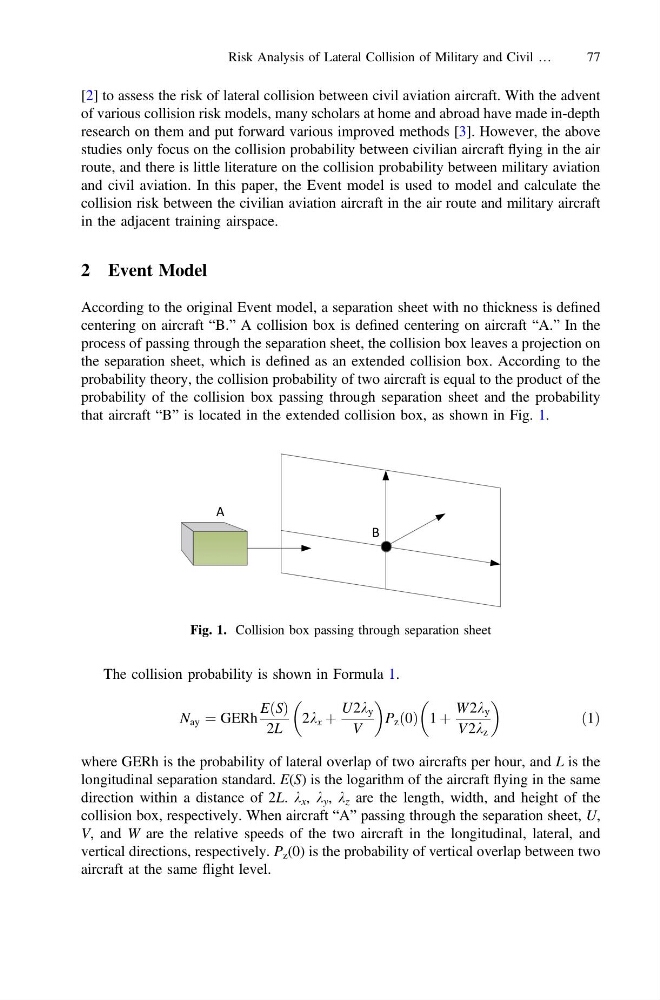
According to the original Event model, a separation sheet with no thickness is defined
centering on aircraft “B.” A collision box is defined centering on aircraft “A.” In the
process of passing through the separation sheet, the collision box leaves a projection on
the separation sheet, which is defined as an extended collision box. According to the
probability theory, the collision probability of two aircraft is equal to the product of the
probability of the collision box passing through separation sheet and the probability
that aircraft “B” is located in the extended collision box, as shown in Fig. 1.
The collision probability is shown in Formula 1.
N ay ¼ GERh
EðSÞ
2L
2k x þ
U2k y
V
P z ð0Þ 1 þ
W2k y
V2k z
ð1Þ
where GERh is the probability of lateral overlap of two aircrafts per hour, and L is the
longitudinal separation standard. E(S) is the logarithm of the aircraft flying in the same
direction within a distance of 2L. k x , k y , k z are the length, width, and height of the
collision box, respectively. When aircraft “A” passing through the separation sheet, U,
V, and W are the relative speeds of the two aircraft in the longitudinal, lateral, and
vertical directions, respectively. P z (0) is the probability of vertical overlap between two
aircraft at the same flight level.
B
A
Fig. 1. Collision box passing through separation sheet
Risk Analysis of Lateral Collision of Military and Civil …
77
of various collision risk models, many scholars at home and abroad have made in-depth
research on them and put forward various improved methods [3]. However, the above
studies only focus on the collision probability between civilian aircraft flying in the air
route, and there is little literature on the collision probability between military aviation
and civil aviation. In this paper, the Event model is used to model and calculate the
collision risk between the civilian aviation aircraft in the air route and military aircraft
in the adjacent training airspace.
2 Event Model
According to the original Event model, a separation sheet with no thickness is defined
centering on aircraft “B.” A collision box is defined centering on aircraft “A.” In the
process of passing through the separation sheet, the collision box leaves a projection on
the separation sheet, which is defined as an extended collision box. According to the
probability theory, the collision probability of two aircraft is equal to the product of the
probability of the collision box passing through separation sheet and the probability
that aircraft “B” is located in the extended collision box, as shown in Fig. 1.
The collision probability is shown in Formula 1.
N ay ¼ GERh
EðSÞ
2L
2k x þ
U2k y
V
P z ð0Þ 1 þ
W2k y
V2k z
ð1Þ
where GERh is the probability of lateral overlap of two aircrafts per hour, and L is the
longitudinal separation standard. E(S) is the logarithm of the aircraft flying in the same
direction within a distance of 2L. k x , k y , k z are the length, width, and height of the
collision box, respectively. When aircraft “A” passing through the separation sheet, U,
V, and W are the relative speeds of the two aircraft in the longitudinal, lateral, and
vertical directions, respectively. P z (0) is the probability of vertical overlap between two
aircraft at the same flight level.
B
A
Fig. 1. Collision box passing through separation sheet
Risk Analysis of Lateral Collision of Military and Civil …
77